

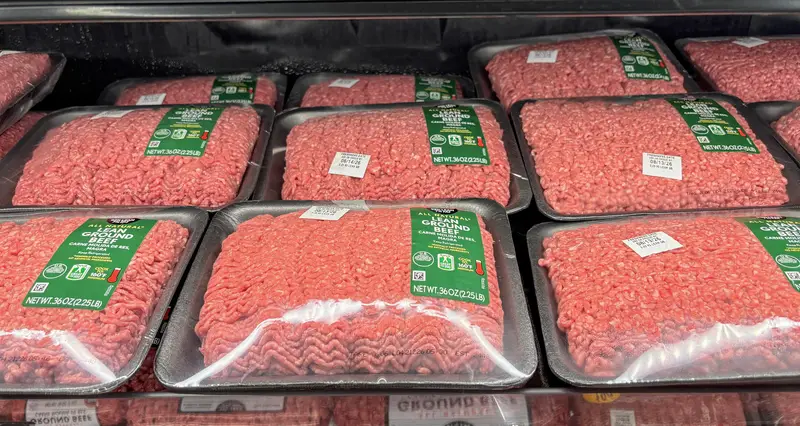
Open your freezer and count the packages of ground beef you cannot remember buying. Most households have at least one, wrapped in a store label with a sell-by date from some other season, buried under a bag of peas.
One of those packages is the subject of an open federal notice. On March 23, 2026, the U.S. Department of Agriculture’s Food Safety and Inspection Service told shoppers in five states and Washington, D.C., not to eat a specific pound of grass-fed ground beef after two customers reported finding pieces of metal in it.
Nobody called it a recall. The beef was no longer for sale, so the agency issued a public health alert instead, out of concern that some of it was still sitting in home freezers. That gap between “off the shelf” and “out of your kitchen” is the warning most shoppers never hear, and it goes well past one brand.
The Pound of Beef the USDA Wants Out of Your Freezer
The alert covers 16-ounce vacuum-packed packages of “White Oak Pastures, Radically Traditional Farming, Grassfed Ground Beef.” The package carries establishment number “EST 34729” inside the USDA mark of inspection, and the sell-by date of March 19, 2026 is printed on the back.
The meat was produced on February 26, 2026, and shipped to a distributor and to Mom’s Organic Markets locations in Washington, D.C., Massachusetts, Maryland, New Jersey, Pennsylvania and Virginia. The potential problem surfaced after the manufacturer got two consumer complaints about metal fragments in the beef.
No injuries have been confirmed. FSIS did not request a formal recall because the product is no longer sold in stores, and the agency’s advice to anyone who has a package left is to throw it out or take it back to where they bought it. Questions go to Justin Wiley, the Processing Operations Manager for White Oak Pastures, at (229) 641-2081, according to the alert details.
Grinding Is What Separates Beef From Steak
By some estimates, up to 65% of the beef Americans eat is ground, and ground beef behaves nothing like the ribeye in the next case. Grinding exposes far more surface to air, which is why a pound of chuck turns long before a steak does.
On a whole cut, whatever is on the meat is on the outside, where the pan hits it first. Grinding takes that outside and mixes it through the entire batch, and the batch is built from more than one animal. Contamination in a single carcass can end up spread across a lot of pounds.
In 2022, Consumer Reports tested 351 packages of ground beef, pork, chicken and turkey bought at stores around the country and found a strain of E. coli in a ground beef sample serious enough that it alerted the USDA immediately. The sample came from a Kroger-branded package bought in Seattle, and more than 28,000 pounds of meat were recalled from major grocery chains across seven Western states.
James E. Rogers, PhD, the group’s director of food safety research and testing and a former USDA official, put it bluntly: “That bacteria should not have been in the meat, period.” “There is a zero-tolerance policy for that bacteria, and for good reason: It’s hard to treat, and can kill,” he said.
160 Degrees, and Never By Eye
The number for home cooks is 160 degrees Fahrenheit, measured with a food thermometer stuck into the burger, not guessed from the color of the juices. The CDC and USDA both land on that figure.
Restaurants work from a different standard. The FDA Food Code tells them to cook ground beef to 155 degrees for 17 seconds, or to 158 degrees for less than a second.
How well that works in practice is worth knowing before you order medium. CDC research on restaurant kitchens found 77% of managers said their kitchens do not always take a final temperature of hamburgers with a thermometer, and about one in ten burgers came off the line under 155 degrees. The same research flagged cooks using one utensil on raw and cooked beef without washing it in between, and wiping their hands on aprons after handling the raw product.
Two Days in the Fridge, and That Is Being Generous
Raw ground beef gets one to two days in the refrigerator before it needs to be cooked or frozen. Not a week. Not “until the date on the sticker,” which is a different thing entirely.
The fridge itself has to be under 40 degrees Fahrenheit, and the freezer at 0 degrees or below. Cooked ground beef, chili, taco meat, the bottom of a lasagna, holds for three to four days in the refrigerator.
Raw beef should never sit out at room temperature for more than two hours, and that window shrinks to one hour once the room goes above 90 degrees. Commercial kitchens are told to throw out any raw ground beef that has been out of refrigeration for an unknown stretch of time, which is a decent rule for a home cook who walked away from a thawing package and lost track.
Frozen, the clock is about quality rather than the calendar. Ground beef holds its quality for roughly four months in the freezer.
Thawing on the Counter Is the Mistake Pros Get Written Up For
Frozen ground beef should never be left on the counter to defrost, because there is no way to control the temperature of the meat while it sits there. The three accepted methods are the refrigerator overnight, a clean sink under cool running water, or the microwave as part of the cooking process.
Professional kitchens also stack their coolers in a set order, and it is easy to copy at home. Raw ground beef goes beneath whole cuts of beef and above poultry. Anything cooked goes on the top shelf, where nothing can drip onto it.
Restaurants reject a delivery outright if the ground beef arrives above 41 degrees. They also check temperature without puncturing the plastic, sliding the probe between two packages instead, because a hole in the wrapping is its own problem.
Gray All the Way Through Is the Warning
Fresh raw ground beef is red on the outside, thanks to a pigment that forms when the meat meets oxygen. The grayish brown color in the middle of the package is not spoilage, it is just the part of the meat that never got any air, and it cooks up fine.
Gray or brown all the way through can mean it is starting to turn, so check the smell and feel before it goes in the pan. A sticky or slimy feel, raw or cooked, means it goes in the trash, and so do fuzzy blue, gray or green spots on leftovers.
The smell test settles most arguments. Fresh ground beef barely smells like anything, with maybe a faint iron note as it nears its date. Beef that has turned goes tangy and putrid, and there is no mistaking it once you have met it.
Sell-by and expiration dates are not the same instruction. A sell-by date tells the store how long it can keep the package on display, and ground beef should be cooked or frozen within two days of buying it, whatever the sticker says. A use-by date is the last day the maker recommends for peak quality, and that one is not worth pushing unless the meat went into the freezer first.
Buy It Last and Drive Straight Home
Ground beef belongs in the cart at the end of the trip, not at the start while you wander the cereal aisle for ten minutes. Pick a package that feels cold in your hand, with no holes or scratches in the wrapping, and keep it away from everything you plan to eat without cooking.
If the drive home runs longer than about half an hour, a cooler in the trunk does more for the meat than anything you do later. Once you are inside, it goes into the fridge or freezer within two hours, on the lowest shelf, in a bag so nothing leaks onto the shelf below.
Freezing in the original store packaging is fine for a short stretch, but for anything longer, wrap it in heavy-duty foil or a freezer bag with the air pressed out. Portion it the way you actually cook it, because a flat one-pound brick thaws overnight in the fridge and a frozen boulder does not.
The Part Worth Remembering
Ground beef is the one item in the meat case where the usual shortcuts do not hold. Two days in the fridge, 160 degrees on a thermometer, and no counter thawing covers almost everything that goes wrong in a home kitchen.
The rest is the freezer. A product can be gone from every shelf in five states and Washington, D.C., and still be sitting in your house, which is exactly why the USDA went to the trouble of issuing an alert for beef nobody can buy anymore. Go check the dates on what you have. If a package matches a federal notice, it is trash, not dinner, no matter how long it has been frozen solid.

