

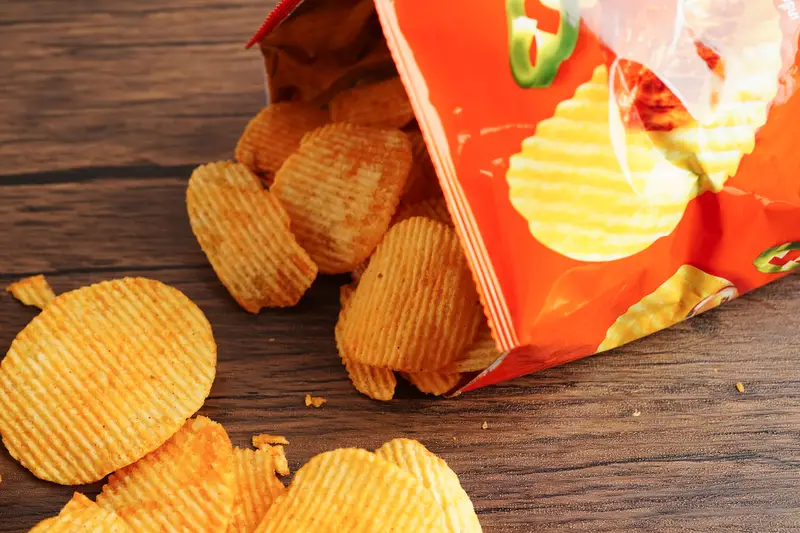
Dump a family-size bag of Lay’s into a bowl and watch what lands on top. Not the big curved chips you actually wanted. A drift of shards, half-chips and loose salt, sitting right where every guest has to dig through it to reach anything worth eating. Those crumbs were already down at the bottom of the bag before you touched it, and tipping the bag over just moved them to the worst possible place. Cut the bag open at the bottom instead, keep it upright the whole time, and the crumbs stay buried where they belong.
The Cut Takes About Four Seconds
Leave the bag standing the way it came off the shelf. Top up, bottom down, never flipped. Hold it over your serving bowl in that same upright position and run a pair of kitchen scissors across the bottom seam. Everything slides out in the order it was already stacked in, so the whole chips land first and the wreckage lands last, under everything.
The one mistake that kills it is turning the bag upside down before you cut. Flip it and all that fine debris slides straight to the new low point, which means it pours out first and ends up on top of the pile again. Food blogger Meleyna Nomura popularized cutting the bottom open.
Use scissors, not your hands. Yanking the bottom seam apart with your fingers crushes chips on the way, which defeats the entire point. The same move works on tortilla chips, crackers like Triscuits and Chex Mix. If the crackers came in a box, pull the inner bag out first and treat it like any other bag.
Why The Crumbs Are Down There In The First Place
Chips get sealed into the bag with gas, not just room air. Manufacturers flush the bag with food-grade nitrogen, which cushions the chips and pushes out the oxygen that would otherwise turn the frying oil stale and flat. The chips themselves are mostly puffed air and almost weightless, which is why a bag can look enormous and weigh nothing.
Then the bag rides a truck. Every bump and turn between the plant and the shelf shakes the contents, and the bigger heavier pieces plus all the broken bits work their way down. By the time the bag reaches your kitchen, it has sorted itself. Whole chips up top, rubble at the bottom, exactly like gravel settling in a jar.
That sorting is the entire reason the trick works. You are not fighting the bag. You are just choosing which end of a pile that already organized itself gets poured out first.
All The Flavor Really Is At The Bottom
Seasoning goes on after the fryer, not before. Patent filings describing industrial seasoning systems lay out the two standard methods: chips tumble through a rotating drum with internal baffles that lift and turn them while powder is dispensed inside, or seasoning is sprinkled down onto them from an applicator they pass under. Either way, the powder hits the chips while they are hot and still coated in oil, which is what makes it stick at all.
Plenty of it does not stick. Loose seasoning is a fine, heavy powder riding along with the lightest snack in the grocery store, so it drops through the gaps during shipping and piles up at the very bottom. That is the orange sediment in a Doritos bag, and it is why the last handful always tastes about three times stronger than the first.
Open from the bottom over a bowl and that concentrated layer goes in first and gets spread across the base instead of dumped on the surface. Anyone who scoops from the bottom gets a bonus. Nobody gets a face full of powder.
The Popular Reason For Doing This Is Wrong
There is a long-running rumor that you should flip a chip bag over and open the bottom because the bottom seal is built stronger, never meant to be opened, and therefore less likely to tear into a ragged mess. It sounds plausible. It is not how the bags are made.
Julie Baillie, the Head of Snacking at the New Zealand snack maker Griffin’s Food Company, has said chip bags are “sealed in exactly the same way at both ends”, so opening one upside down accomplishes nothing except making the nutrition panel harder to read.
So the bottom-first rule survives, but for a completely different reason than most people repeat. It is not about the seal. It is about where the crumbs and the seasoning are sitting at the moment you cut.
One Engineer Admits He Made The Bags This Hard
If you have ever wrestled a bag until it exploded, there is a name attached to that. John Spevacek wrote a confession that ran in 2012 and opened with the line, “I’m that guy. The guy that everyone hates.”
Fresh out of school, he worked in the Packaging Films Group at Hercules Chemical, a company that no longer exists, making multilayer polypropylene films with a heat-seal adhesive on one side. A large client used those films for potato chip bags, and it had a problem: its plants sat west of the Rocky Mountains, and trucks hauling chips into California kept popping seals open from the pressure difference at altitude. The fix landed on his desk. Make the seal stronger.
Heat-seal strength comes down to three variables and only three: time, temperature and pressure. Slowing the line to seal longer or hotter costs money, so the real solution was an adhesive that sealed at a lower temperature. It worked. Spevacek says colleagues have been piling on the complaints ever since they found out he was the one.
How Much Of That Bag Is Actually Air
The industry term is slack fill, and the FDA allows it as long as the empty space serves a function, such as cushioning fragile product or keeping it fresh. Packaging that is empty for no reason can be called misleading and is not legal. Lawsuits over excessive air in snack bags have mostly been thrown out, largely because chips are sold by weight and the net weight printed on the bag has to be accurate. Slack fill cases over other foods have landed, though. McCormick paid $2.5 million over underfilled pepper tins.
Brands are nowhere near equal on this. In 2018 a cabinet company, Kitchen Cabinet Kings, dunked 14 well-known brands in a bucket of water and put the average at 43% air. Not a lab, but it is the number everyone quotes. Fritos came in at 19% and Pringles at 28%. Cheetos used the most, at 59%.
Bags have also been quietly getting lighter. Doritos was reported in 2022 to have about five fewer chips per bag, and other brands have run the same play. For what it is worth, chips did not start out in bags at all: they were sold loose, out of barrels and big glass display jars that stores scooped from. In the 1920s Laura Scudder had her workers iron sheets of wax paper into sealed bags, which is what finally let a bag of chips keep.
No Bowl? Roll The Bag Into One
The bottom-cut trick assumes you are pouring into something. When you are not, and nobody wants to wash a bowl at halftime, there is a better move than letting a tall bag flop over on the couch cushion.
Open the top normally. Press the empty bottom of the bag flat, gently, then start rolling the bottom edges upward and folding them inward as you go. The bag gets shorter, the trapped air escapes, and the chips ride up to the open top where hands can actually reach them. Dustin, the creator behind the account @that40yearguy, spread this self-standing bag bowl version. The only real risk is crushing the chips at the bottom while you flatten it, which is solved by not shoving.
Tucking in the two bottom corners first gives you a cleaner ring to build on. Rolled tight, that cuff turns into a rigid base and the bag stands on the table by itself. The rolled cuff holds its shape well enough to share out of without anyone knocking knuckles. As the level drops, roll the bottom up a little more and the chips come back to the top.
Put The Scissors Where You Can Find Them
Tearing a bag open with your hands is the worst version of every method here. A ripped, uneven opening is harder to fold and harder to store, and it turns a half-eaten bag into something that will not close. A clean cut with something sharp keeps the bag usable. Scissors are the best tool, a knife works, and the Tokyo Metropolitan Police once tweeted a trick for pressing two coins together to shear a bag open when you have nothing else.
Shaking the bag before you open it is worth a second, too. It redistributes the settled pieces and the seasoning so the first handful and the last handful are closer to the same snack. That is the move for eating straight out of the bag.
For a bowl, do not shake. Do not flip. Stand the bag over the bowl, cut the bottom, and let gravity hand you a clean-looking pile of whole chips with the broken stuff hidden underneath. Same bag, same price, same thirty seconds of effort. It just stops looking like the bag lost a fight on the way home.

