

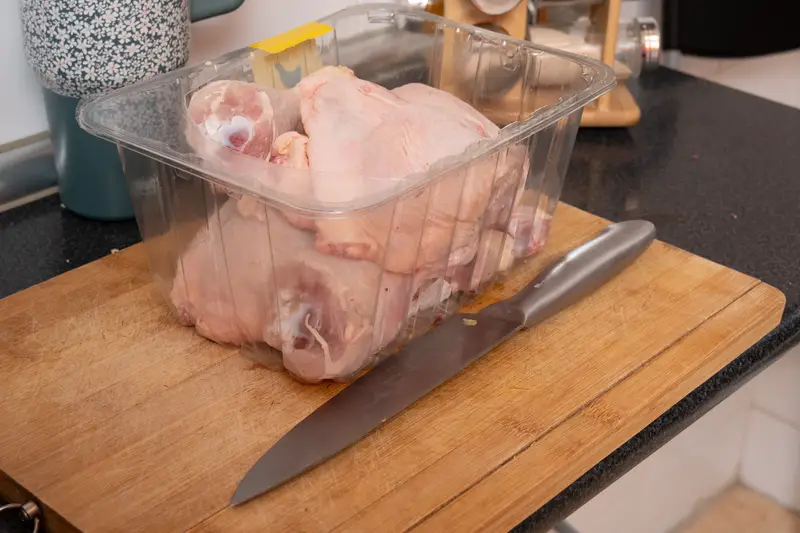
You pulled the breast out of the skillet at what looked like the perfect moment. Golden on both sides, smelled like dinner, felt right when you pressed it. Then the knife went in and the thin end was chalky and stringy while the thick middle was still pink and cool. Nothing you did at the stove caused that. It happened before the pan ever got hot, back when you took the chicken off the refrigerator shelf and dropped it straight into the heat. Cold meat cooks from the outside in, and the outside finishes long before the center wakes up. The fix costs you between 15 and 45 minutes of counter time and zero dollars.
Cold Chicken Cooks In The Wrong Order
Heat moves through meat slowly. The interior of a chicken takes noticeably longer to warm than the surface does, so a piece that goes from a cold shelf into a hot oven or pan builds a scorched, overdone exterior while the middle is still catching up. You end up overcooking the outside just to drag the center to a temperature you can actually serve.
Chicken breasts make it worse because of their shape. A breast is teardrop-shaped, thick at one end and thin at the other, so the skinny tip is finished and drying out while the fat part is barely warm. Pounding the thick end down to a uniform half inch is one of the most effective ways to get an even cook, and it works even better on tempered meat.
Texture takes a hit too. Muscle fibers contract hard when they hit heat too fast, which is how you get chicken that chews like a pencil eraser. Thick cuts like breasts and bone-in thighs suffer most. Letting the meat relax on the counter first gives you a more tender piece for doing absolutely nothing.
How Long To Leave It Out, By Cut
Small boneless pieces barely need any time. Tenders and thin cutlets warm up fast, and 15 minutes on the counter is plenty. Big bone-in pieces like thighs and drumsticks want closer to 25 or 30 minutes. A whole bird is a different animal, often needing an hour or more depending on its size.
Somewhere between 20 and 45 minutes covers most weeknight chicken. Set the pieces in a bowl on the counter for 15 to 25 minutes if you are working with average supermarket cuts, and push toward 30 to 45 if the chicken is thick or you are grilling.
There is a ceiling, and it is not vague. USDA’s limit on total time out of refrigeration is two hours, and one hour once the room is above 90 degrees Fahrenheit. That is a ceiling on exposure rather than a recommendation; USDA’s own guidance is to keep raw chicken refrigerated until you cook it. If your kitchen runs warm in August, stay closer to the 30 minute mark and get it into the pan. Nobody needs the chicken sitting out all afternoon; the warming window is short on purpose.
Cold Meat Steams, It Doesn’t Sear
Browning is where cold chicken quietly robs you. A chilled piece hitting a hot surface dumps moisture almost instantly, and those juices come out so fast they get in the way of the sear. Instead of a deep golden crust you get a pale, weeping piece of meat sweating in its own liquid. A good sear needs two things at once: real heat and a dry surface. Cold chicken kills the second one.
While it is warming, pat it thoroughly dry with paper towels. This is also the moment to skip the rinse. Running chicken under the faucet does not accomplish anything useful and just flings whatever is on the surface around your sink, your counter and your dish rack. Paper towels do the job.
For a roast bird with skin you actually want to eat, leave it unwrapped in the fridge overnight before cooking, on a rack set in a rimmed tray on the bottom shelf so nothing drips onto anything else. It sounds backwards, but drying the skin out is exactly what makes it crisp up instead of turning to rubber. A bird taken straight from the fridge in its packaging goes into the oven cold and damp, and damp skin never gets crackly.
Seasoning Slides Off A Cold Bird
Marinades season the surface and not a great deal more, whatever temperature the meat starts at. Testing has found the flavors rarely travel past the first few millimeters even after a long soak, so that expensive spice blend mostly sits on the outside and burns off.
Use the waiting period as your seasoning window. Dry the chicken, then salt and pepper it generously while it tempers. Under-salting is the reason so much home-roasted chicken tastes like hot nothing, and salt is also what helps the skin brown properly. If you are roasting a whole bird, season inside the cavity too.
Do not overdo the marinade, though. Citric acid from lemon, lime or orange juice softens the surface of the meat over time and turns it mushy once it cooks, so keep a citrus marinade short. An hour or two is plenty. Buttermilk and yogurt are gentler, and an overnight soak is standard practice for fried chicken, but they are acidic too and there is nothing to gain from stretching it for days.
The Whole Roast Chicken Problem
Samin Nosrat makes a version of this argument in her book Salt, Fat, Acid, Heat, advising that all but the thinnest cuts come to room temperature before they are cooked. A whole chicken is thick, dense and irregular, which is the worst possible candidate for a cold start.
Throw a refrigerator-cold bird into a hot oven and you can get all three failures at once: skin that rips, an exterior that burns and an interior that is still raw when the timer goes off. Chicken has a much slimmer margin of error than steak, where doneness is a matter of preference. With a bird, there is one target and you either hit it or you do not.
Give a whole chicken an hour on the counter, uncovered and dry, before it goes in. That hour is not idle time either. It is when you preheat the oven properly, set up your roasting rack and get the vegetables cut.
Fried Chicken Is Where Cold Meat Does The Most Damage
Frying already runs on a knife’s edge between oil temperature and time. Drop cold chicken into the pot and you tip the whole balance. You will either scorch the breading before the middle is done or pull out pieces that are pink in the center, and on a bad day you get both in the same batch.
Bone-in fried chicken belongs at the low end of the frying range, around 325 degrees Fahrenheit, so the heat has time to work all the way into a thick thigh without incinerating the crust. Use a thermometer on the oil: bring it to 350 so it settles back to 325 when the chicken goes in, and hold it there for the whole cook. Adding cold pieces drags that oil temperature down and the crust goes soggy.
A half hour of resting is not wasted time on fried chicken night. Season your flour, lay out the dredge, heat the oil and knock out a batch of fries or hush puppies. Biscuits or a skillet of cornbread will fit in that window too.
Let It Warm Up Without Wrecking Your Kitchen
Leave the chicken sitting in the container it was already stored in while it comes up in temperature, or set it in a bowl. That keeps any leaking juices in one place instead of on your counter. When it is time to prep, keep raw poultry on its own cutting board, away from everything else, and wash your hands the second you are done handling it.
A trick worth stealing: handle the raw chicken with one hand only. Your clean hand stays free to grab the faucet, open a drawer or reach for the salt without smearing anything. Any utensil that touched the raw meat gets washed before it touches anything else.
Storage decides a lot of this before you ever start cooking. USDA gives raw chicken one to two days in the refrigerator, stored toward the back in a sealed container so nothing drips onto ready-to-eat food. Miss that window and freeze it instead: USDA gives a whole bird a year and parts nine months for best quality, and chicken kept frozen stays safe indefinitely. Thaw frozen chicken in a bowl on the bottom shelf of the fridge, or submerged in cold water in a leak-proof bag with the water changed every half hour, or in the microwave if you cook it straight afterwards. Never on the counter and never in hot water. And if a package looks gooey or discolored, it goes in the trash, no matter what the date says.
The Thermometer Settles It
Tempering gets you even cooking. A thermometer tells you when to stop. USDA’s safe minimum is 165 degrees Fahrenheit for all poultry, breasts and thighs and legs alike. Plenty of cooks take dark meat to 170 or 175 because it carries the extra heat well, but that is preference, not safety. Slide an instant-read probe in sideways on thin pieces so it reaches the center, and check more than one spot on a big cut.
Take the temperature before the chicken comes off the heat rather than after: 165 is a number to hit in the pan, not one to coast up to while it rests. Cutting into the meat to peek is the worst way to check, because one section running clear tells you nothing about the rest of the bird and you have just let all the juice out. A fast digital thermometer pays for itself in one dinner.
Rest cooked chicken for 5 to 10 minutes on a clean board before slicing. A whole roasted bird wants 15 minutes, tented loosely with foil, or the juices run out onto the cutting board instead of back into the meat.
Twenty Minutes Buys You A Better Dinner
Most of the chicken complaints people have are the same complaint wearing different clothes. Dry outside, raw inside, tough, bland, pale skin. Almost all of it traces back to meat that went into the heat too cold, and almost all of it disappears if you pull the chicken out, dry it, salt it and give it 15 to 30 minutes on the counter while you get everything else ready.
Do not confuse patience with forgetfulness, though. Two hours is the outer limit in a normal kitchen, one hour if it is over 90 degrees, and there is no reason to get near either number. Set a timer, prep your sides, and put the chicken in the pan.

