

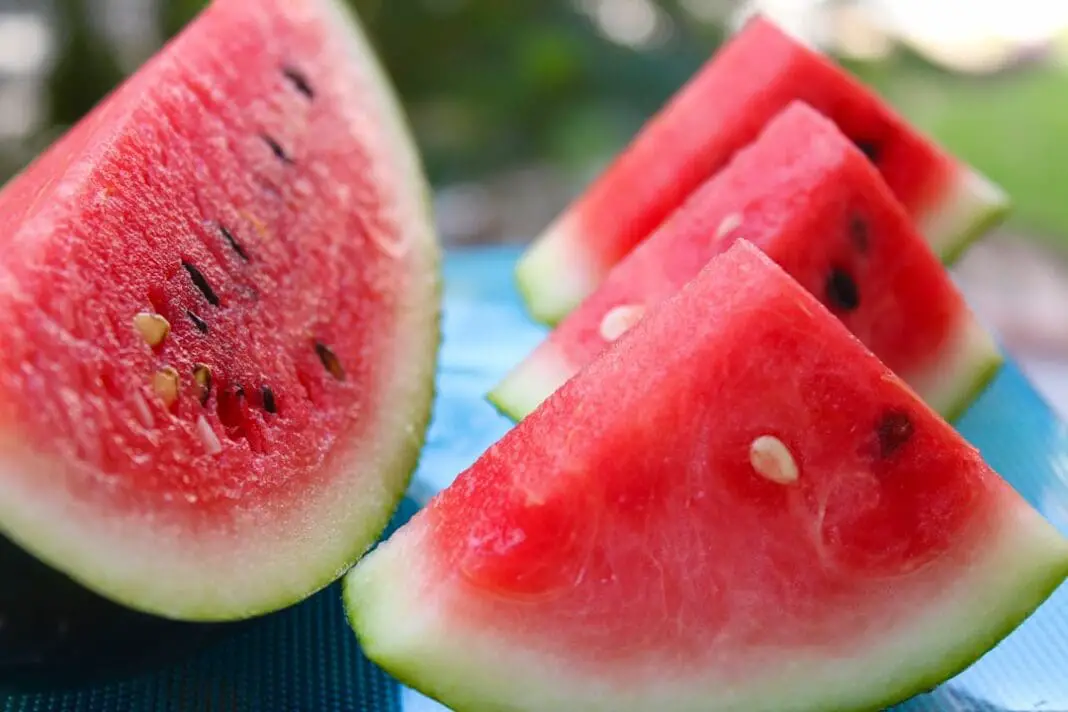
You can spot the confident shoppers in the produce aisle. They pull a melon off the pile, give it a knock with two knuckles, nod like a mechanic listening to an engine, and drop it in the cart. Half the time they get home, cut it open, and find pale pink flesh that tastes like wet packing material. There is a faster move that beats the knock, and it takes about two seconds. Turn the melon over and look at the bare patch on the bottom. If that patch is a creamy, buttery yellow, take it. If it is white or washed-out green, put it back and grab another one.
That patch matters so much because watermelon is not like a cantaloupe or a banana. It does not keep ripening once it has been cut from the vine. Whatever sweetness it had when the grower picked it is the sweetness you are bringing home. The bottom spot is a receipt showing how long it sat out there.
The Yellow Belly Spot Tells You Almost Everything
The field spot forms where the melon rested on the soil. No sunlight reaches it, so it never develops the green pigment the rest of the rind has. As the fruit ripens, that patch runs through a predictable set of colors: white, then pale cream, then light yellow, then deep butter yellow that can edge toward orange.
White means it came off the vine too early. Pale yellow means barely sweet enough to bother with. Deep yellow means it stayed out there long enough to load up on sugar. Texas A&M’s extension specialists put the field spot at the top of their own list of ripeness tips, and the sugar math backs them up: on the Brix scale, the lab measure of sugar content, the USDA calls anything over 10 very good eating quality.
The trick is to compare, not to judge one melon in isolation. Flip over five or six of roughly the same size and line up the spots in your head. The darkest yellow one in the bin is almost always the best one in the bin. Cookbook author Suzy Karadsheh, who learned to shop for melons alongside her father in the market streets of Port Said, Egypt, treats that spot as the deciding factor and looks for a large patch that is creamy or dark yellow.
A Melon With No Field Spot Is Not Automatically Bad
Some watermelons show no pale patch at all, and shoppers walk right past them thinking they are unripe. That reads the sign backward. The spot is not a ripeness stamp that appears on schedule. It only shows up where the fruit was pressed against dirt, blocking the sun.
A smaller variety that sat up on top of the soil can get sunlight from every angle and color up all the way around. Melons grown on a trellis never touch the ground at all, so they never develop a ground spot. None of that says a word about what is inside.
So the rule is one-directional. If there is a spot, read it, and pick the deeper yellow one every time. Bright white is the real warning. If there is no spot, move on to weight and rind texture and stop worrying about it.
The Knock Test Works, But Nobody Agrees On What They Are Hearing
Tapping is the most famous move in the produce section and the most argued about. The common advice is to hold the melon up near your ear, rap it with your knuckles in a few spots around the middle, and listen for a deep, hollow sound like a tenor drum. A high-pitched ring means underripe. A flat, dead thud means it has gone soft inside.
Not everyone hears it that way. Karadsheh describes the ripe sound as a deep tenor tone and says a hollow sound points to a drier, less ripened melon, which flips the usual advice on its head. Gardeners who grow their own make a blunter argument: some varieties never produce that soft hollow note even when they are perfectly ripe, so the whole test is subjective.
Treat it as a tie-breaker, not a verdict. If two melons have equally good bottoms, tap both and take the deeper one. Produce pros also point out that you can feel the difference as much as hear it, so hold the melon against your body while you knock and pay attention to the vibration instead of the noise.
Heavy For Its Size Beats Big Every Time
Weight is the least romantic test and one of the most useful, because it is not a matter of opinion. A watermelon is over 90% water by the USDA’s numbers, ripe or not, so water is not what you are weighing. What you are feeling is flesh. A melon that filled out properly packed its middle solid instead of leaving it spongy, and that is what makes a good one feel denser than it looks.
Pick up two or three melons of the same rough size and take the one that surprises you with its heft. A melon that feels light for its dimensions has flesh that never filled out. If you are shopping somewhere with a scale, use it. Your arms are a rough instrument.
Bigger is not better here. A medium melon with real density beats a giant one that feels hollow in your hands, and it fits in the refrigerator without a fight.
Shiny Rind, Walk Away
Glossy skin looks like the fresh one. It is usually the young one. Watermelons start out with a shine and go matte as they mature, because the waxy protective layer on the rind is still forming. University of Maryland researchers measured it: rind gloss drops off once the fruit’s sugar and flesh color have already leveled out, and the wax coating on the surface changes as the melon finishes ripening.
Run your palm over the rind. It should feel slightly rough and dry, not slick. The stripes should be dark and clearly defined rather than muddy or faded, and you should not be able to dent the skin with a fingernail.
Keep the variety in mind before you get religious about this one. Color and sheen shift from one type of melon to the next, and a melon that grew under heavy leaf cover will look lighter than one that sat in full sun. Dull is a point in its favor, not a court ruling.
Those Brown Squiggles Are A Feature
Plenty of shoppers reject the melon with the rough tan scarring across the rind because it looks damaged. That webbing is a selling point. It forms where bees worked the flower over and over during pollination, and heavier bee traffic means a bigger, better-developed fruit with more sugar in it.
Real webbing is dry, slightly raised, and laid out in a spider-web network of tan to dark brown lines rather than isolated soft blotches. There is no percentage that settles it; what matters is that there is plenty of it.
Use it the way a judge uses a photo finish. When two melons have the same deep yellow spot and the same heft, take the one with more pronounced webbing. The webbing itself is not sweet, it just proves the flower got hammered with pollen.
The Dried Stem Rule Is The Weakest Advice Out There
Almost every melon guide says the same thing: a brown, dried-out stem means the fruit ripened naturally on the vine, and a green stem means it was cut too soon. Produce professionals lean on it hard, and on a farm stand melon with the curly tendril still attached, a fully dried tendril is a decent sign.
Growers who cut their own push back on this, and they have the better argument. A watermelon’s attachment point can stay bright green on a completely ripe fruit, because a healthy plant keeps a healthy vine right through peak ripeness. A dried brown stem often means the vine died from disease or stress, which says nothing good about whether the melon had time to finish.
There is a related myth worth killing. Watermelons do not reach full slip, meaning they do not detach from the vine on their own the way a cantaloupe does. They usually have to be cut, green stem and all. In a grocery store, where the stem is already trimmed to a nub, this whole category of evidence is close to worthless. Read the bottom spot instead.
Forget Round Versus Oval, Look For Symmetry
Shape advice contradicts itself depending on who is giving it. Some say round melons concentrate sugar more evenly and elongated ones run watery. Others say a perfectly round melon can point to stress during growing while a gently oval one grew steady and even.
What everyone actually agrees on is symmetry. Round or oval is mostly a question of variety, so what you want is a melon that is even and regular on every side, with no odd bumps. Lumps and flat sections point to uneven growing conditions, not to better fruit.
Two More Checks Before It Hits The Cutting Board
Smell it, but not for sweetness. A cantaloupe’s thin rind lets the perfume out; a watermelon’s does not, so smelling nothing tells you nothing. What you are checking for is a sour, fermented edge, which means it is already going.
Press the rind. You want firm with the barest give. A soft rind is the sign of a melon sliding toward mushy, the stage where the flesh turns grainy and the sugar can actually drop off as it starts to ferment. Soft spots and a field spot gone dark brown put a melon squarely in that territory.
Once it is cut, the clock speeds up. Get it into the fridge within two hours, one hour if it is above 90 degrees out, because cut melon is a perishable in a way a whole one is not. Chilled, it is best eaten within five days. If you end up with more than you can get through, freeze the chunks and use them for smoothies or sorbet rather than thawing them out, because defrosted watermelon comes back limp.
If you remember one thing from all of this, make it the flip. Field spot first, weight second, and treat the knock, the webbing, and the matte rind as the tie-breakers they are. The stem gets no vote at all.

