

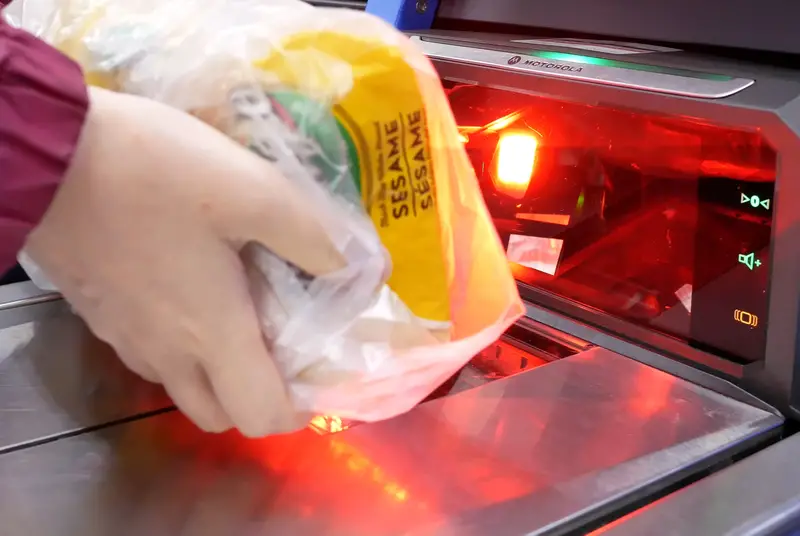
Lesleigh Nurse of Semmes, Alabama was at a Walmart self-checkout in when the scanning device froze. Store workers refused to accept her explanation, and she was arrested and charged with stealing $48 of merchandise: eleven items including Christmas lights, a loaf of bread and a box of Cap’n Crunch. The criminal case was dismissed about a year later, after the Walmart employee who accused her failed to answer a subpoena. What happened to her is not a freak accident of one bad night at one store. Ordinary people are being stopped, detained and charged at self-checkout over what a machine did or did not register, and the machines are now watching a lot more closely than they were in 2016.
The Employee Staring At A Phone Is Watching Your Hands
That worker hovering near the self-checkout lanes who looks like she is texting may be reading a surveillance feed. At the Loss Prevention Research Council’s lab, research project coordinator Josh Bush showed a Slate reporter footage of a Walmart self-checkout. The employee in frame looked to the reporter like she was texting; Bush told him she was monitoring a digital-surveillance tool. The devices show video from each register, log every item scanned, and buzz with automatic alerts when the software decides an item went into the bag without a scan.
Walmart’s missed scan cameras are installed in the ceiling above the registers and watch item flow, which is then compared against what the scanner recorded. Walmart says it does not publicly disclose the security measures in its stores. When the two do not match, the screen says “Associate is on the way,” and the transaction locks until a person shows up.
Walmart Workers Have A Nickname For The System
The software is called Missed Scan Detection, built by Everseen, a company based in Cork, Ireland, and which Walmart began deploying in 2017. Employees who work with it call it “NeverSeen” because of how often it gets things wrong, a detail WIRED reported in May 2020 after a group of Walmart corporate staff brought it a video of the system failing.
AI is spreading through the lanes anyway, if not always this system. Walmart’s vice president of checkout experience, Christyn Keef, said in June 2026 that a new AI tool was live in about 30 percent of stores and would reach half of them soon, roughly 2,300 of Walmart’s 4,615 US locations. That one recognizes fruit and vegetables for the customer rather than watching for theft.
A video made by a group of Walmart corporate employees and handed to WIRED in 2020 shows what imperfect looks like: the system missed $100 of merchandise carried past one-handed, then threw a false alert at a cell phone set on top of the machine.
A Jury Put A Price On A Frozen Scanner
Months after Nurse’s criminal case was dismissed, letters started arriving from a Florida law firm demanding $200 as a civil settlement. She sued instead. A Mobile County jury awarded her $2.1 million in November 2021, all of it punitive damages on a claim of abuse of process; the jury rejected her false arrest, false imprisonment, malicious prosecution and slander claims. Walmart said it continued “to believe our associates acted appropriately” and moved in December 2021 to have the verdict thrown out.
Testimony at that trial showed the scale of the machinery behind those letters. Ryan Sullivan, the University of Nebraska law professor who testified about them, has documented that the collection firm retailers use sends roughly 1.2 million such letters a year across all its clients.
A Condiment That Would Not Scan In Charlotte
In March 2026, Brianna Jones was shopping at the Walmart on Wilkinson Boulevard in Charlotte, North Carolina when her self-checkout register shut down mid-transaction. A condiment would not scan because the machine had quit. She asked for help.
A complaint she filed herself in federal court in May 2026 alleges that employees and law enforcement officers surrounded her, that an officer accused her of improperly scanning items even after she showed a receipt, and that a Walmart employee “harshly snatched” items from her hands. Those are allegations, not findings of fact. Walmart has never been served and has never appeared, and the court twice refused her request to proceed without paying the filing fee.
What Actually Trips The Alarm Is Boring
The behaviors that set off a flag are things most people do without thinking. Setting a purse, tote or phone on the bagging scale before you scan registers as unaccounted weight. A damaged or badly printed barcode can slide past the reader while you assume it beeped. Shifting items into a second bag before the scale logs the first one confuses the system. So does grabbing produce or deli items that need a manual code and then pausing before you punch it in. In a 2021 survey of a thousand American shoppers run by the kiosk-software vendor Raydiant, 67 percent said a self-checkout kiosk had failed on them, so machine error is not the exception.
Overhead AI cameras at major retailers now flag skip scanning, barcode mismatches, weight discrepancies in the bagging area, suspicious hand movements and scanning one item while bagging another, and some can replay the exact moment the software thinks something went wrong. The software does not know whether you meant it. It flags the behavior and hands the judgment call to a human being who is already primed to expect theft. Undercover floor walkers and receipt audits are part of the same push. A few chains have pulled the lanes out of some stores, Dollar General from 300 of roughly 20,000 in 2024, but the technology is still spreading overall.
Stores Are Not Letting It Slide Anymore
Doug Burnetti, a Florida personal-injury attorney and founder of Burnetti, P.A., says the calculation has changed at the corporate level. “Most stores are prosecuting those cases,” he said, adding that retailers want the self-checkout process to run smoothly and want customers to understand that doing it wrong leads to prosecution. Some stores will let you explain and pay for the missed item. Others have a written policy of reporting every suspected shoplifter to police, and prosecutors in some counties take a zero-tolerance position regardless of what you say happened.
Intent is the legal hinge, and it is slippery. Burnetti points to mens rea, the state of mind at the moment of the act, and notes intent is hard to prove either way. Someone who forgot to scan an expensive package of beef jerky looks a lot like someone who chose not to on grainy overhead footage.
Charges scale with the price tag. In Michigan, where the offense is called retail fraud and chains including Meijer, Walmart and Kroger lean hard on self-scanning lanes, cases run from misdemeanor to felony depending on value and prior record. A conviction follows you into job applications, rental applications and background checks long after the $12 item is forgotten.
Some States Raised The Stakes
California’s Proposition 36, effective December 2024, allows felony charges for petty theft or shoplifting regardless of value when the defendant has two or more prior convictions for qualifying offenses, a list that runs well past simple theft to burglary, robbery and carjacking. Early county numbers show prosecutors using it: by April 2025 the Orange County district attorney had charged 269 people with felony theft, and the Riverside County sheriff had sent 335 felony theft cases to prosecutors. California reported 35,907 arrests and more than $293 million in recovered merchandise since October 2023, the results of state grants to local police forces and district attorneys. Its DOJ recorded 121,339 shoplifting offenses in 2025, down 8.1 percent from the 132,076 logged in 2024, which had itself been a 15.9 percent jump. More than 30 state organized retail crime laws have been enacted or amended since 2022, by the National Retail Federation’s count.
Cameras Are Also Reading Faces
Under a settlement the Federal Trade Commission announced in December 2023 and finalized in March 2024, Rite Aid is barred for five years from using facial recognition for security or surveillance. The FTC alleged the system, used from 2012 to 2020 across hundreds of locations, “generated thousands of false-positive matches,” sometimes flagging shoppers over incidents thousands of miles away, and was more likely to produce false positives in stores in plurality-Black and Asian communities than in plurality-white ones. Rite Aid settled without admitting the allegations. Employees acted on those alerts by following people, searching them, accusing them in front of family and calling police.
Home Depot faced a class action filed in August 2025 in the US District Court for the Northern District of Illinois alleging it scans faces at self-checkout without consent. Lead plaintiff Benjamin Jankowski said he saw a green box drawn around his face on the kiosk screen, and the suit invoked the company’s 76 Illinois locations. Jankowski voluntarily dismissed it on October 31, 2025, before Home Depot ever responded. Target is fighting a separate biometric privacy case in the same court, Arnold v. Target Corporation, where a judge denied the company’s motion to dismiss in November 2024. None of those claims has been proven.
The Crews That Made Everyone A Suspect
Retailers are not imagining the problem. Queens District Attorney Melinda Katz announced a 780-count indictment against 13 defendants in December 2025 in a case her office called Operation Self Checkout, accusing them of stealing more than $2.2 million in merchandise from 128 Home Depot stores across nine states in 319 documented incidents. The alleged crew leader is Armando Diaz, 52, of Flushing, New York. Eleven of the thirteen have been arraigned; one remains at large.
According to the indictment, the crew met almost daily at 5:30 a.m. between August 14, 2024 and September 11, 2025, at times hitting the same store as many as four times in a day, and sold the day’s haul to five fences, who allegedly resold it through a Brooklyn storefront or on Facebook Marketplace. The eight alleged crew members face up to 25 years in prison if convicted; the five alleged fences face up to 15. They have been indicted, not convicted. That is the operation the surveillance was built for, and the reason a mom with a frozen register gets treated like part of it.
How To Keep Yourself Out Of A Case File
Scan one item at a time and wait for the screen to confirm it before bagging. Keep your wallet, keys and phone off the bagging scale until payment clears. If the machine freezes or an item will not read, call the attendant right then instead of trying to fix it yourself, because a visible conversation with staff before an alert fires changes how everything after it gets read. Ask for a paper receipt even if you paid with your phone, and look at the bottom rack of the cart before you walk.
If you get home and find something you did not pay for, Burnetti’s advice is blunt: “If you realize that you haven’t paid for something, even if you get home, return it as soon as possible and pay for it.” Most states allow stores to briefly detain someone under shopkeeper’s privilege when they have probable cause or reasonable grounds, depending on the state, to believe someone has taken merchandise, so long as the detention is reasonable in manner and length. An AI alert is what a lot of retailers now count as reasonable grounds.
Self-checkout was sold as convenience. In practice it moved the cashier’s job onto the customer, then moved the cashier’s mistakes onto the customer too, with a camera keeping score. Until a store’s software can tell a jammed scanner from a thief, the safest lane in the building is the one with a person standing behind the register.

