

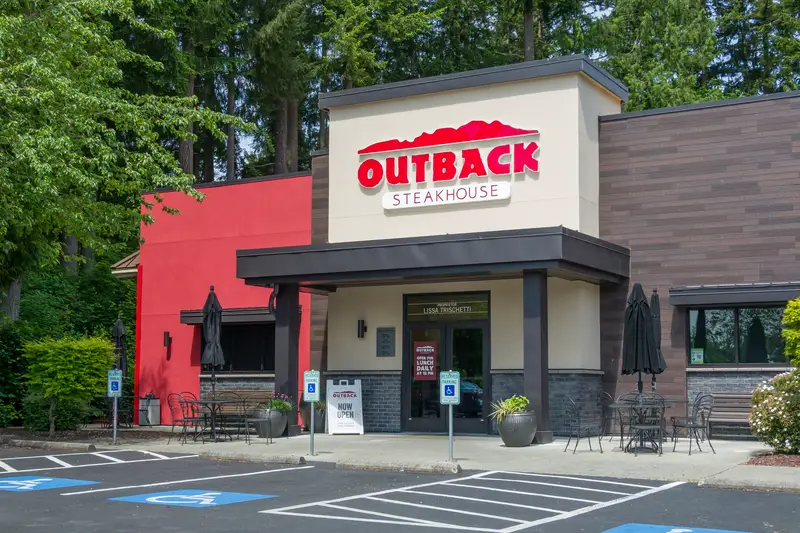
A note taped to the door is how Evansville, Wyoming, found out. The Outback Steakhouse there stopped serving on August 23, 2026, a franchised restaurant that thanked the Casper area for its support over the past 21 years and then went dark. Two more Outbacks, each open for more than two decades, are also on the way out. The chain that started in 1988 is shutting more than 40 U.S. locations, and parent company Bloomin’ Brands has not published a list of which ones.
The Cuts Came Without A List
Bloomin’ closed 21 underperforming restaurants across Outback, Bonefish Grill and Carrabba’s Italian Grill in a single week in October 2025. It also flagged 22 more locations where it will not renew the lease. Most of those leases expire within four years, and some run as late as 2029. That is where the 40-plus number comes from.
The trimming kept going into this year. During the second quarter of fiscal 2026, which ended June 28, the company closed nine restaurants and opened five, finishing with 1,448 locations. Four of the nine were company-owned and five were franchised. Outback shut four U.S. restaurants and four international ones. Fleming’s Prime Steakhouse & Wine Bar closed one in the U.S., leaving 64.
Outback finished 2025 with 666 U.S. restaurants. It had 679 three months earlier. Across all four brands, Bloomin’ operates more than 1,440 restaurants in 46 states, Guam and 12 countries.
A $75 Million Bet On Steak
On November 6, 2025, alongside third-quarter earnings, Bloomin’ announced a $75 million turnaround plan built around returning Outback to affordable, high-quality steak. The bulk of it, about $50 million, was earmarked for 2026: roughly $25 million for steak quality and a redesigned menu, $7 million for service, $8 million for managing partners and $10 million for marketing. The company suspended its dividend to help pay for it. Its stock fell about 7.4% in the morning session that Thursday.
By August 2026 that spending had been dialed back. Bloomin’ now expects total 2026 turnaround investment of about $36 million, down from the $50 million it originally planned, while productivity savings stay on track at roughly $30 million. The company is aiming for $80 million in savings between 2026 and 2028, from supplier renegotiations, cutting vendor spend, trimming product selections and simplifying back-of-house work.
The Company Says It Lost Its Way
CEO Mike Spanos, a former Delta Air Lines executive, was blunt with analysts about how Outback got here. “We faced several critical challenges, including overly complex menus, unclear brand positioning, inconsistent guest experiences, a gap in steak quality and diminishing value perception,” he said on the third-quarter earnings call. He added that the company had drifted away from making decisions centered on the guest.
Before the big plan, Outback had already refranchised its Brazilian restaurants, laid off corporate staff, cut menu items and pulled back on limited-time offers. Same-store sales and traffic had been falling for years.
Four Tables Per Server Instead Of Six
If you have ever waited 10 minutes for a refill at an Outback, this is the fix. The chain decided its six-tables-per-server model was too much for staff during peak hours and moved to four, backed by about $7 million of the turnaround money. In tests, scores went up on intent to return, server attentiveness and how likely diners were to recommend their server. Employees liked it too. The new model started rolling out systemwide in the second quarter of 2026.
Another $8 million went to leadership, training, field compensation and recognition, with the goal of paying managing partners enough to keep them. Spanos has tied the whole chain of logic together in public: better managers mean better execution, which eventually means better sales.
New Steaks, And New Grills To Cook Them On
In November 2025, Outback launched a new steak lineup led by sirloin, bone-in ribeye and a half-pound burger. Pilot tests of the steak changes delivered an average 10-point improvement in guest satisfaction, taste, value, intent to reorder and quality perception. Multi-unit leaders completed steak excellence certification before coaching their own restaurant teams, and operators now work peak hours checking cook accuracy against standards.
The kitchens are getting hardware to match. Outback is expanding char grill capacity in all of its restaurants to handle the new lineup. There are now two sizes of bone-in ribeye on the menu, and marketing is leaning on the thickness and freshness of the cuts plus the signature Outback seasoning.
The $14.99 Aussie 3-Course Is Doing The Heavy Lifting
Outback’s value play comes in three tiers: $14.99, $17.99 and $20.99. Each includes a soup or salad, an entrée and New York-style cheesecake. The base tier gets you the Bloomin’ Burger, Gold Coast Coconut Shrimp or Shrimp on the Barbie, with upgrades to sirloin, ribs or chicken for a little more. About 60% of guests trade up to the higher tiers, and some go further into a Delmonico or a filet once they are looking at the menu.
Grocery-store beef is the reason that math works. Beef prices rose 9.4% year over year in July 2026, and Bloomin’ executives have made the comparison openly. “We’re getting a lot of guest feedback that guests know they can come into Outback, get a perfectly cooked steak at a great value, get a couple of sides, get a great experience … but yet it’s almost the same cost as what they’re paying for beef at retail,” Spanos told analysts on the November 2025 earnings call. The research and development side of the company has said much the same thing, arguing its cooks handle a steak better than most people do at home.
Every Surviving Outback Gets A Facelift By 2028
Bloomin’ is spending $350,000 to $400,000 per restaurant on refreshes that hit guest-facing areas inside and out. About 31 were finished through the end of July 2026, with roughly 85 planned for the full year and a target of touching 100% of Outback restaurants by the end of 2028. Money that used to go toward opening new stores is funding the remodels instead.
The tabletop Ziosk tablets are already everywhere, and more than 85% of guests use them to pay. That alone cut five to seven minutes off table turns, which matters when a dining room is trying to seat one more party on a Friday night. Outback also ran 42 test locations stacking steak changes, menu work, the new service model and value offers together, and Spanos called the results across traffic, satisfaction and value scores highly encouraging.
Is Any Of It Actually Working?
Partly. Outback’s same-store sales rose 0.4% in the third quarter of 2025, its first positive quarter since the second quarter of 2023, with flat traffic. In the fourth quarter of 2025, U.S. same-store sales slipped 0.6% but traffic grew 0.9%, the first traffic gain since the fourth quarter of 2021. Brand trust climbed seven points, food scores five, service five, value three and atmosphere three.
The second quarter of 2026 was a mixed bag. Companywide revenue rose 1.3% to $1.02 billion and comparable U.S. sales climbed 2.3%. Outback’s own comparable sales rose 1.4%, but its U.S. traffic fell 2.8% while average check per person jumped 4.2%, meaning fewer people spending more. Bonefish Grill was the standout, with comparable sales up 8.1% and traffic up 4.5%. Spanos said he was pleased with the quarter and the progress on the Outback turnaround, and the company raised its full-year earnings guidance.
Profitability is still the sore spot. Restaurant-level margins fell nearly 2 percentage points year over year to 9.2% in the third quarter of 2025, pushed down by food, labor, supply and insurance costs.
What This Means For Your Local Outback
Outback is not collapsing. Forty-plus closings out of a U.S. base in the mid-600s is a pruning, and the company is pouring tens of millions into the restaurants that survive. The tell is the lease list: 22 of the closures are locations Bloomin’ simply will not re-sign for, which means older buildings in weaker trade areas are the ones at risk, some not until 2029. If your Outback has already been remodeled, it is being kept.
The chain is far from alone in cutting. Dozens of restaurant brands have shut locations in 2026, including Wendy’s, Starbucks, Papa John’s, Pizza Hut and Del Taco. Jack in the Box closed 86 restaurants in fiscal 2025 and plans another 50 to 100 in 2026.
Here is the honest read on whether the money is well spent. Spanos said Outback needs to be more relevant and that strong brand awareness should be converted into visits, and the plan he laid out is aimed at the two things people complain about most: the steak and the service. Better cuts, real grills and a server covering four tables instead of six are fixes you can taste. The remodels and the digital ad shift, from 30% digital in 2025 to 60% in 2026, are not. Outback got into this hole by drifting from a fun steakhouse into a fuzzy chain restaurant with a bloated menu, and the $14.99 three-course deal plus a $20.99 trade-up is the closest thing it has to an answer. Go before your lease-expiring location gets the note on the door.

