

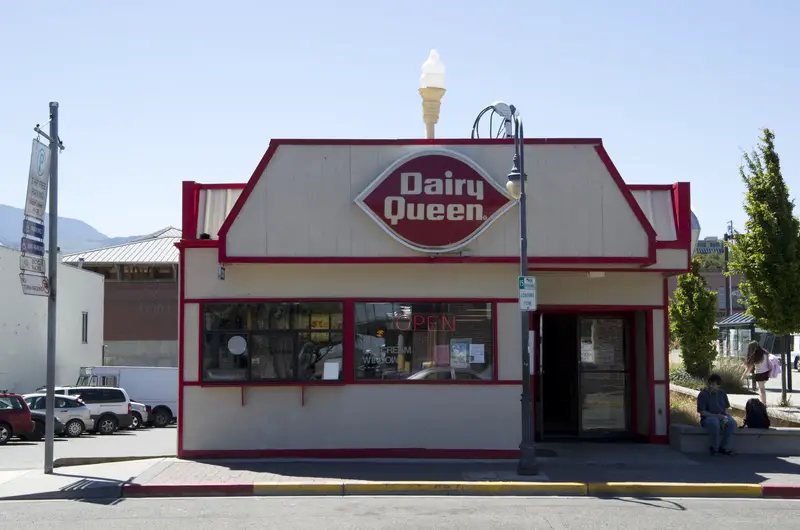
Fries are the item almost every fast food chain sells and almost nobody bothers to defend. With more than 200,000 fast food restaurants in the United States, the assumption at the register is that you will eat whatever fried potato lands in the bag and not think twice about it. Most chains land somewhere between fine and very good. A handful are genuinely bad. One finishes at or near the bottom, and it is not a burger chain at all: Dairy Queen has been selling fries since the late 1950s, when its Brazier hot-food line was bolted onto a reputation built entirely on soft serve.
10. Dairy Queen
The packaging does the heavy lifting. DQ fries arrive looking golden and crisp in the bright box, then give way the instant you bite one, with no resistance and almost no flavor behind it. Tasters who have worked through the entire field put them dead last for a total absence of crispiness and seasoning, and a separate ranking that ran three dozen chains deep parked them at the very bottom too. They are short, stubby, soft and under-salted. When a dominant note does turn up, it is frying oil rather than potato.
Consistency is no consolation either. Reviewers working the menu find them reliably mediocre rather than occasionally good, and portions run stingy for what the chain charges. Dairy Queen opened in Joliet, Illinois in 1940 as a soft-serve shop, and the fry has never been part of what it is actually good at. Order the onion rings, which come out properly crisp, or, if you are in Texas, Jalitos, crispy breaded jalapeño strips with ranch.
9. White Castle
A crinkle cut exists to hold crunch. White Castle’s manage to lose it anyway. The fries are limp, close to saltless and short on any crisp edge at all, which is how they landed second from the bottom of Tasting Table’s 2023 25-chain ranking, and 35th in a field of three dozen. The sliders are hit or miss depending on the hour. The fries are reliably mush.
Longtime customers argue the recipe got worse around 2020, the same year the chain started handing some fry-cook duty to robots, which is not the kind of upgrade that fixes a flavor problem.
8. In-N-Out Burger
This is the entry that starts fights. In-N-Out cuts whole potatoes to order in every store, widely reported to be Kennebecs, and fries them without the blanch and par-fry the rest of the industry uses. The moisture and starch left in a raw potato work directly against crispiness. What comes out turns into stale, room-temperature matchsticks in about the time it takes to get to your car. One 25-chain ranking left them at 21st, down in the bottom five, and a 2026 food blogger who worked through the major chains put them last of the lot.
The burgers are still the reason anyone is in that line, and the fries are salvageable if you order them animal style and let the cheese and grilled onions do the work the potato is not doing.
7. Sonic Drive-In
Sonic’s menu is enormous and the fries are clearly the part nobody was assigned to care about. They are plain standard cut, and they somehow never taste fresh no matter what time you pull into the stall, which is how they finished 23rd out of 25. The tater tots and onion rings come out of the same kitchen and are considerably better. The newer Groovy Fries, a deep-ridged cut built for dipping, are the first sign anyone at the chain noticed.
6. Burger King
Most of North America’s frozen fries come out of a handful of processors, so the big chains overlap on sourcing. What separates McDonald’s from Burger King is recipe and execution, not the potato. In a seven-chain taste test published in 2023, BK’s Classic Fries finished last: badly under-seasoned, dry, and so thick and starchy in the middle that the texture never balanced out. A medium cost $4.15 that day. The chain’s own marketing promises they turn up piping hot and perfectly salted, and customers keep saying the opposite, often in the same breath as a complaint about how much the experience varies by store.
No chain has reinvented a fry more often. In January 1998, Burger King dropped its shoestring for a thicker fry sprayed with a potato-starch coating it has never named. In 2011 the cut got thicker with a promised crunchy shell. In 2013 came Satisfries, a crinkle-cut version priced at $1.89 against $1.59 for the original, built on a dense batter that kept the oil out and took the flavor with it. About two-thirds of U.S. and Canadian locations dropped them within a year.
The current recipe is better than its reputation. A 2026 review called the current BK fries among the most underrated in fast food, and still ranked them fourth of the seven it tried. The catch is the lottery behind the counter: fryer oil that does not get skimmed and changed on schedule, stale fries pushed out on a slow shift instead of dumped, and a multi-step frying process that not every crew follows. Spread across about 6,650 U.S. locations, that variance is the product.
5. Shake Shack
Shake Shack charges restaurant prices for a freezer-aisle cut, and the strange part is that it mostly works. The crinkle cuts are thicker than the norm, brown evenly into every groove, and stay crisp even after they have gone cold, which is how they won that same 2023 seven-chain head-to-head taste test at $4.25 for a regular order. Against the wider field they slide to 16th of 25, because they can arrive under-salted and occasionally get fried past crisp into genuinely hard. Add the cheese sauce and most of that stops mattering.
4. KFC
The Secret Recipe Fries are the side most people never think to order. They lean crunchy and well done, an extra-thick battered cut rather than a shoestring, and they are seasoned rather than merely salted. In that same seven-chain test they came back salty, flavorful and crisp-shelled with a soft, fluffy middle, marked down only for grease. Price is the real objection: a large ran $6.39 in that test, which is serious money for potatoes, and quality swings hard from one location to the next. A 25-chain ranking put them mid-table at 14th, which undersells the good ones badly.
3. Arby’s
Curly fries are seasoned all the way through, hold their moisture without going limp, and are the best value in the category by a wide margin. They took third in a 2026 blogger ranking of the major chains. The only genuine gripe is anatomical: an actual curl is rarer than the name implies, and a good portion of the box is short broken pieces. Arby’s sells the frozen bags at Walmart, and the package’s own air fryer directions, 12 to 14 minutes at 360 degrees with a shake halfway, get them close to the drive-thru version.
2. McDonald’s
Straight out of the fryer, nothing in fast food beats them. The fries are coated in dextrose by the supplier before par-frying, which is where the faint salty-sweet edge and that even golden color come from, and on a fresh basis they top most rankings that exist. They also collapse faster than anyone else’s. Old fries from other chains stay edible; McDonald’s go stale, stiff and cold in minutes, and the average order has already spent longer than that under a heat lamp.
The flavor change people swear they can taste is real history rather than nostalgia: McDonald’s switched from beef tallow to vegetable oil in 1990 and does not use tallow today, though its suppliers still add a beef flavoring to the par-fry oil. If you want the version that earns the reputation, order with no salt, which McDonald’s says gets you a batch prepared fresh, then salt them yourself in the car. McDonald’s has the highest highs in the business and the lowest lows, and the lows are the only reason it is not first here.
1. Checkers And Rally’s
The Famous Seasoned Fries win because they are built for the way people actually eat fries, which is in a car, several minutes after paying. Checkers and Rally’s coats its fries in a seasoned batter of flours, starches and 15 herbs and spices before frying and freezing them, and lays it on thicker than anyone else, which is why the crunch survives a 20-minute drive home or a delivery order that sat in a bag. The seasoning is assertive without tipping into novelty, and these are one of the few chain fries worth ordering on their own rather than as ballast next to a burger. That same 2026 blogger ranking put them first on flavor, texture and staying power. Most grocery stores carry the frozen bags, and they come back from an air fryer better than anything else on this list.
Two other moves are worth knowing about. Wingstop quietly dropped the words fresh-cut from its description of its fries between the 2024 and 2025 annual reports, a change of language that points to a change of potato, and Steak ‘n Shake went back to beef tallow in early 2025. For a sleeper, Taco Bell’s Nacho Fries are heavily seasoned with what the chain calls bold Mexican spices and come with nacho cheese sauce for dipping, and Del Taco’s Crinkle Cut Fries loaded with Secret Sauce show up hot and crisp far more often than they should. As for Dairy Queen, the fries are a mistake at any temperature. Get the dipped cone, which is the thing the chain has genuinely perfected.

