

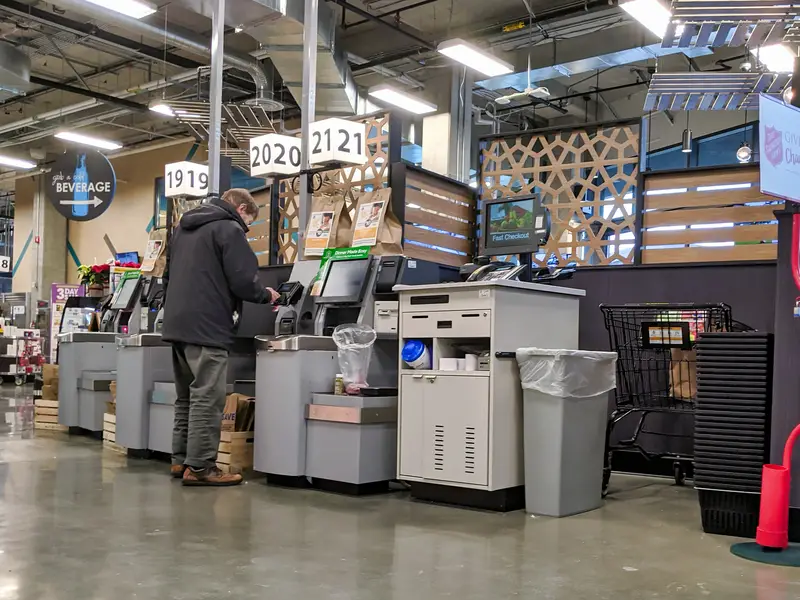
Loss prevention staff at a Walmart Superstore on U.S. Highway 19 in Pinellas Park, Florida, spent part of their day doing the least glamorous job in retail: standing off to the side of the self-checkout lanes, waiting for somebody to get sloppy.
Police say the shopper they were watching, 51-year-old Bruce Wayne Higgins Jr., rang up a $329 computer monitor as a banana, then failed to properly scan more merchandise before heading for the exit. The items came to $525.68. Pinellas Park police arrested him and charged him with petit theft between $100 and $750, a misdemeanor under Florida law. He was detained without incident. After being read his Miranda rights, he denied stealing anything on purpose and said it was a mistake, blaming exhaustion from working overnight, according to the arrest affidavit. The whole thing was on surveillance video.
The banana trick and its two cousins
The move is exactly as dumb and as effective as it sounds. You put something expensive on the scale, punch in the produce code for something cheap, and the register happily charges you 60 cents for a ribeye. Bananas got their name on it because they are usually the cheapest thing in the store with a lookup code.
Two other tactics travel with it. The pass around is just moving an item into the bagging area without scanning it, often tucked under something you did scan. The switcheroo is peeling the sticker off a cheap item and sticking it over the barcode of an expensive one. The cutesy names are not an accident, and they are a tell: people who do this treat it as a game rather than a crime, which is something loss prevention teams talk about constantly.
Why a banana, and not something else
Math. Bananas ran about 65 cents a pound in the BLS average for August 2026. Shrimp runs many times that. Same scale, same two seconds of typing, completely different receipt.
Every chain has its own banana, and finding it is a real job in retail analytics. The candidates are the impulse junk parked by the register: gum, mints, lip balm, postcards, loose candy, anything under a dollar. Bag fees and the little charity round-up codes qualify too, since they can be keyed in by hand without a barcode ever being involved. Once a company figures out which cheap code its thieves keep reaching for, it can flag the pattern instead of chasing individual shoppers.
The register keeps score
Here is the flaw in the plan. Somebody stealing four things usually uses the same banana four times, which leaves a transaction with four scans of the same cheap SKU sitting in the data like a flare. Grocers pull reports on exactly that, duplicate low-cost SKUs in a single order, and route automatic alerts to a manager.
The inventory system catches it from the other direction. When a product shows negative inventory, it has been scanned or keyed more times than the store ever had units on the shelf. That is a banana. Pair that report with camera footage of the lane at the time stamp and the case basically writes itself.
A lot of people are trying this
Self-checkout is most of the way to normal now. Catalina counted it at 38% of grocery checkout lanes in 2022, the Food Industry Association put 33% of supermarket transactions through it in 2025, and 86% of American adults told Morning Consult they have used one.
The attitude surveys are worse than the arrest numbers. LendingTree has asked twice. In 2023, 69% of self-checkout users thought the machines made stealing easier and 15% admitted doing it on purpose. When it put the question to 2,050 adults again in October 2025, that 15% had become 27%, and 55% of them said they expected to do it again. The Loss Prevention Research Council came at it from the other end and interviewed two dozen caught shoplifters; most rated stealing from a self-checkout easy or very easy.
What it actually costs the store
Adrian Beck and Matt Hopkins, criminologists at the University of Leicester, audited a million transactions over a year at retailers using handheld scan-as-you-shop devices. Sales totaled $21 million. Nearly $850,000 in goods walked out unpaid for. Their paper ran in Security Journal in 2017.
Per dollar rung up, self-checkout loses roughly 16 times more than a staffed lane, according to a 2023 analysis by Grabango, a checkout-free technology vendor that shut down the following year. Total U.S. retail shrink hit $112.1 billion in fiscal 2022, about 1.6% of sales, and that was the last year the National Retail Federation published an industry shrink figure. The National Retail Federation’s Impact of Retail Theft and Violence 2025, drawn from 70 companies representing 168 brands and $1.3 trillion in sales, found shoplifting incidents up 18% in 2024 against 2023, and threats or violence during theft events up 17% over the same stretch. Sixty-seven percent reported a transnational organized retail crime group involved in thefts against them. Its 2026 edition, out in July, found the trend had turned: shoplifting incidents down 12.4% between 2024 and 2025.
The kiosk is watching you back now
The old defense was the scale, and stores gutted it themselves because the constant unexpected-item nagging drove shoppers crazy. What replaced it is cameras that actually look at your groceries. Walmart has used a system from Everseen Ltd. that tracks products and shopper movements, compares them against what the register says was scanned, and pings a store worker when the two do not match. Kroger’s Harris Teeter goes further and halts the checkout outright. NCR Voyix, a longtime supplier of Walmart’s self-checkout hardware, sells the same idea one step on: short clips of suspected mis-scans get reviewed by humans off-site, a technique it picked up when it bought StopLift in 2018.
Walmart has also rolled out its own produce recognition, which looks at what is on the scale and works out what it is. It was in about 30% of stores as of June 2026, with roughly half the fleet planned.
Why people who would never rob a person rob a kiosk
The Leicester researchers landed on the boring answer: it is easy, so people who never planned to steal do it anyway once they are standing there. Consequences softened too. Dallas police stopped routinely responding to shoplifting calls under $50 in 2012, and the floor rose to $100 in 2015 when Texas lifted its Class C misdemeanor theft threshold.
The machines give “the false impression of anonymity,” according to Barbara Staib, director of communications of the National Association for Shoplifting Prevention. “This apparently empowers people to shoplift.” Criminologist Shadd Maruna, then at the University of Manchester and now at Queen’s University Belfast, put the self-justification more bluntly to the Observer in 2018: “Individuals can neutralise guilt they might otherwise feel when stealing by telling themselves that there are no victims of the crime, no human being is actually being hurt by this, only some mega-corporation that can surely afford the loss of a few quid.” Temple University psychologist Frank Farley adds a personality angle, describing a chunk of supermarket thieves as thrill-seekers who find it entertaining.
The charge is small until it isn’t
Skip scanning gets charged as ordinary theft, and the dollar amount decides whether you are dealing with a misdemeanor or a felony. In New York, the common charge is petit larceny under PL 155.25, punishable by up to 364 days in jail, and anything over $1,000 becomes grand larceny with state prison on the table.
Texas has produced a steady run of these. Two women were arrested in Wichita Falls in February 2020 for scanning one item and bagging several others, $200.70 worth. That June, the executive director of the Marion County Chamber of Commerce in Jefferson was arrested after bagging $468.73 in merchandise at a Marshall Walmart without scanning it; she said she had forgotten to scan two twelve-packs of soft drinks. She pleaded guilty that November to a charge covering six earlier trips. In October 2020, a former Brownsville police officer was arrested after moving the tag from a $12.99 decorative basket onto a $29.99 item and scanning the cheaper price at a Target self-checkout.
Honest shoppers get swept up in it too
All this monitoring creates its own mess. Confusing screens, a barcode that does not take, the wrong quantity keyed in, an item left in the cart under the bag of dog food. Those happen constantly, and they look identical to theft on a camera feed.
Sometimes the store gets it wrong and pays for it. A Mobile County jury awarded Lesleigh Nurse $2.1 million in 2021 after she was arrested for shoplifting at a Semmes Walmart when the self-scanner jammed. Walmart moved to have the verdict thrown out and said it would appeal. Which is a decent argument for keeping your receipt and slowing down at the scanner even when the line behind you is getting impatient.
The lanes themselves are shrinking
Retailers are hedging. Target piloted a 10-item cap at about 200 stores in late 2023 and took it chainwide in March 2024, across most of its 2,000-plus locations. Walmart has pulled kiosks out of a handful of stores in New Mexico, Missouri and Ohio, though it said those calls were about the shopping experience rather than theft. Dollar General CEO Todd Vasos said on the December 2023 earnings call that the chain had leaned on self-checkout too hard and would put people back at the front end. By March 2024 it was pulling the machines out of 300 stores entirely.
My read: the banana trick had a good decade because the machines were stupid and nobody was looking. Both of those conditions are gone. The scale you were beating has been replaced by a camera that knows what a monitor looks like, the register is quietly counting how many times you rang up the same cheap produce code, and a person whose entire job is watching that lane is standing twenty feet away. A $329 monitor is not worth a theft charge on your record, and the people who run these stores now find out.

