

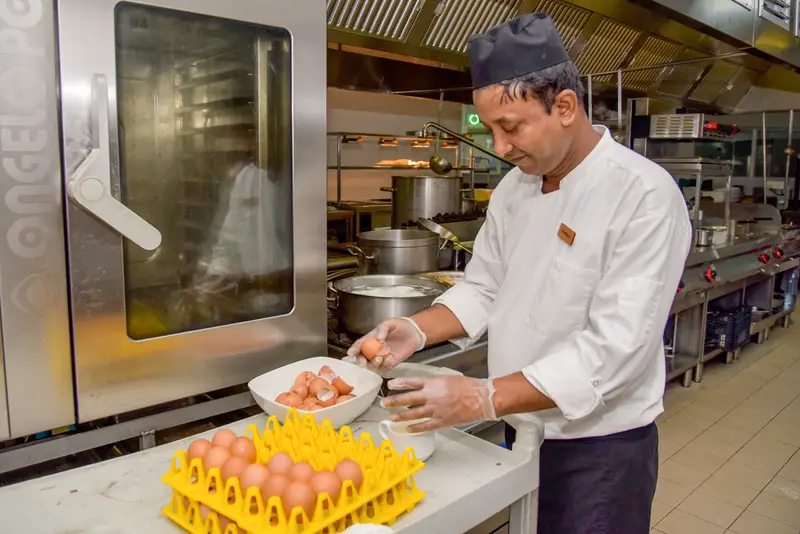
You are three eggs into a bowl of pancake batter, tapping each one against the lip of the mixing bowl because that is how your mom did it, and now there is a white sliver of shell riding around in the flour while you chase it with a fork. The rim did that. Not your grip, not a bad egg, not luck. A curved edge is the fastest way to put shell inside your breakfast, and the fix is embarrassingly simple: a flat countertop and one confident whack.
The rim pushes the shell the wrong direction
A bowl edge concentrates all the force into one narrow line and drives the broken shell inward, toward the egg you are trying to save. It also shatters the shell into smaller shards, which are harder to spot and harder to fish out than the larger pieces a flat surface leaves.
Gentle repeated tapping makes it worse. Each little knock adds another tiny fracture, and when your thumbs pry the halves apart, those fractures go along for the ride. The mess is the other half of the problem. Crack on a bowl rim and you get whites running down the outside of the bowl and egg all over your fingers while you hunt for shards.
It is rough on the yolk, too
The yolk is wrapped in a thin membrane called the vitelline membrane, and a sharp edge is very good at puncturing it. Culinary scientist and author Jessica Gavin put the problem plainly: “If you crack on the edge of a bowl, you need to control the force to avoid piercing the delicate yolk membrane.”
That control is the part nobody has at 7 a.m. If you are scrambling, a broken yolk costs you nothing. If you are frying eggs sunny side up, poaching, or separating whites for meringue, a ruptured yolk means starting over with a new egg.
Restaurant cooks go flat because it is faster
Speed is the reason professionals switched, not fussiness. Bruno Enciso, chef de cuisine at Lutèce in Washington, D.C., said he can crack many eggs at once on a flat surface, while the bowl edge forces you to do them one at a time.
Marque Collins, director of food and beverage operations for Tullibee and the Hewing Hotel in Minneapolis, said the countertop method makes less mess when he is going through flats of eggs for brunch service. There is one exception. Nick Korbee, then executive chef of Egg Shop NYC, told TODAY he used the sharp edge for mass quantities of scrambled eggs, but he was honest about the trade: that method tends to leave shell fragments and broken yolks, so he strains the eggs through a mesh strainer before using them. If you are not straining, you are not getting the same result he is.
The other reason pros keep shell out of the bowl
Penny Stankiewicz, chef-instructor at the Institute of Culinary Education, framed the case against the rim this way: “Eggs are not clean on the outside, and cracking one on the rim of a bowl can force shell inside, and could end up contaminating the inside of the egg with the shell’s bacteria.”
That is a good argument for the flat-surface tap and an even better argument for wiping the counter down before and after, along with washing your hands once the eggs are open.
Aim for the equator and commit
Hold the egg in one hand and hit it once against the flat countertop or a table, not the edge. Target the equator, the widest point in the middle, so the egg splits into two even halves. There is a sweet spot between crushing the egg in your fist and delivering a blow with enough conviction to make one jagged crack straight across.
Then move the egg over the bowl and press your thumbs into the crack until the membrane gives, and pull the halves apart. Shamim Popal, co-owner and chef of Lapis in Washington, D.C., cracks in the middle for exactly this reason: two even halves make it easy to separate white from yolk, and you avoid runny egg on your fingers and bits of shell in the bowl. Chef Tolu Eros of Ile in Los Angeles said the real trick is to crack with confidence and know how to handle the egg once it is open. He is careful to add that the method you choose is mostly personal preference.
Give every egg a layover in a small bowl
Cracking straight into your batter is the habit that turns a two-second problem into a ruined bowl of cake mix. Altreisha Foster, baker, owner of Sugar Spoon Desserts and president of the Cake Therapy Foundation, cracks eggs one at a time into a small bowl before adding them individually, which catches broken yolks, bad eggs and falling shell before any of it hits the batter.
There is a practical reason beyond damage control. Once you have six eggs in a big mixing bowl, spotting a translucent chip at the bottom is nearly impossible. In a small clear bowl with one egg, you see it immediately.
Jamie Oliver’s shell scoop beats your fingers
When a piece does get in, stop chasing it. In his YouTube series “Jamie’s 1 Minute Tips,” Oliver demonstrates that fingers do not work: “The natural instinct is to get in there with your fingers,” he says, “but if you try and get it, it always runs away, and it’s kind of annoying.” His fix is the half shell you just cracked, used as a scoop. “You can mop it up easily, and get those annoying bits of shell every single time. Happy days!”
The reason it works is mechanical. Whites are roughly 90% water and 10% protein, mostly ovalbumin, and that viscous liquid slides around a blunt fingertip, carrying the shard with it. The thin, rigid edge of a shell is sharp enough to slip underneath the fragment and trap it instead of pushing it. Korbee suggests a different approach if your hands are clean: moisten your fingers first, because egg white sticks to dry skin and makes the shard harder to grab. The shell trick still wins for speed.
Separate yolks with your hand, not the shell halves
Passing a yolk back and forth between two shell halves looks like something a pastry chef would do, and it is the worst option available. Those jagged edges are sharp, and a nicked yolk bleeds into the whites and costs you the egg.
Crack the egg into your clean, cupped hand instead and let the whites run between your fingers into a bowl below, bouncing your hand gently to help them drop. Korbee prefers this at home because it is gentle, and if a yolk starts to break in your palm you can drop it into a second bowl before it contaminates the whites you already have.
Two methods most home cooks have never tried
Eros noted that a sharper tool, like a knife, can make a cleaner break in the middle when you are separating an egg. Stankiewicz skips hard surfaces entirely and cracks eggs against each other, one at a time, because only one of the two ever breaks and it moves quickly when she has a lot to get through.
One thing you can drop from your ambitions: the one-handed crack. Korbee said there is no earthly reason to force home cooks to do it. It is a line-cook skill for firing dozens of egg orders in minutes, and it takes real practice. If you want to learn anyway, he suggests holding the egg between thumb and forefinger, tapping to crack the shell, then pulling your thumb back gently to release the egg.
The hot pan rim is even worse than the bowl
Cracking straight onto the edge of a skillet over a lit burner adds problems the mixing bowl never had. Butter and oil already in the pan can splash back at your hands when the egg drops in, and the same uneven pressure that ruptures yolks in a bowl ruptures them over the heat, which is how a sunny side up egg becomes scrambled by accident.
Crack flat, check the egg in a small bowl, then slide it into the pan from an inch or two above the surface. It costs you about four seconds.
Brown eggs do not crack any better than white ones
Shell color is no guide to whether you end up picking chips out of your batter. Shell color is set by breed genetics: brown-egg breeds deposit porphyrin pigment in the shell gland, blue- and green-egg breeds deposit biliverdin, and white-egg breeds such as the Leghorn deposit none at all. Feather color has nothing to do with it, and even the old earlobe rule of thumb has plenty of exceptions. The difference stops there. If the fancier carton has been cracking cleaner for you, it is your technique that changed, not the eggs.
The verdict
Crack on the flat counter, hit the equator once and mean it, open the egg over a small bowl, and check it before it joins anything else. The whole routine takes a few extra seconds on the first egg and none at all by the fourth. Most of the chefs asked about it prefer the flat surface, and the one who still reaches for an edge does it for bulk scrambles and strains the eggs afterward.
It feels wrong the first time. Whacking something as fragile as an egg against a solid countertop goes against every instinct you have about eggs. Try it twice. The tentative tap-tap-tap on the bowl rim is what has been breaking your shells into pieces all along, and once you feel a clean single break across the middle, you will not go back.

