

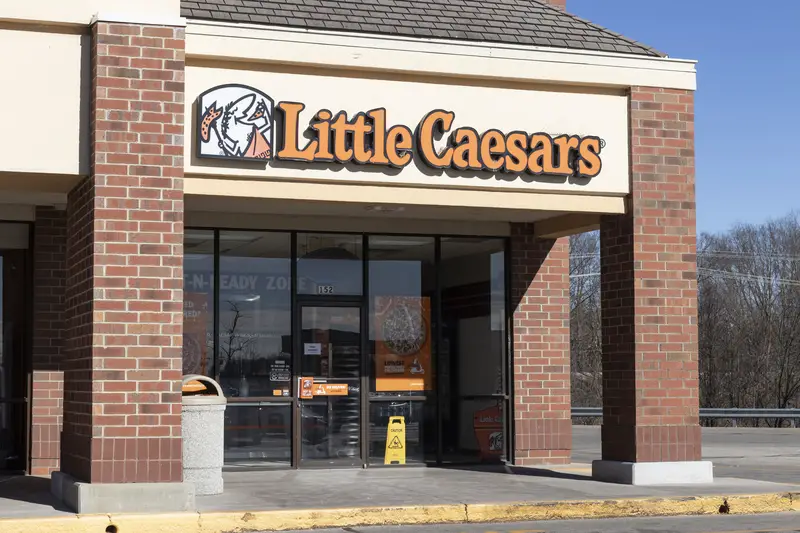
Walk into a Little Caesars at 5:30 on a Tuesday and the pizzas are already sitting there, made, boxed, waiting. You pay, you leave, you’re back in the car faster than most drive-thru lines move. That speed is the pitch. The price is the reason people put up with everything else.
And the price traces back to one ingredient. One Chicago pizzeria puts cheese at around 40% of what a pizza costs to make, and it is the first place any chain goes looking when it wants to hold a price down. Little Caesars went there harder than anyone.
Cheese Is Where Little Caesars Does Its Cutting
The chain’s number-one cost-saving move is the cheese, and it works two ways. First, the cheese itself: low-moisture mozzarella that keeps for a long time, so very little gets thrown out. Second, and more obvious once you’ve eaten one, is how much of it lands on the pie. Workers are instructed to sprinkle conservatively. If you’ve ever noticed a Little Caesars slice pulls thinner than a slice from the pizzeria down the street, that’s not your imagination, it’s policy.
The math on the finished product is brutal. The same pizzeria puts the chain’s cost at about $2 for a cheese pizza, and a Little Caesars employee on Reddit put a pepperoni at roughly $2.50. Neither figure comes from the company. The Hot-N-Ready built an empire on the gap between numbers like those and what you paid at the counter. It held at $5 from 2001 until January 2022, when it went to $5.55, and most markets now pay closer to seven dollars.
It Is Real Dairy, There Is Just Less Of It
Cheapest does not automatically mean fake. Little Caesars uses mozzarella made from real cow’s milk with Muenster mixed in alongside it, and that blend goes on the whole menu rather than just the Hot-N-Ready.
You’ll still see the chain described online as serving a processed “pizza cheese” loaded with oils and starches, which does not square with the cow’s-milk mozzarella account. Where imitation cheese genuinely has turned up is overseas, and in independent takeaways rather than chains: when Warwickshire County Council trading standards bought 40 pizzas from takeaways in 2016, five of them used a non-dairy product built mostly from fat and oil to look and taste like the real thing.
Almost Every Chain Buys From The Same Company
Here’s what makes the whole cheese argument stranger. Leprino Foods, a family-owned company headquartered in Denver, is the largest mozzarella manufacturer in the world, and on 2017 reporting it controls as much as 85% of the U.S. pizza cheese market. Pizza Hut, Domino’s, Papa John’s and Little Caesars are all on the customer list.
Leprino moved about a billion pounds of cheese a year as of 2017. Its big 1980s breakthrough was individually quick-frozen shredded cheese, which let thousands of separate restaurants turn out pizzas that behaved the same way in every oven. In 2023 it signed a five-year deal with Domino’s Pizza Enterprises, the Australian-listed master franchisee, covering more than 260 million pizzas a year across nine markets in Europe and Asia-Pacific. The United States is not in that deal. So when you argue about whose cheese is better, you may be arguing about two shreds from the same plant.
Pizza Hut’s Cheese Has Starch In It
Pizza Hut says it uses real cheese, and that depends on what you mean. What goes on the pie is part-skim mozzarella, the stuff the industry calls “pizza cheese,” and the ingredient list runs longer than four items. Pizza Hut’s adds modified food starch to the milk, cultures, salt and enzymes. Domino’s published list goes further still, with cellulose and whey protein concentrate. Real mozzarella, the kind sitting in water at the deli counter, does not arrive in a bag pre-shredded.
The starch and the whey concentrate are there for the melt and the stretch, plus the shelf life, and yes, they make the cheese cheaper to produce. For context on how loose the word “cheese” gets in fast food: anything labeled “pasteurized process cheese food” has to be at least 51% cheese by weight. There is no general 51% test for whether something counts as cheese, and the American slice on your burger is usually the stricter grade above it, pasteurized process American cheese.
Domino’s Cheese Is A Blend, And It Says So
Domino’s is often quoted as promising 100% real mozzarella made from milk. Its U.S. site does not put it that way. What it publishes is “Pizza Cheese”, a blend that opens with part-skim mozzarella and then adds modified food starch, cellulose, nonfat milk and whey protein concentrate.
Real cheese needs milk, rennet or microbial enzymes, salt, and cultures. Processed cheese products add vegetable oils, starches, emulsifiers and preservatives, which is what keeps them cheap and stable in a commercial kitchen. Between the two extremes sits basically every chain pizza in America.
Sauce From A Bag, Dough From The Back
Little Caesars says its sauce starts as fresh-packed California crushed tomatoes, mixed in store with water and a spice blend. Not romantic, but not a powder either. The dough, though, is made fresh in the store every day, from flour, water, sugar, salt, yeast and soybean oil, and the stores work from a dry mix rather than finished dough. Neither the dough nor the sauce contains dairy or meat, which makes both cheaper to produce than the cheese sitting on top.
The chain also runs its own distribution arm, Blue Line Foodservice Distribution, which buys flour, pepperoni and block mozzarella in wholesale volume and cuts out the middleman. Across more than four thousand U.S. stores, small per-pie savings turn into real money fast.
Pizza Hut’s Dough Arrives Frozen
The dough-tossing pizzaiolo is not what’s happening behind the counter at most chains. At Pizza Hut, workers have described frozen discs of dough that get dropped into pans, sprayed with oil, then left to thaw and rise. Some locations go further and pre-assemble pizzas with sauce, cheese and toppings, then park them in the refrigerator until an order comes in and the pie rides a conveyor oven.
Breadsticks and garlic knots exist for a similar reason. They are a high-margin way to sell you more of the cheapest thing in the building, which is dough. The slick on Little Caesars Crazy Bread is not butter either: it is an oil spread of soybean oil, water, salt, hydrogenated soybean oil and flavorings, with a parmesan mix on top that is where its milk allergen comes from.
The Dipping Sauce Is Not Butter Either
Papa John’s says its garlic cup was the first dip made to go with pizza rather than breadsticks, a claim that comes from the company itself. It contains no butter and no milk of any kind. The first ingredient is soybean oil, and actual garlic turns up fifth, inside the group that makes up less than two percent of the cup.
Domino’s butter-flavored dipping oil is not butter either. What it publishes is soybean oil, hydrogenated soybean oil, salt, sunflower lecithin, natural flavor and coloring. These little cups are pure margin, and they’re also very good at covering for a dry crust, which is part of the point.
Nobody Pays For A Dining Room You Don’t Use
Little Caesars runs carry-out stores, so there’s no dining room to heat, staff or clean. It does deliver, through its own app and through DoorDash since 2020, but it employs no drivers, so it carries the demand without the fleet. Back in 2017, when the chain had no delivery at all, Darren Tristano, then chief insights officer at the research firm Technomic, put the strategy to CNBC this way: “While everyone else is chasing delivery, Little Caesars is letting the customer come to them.”
Making you come in also makes you shop. Once you’re standing inside, wings and a two-liter are an easy add, and the contactless Pizza Portal means an employee never has to talk to you or wipe down a counter you leaned on. Every one of those savings stacks under the same cheap pizza.
The Genuinely Fake Cheese Lives In The Freezer Aisle
If you want an actual cheese substitute, skip the chains and look at Totino’s. The ingredient lists for Totino’s Party Pizzas and Pizza Rolls include “imitation mozzarella cheese” alongside “rehydrated” mozzarella. That imitation cheese is built from water, vegetable oil, potato starch, modified food starch, rennet casein, gelatin and modified whey, plus a sub-2% group of ingredients that includes titanium dioxide for coloring. The FDA permits titanium dioxide as a food dye up to 1% of a product’s weight; the EU banned it for consumption in February 2022.
Somebody tried to fight it in court. A 2022 class action over Totino’s Pizza Rolls, not the Party Pizzas, argued the packaging misled buyers because the cheese is almost entirely imitation. In March 2023 a Chicago federal judge dismissed it without prejudice, finding no reasonable consumer would have been deceived and noting that the FDA has no standard of identity for pizza at all. Totino’s got big on price, not quality, and for under $2 a pie it’s hard to argue anyone was promised mozzarella.
So Where Should Your Money Go
Little Caesars is not cutting corners on what the cheese is. It is cutting them on how much of it you get. Real mozzarella, a little Muenster, and a hand that’s been trained never to be generous. Little Caesars picked its lane a long time ago and has never pretended otherwise.
That’s a fair trade if what you want is a hot pizza the moment you walk in, at a price nobody else matches. If what you want is the cheese pull, the stringy, heavy, slightly greasy top layer that makes a slice worth folding, you’re buying the wrong pizza and no amount of dipping sauce fixes it. Order the Hot-N-Ready knowing exactly what it is: the fastest cheap dinner in the country, with the cheese used like it costs something. Because it does.

