

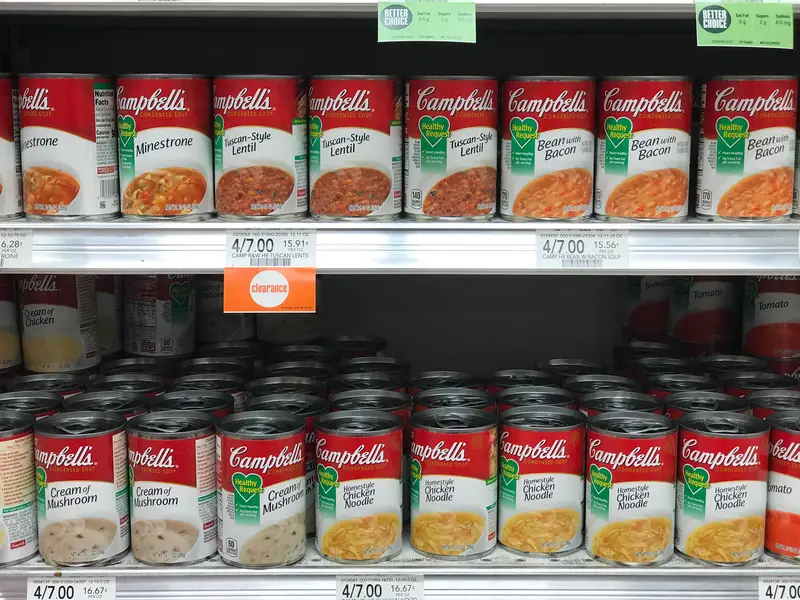
Somewhere in your family there is a stained index card with four lines on it: one can, a block of cream cheese, a bunch of green onions, a sourdough round with its middle cut out. The dip takes ten minutes to make and about five to disappear. This year, that one can is the problem. Campbell’s cream of shrimp soup is gone, and the recipes built on top of it are going with it.
The can disappeared without an announcement
Cream of shrimp is no longer listed on the Campbell’s website. The company never put out a press release about it, never named a date, never explained itself. Shoppers noticed the way people always notice these things, by reaching for a can that had always been there and finding an empty spot on the shelf. Home cooks tracking it say the soup vanished from stores at some point in 2025. If you get lucky, a stray can might still be sitting in a small-town grocery that hasn’t rotated its stock in a while. That is the only way you are finding one at retail.
The clam chowder went first
Cream of shrimp was not the only condensed can to quietly leave. In 2025, Campbell’s stopped producing its condensed New England clam chowder, and that one did get an explanation. A Campbell’s spokesperson told Mashed the company found that consumers preferred the variety in a ready-to-serve format. Loyalists pushed back and the company held its ground.
Campbell’s still sells a New England clam chowder in its Chunky line, ready to eat out of the can. Condensed purists are not impressed. The complaints repeat: the Chunky version tastes flatter, and you lose the one advantage condensed always had, which is that you control how much milk goes in and therefore how creamy it gets. Traditionalists also object to the celery. Campbell’s pioneered the add-water condensed format all the way back in 1897, so watching two of those cans get pulled in the same stretch says something about where the company’s attention is.
The holiday recipes that lose their anchor
Shrimp dip is the big casualty. The classic version is the soup stirred into cream cheese with fresh green onions and slices of ham, spooned into a hollowed-out sourdough round with the bread cubes arranged around the sides. It is a New Year’s Eve and cocktail party staple that got handed down through families for generations, and it does not work without its base.
Shrimp casserole and shrimp bisque are in the same boat. Campbell’s built this dependency on purpose decades ago, with test kitchens turning out thousands of recipes designed around the cans and pushing them through magazines, radio and television. Cream of mushroom arrived in 1934 and became the foundation of green bean casserole, which by Campbell’s own estimate lands on 20 million Thanksgiving tables a year. Cream of shrimp never got that big, but in Southern and coastal kitchens it did the exact same job, and plenty of cooks who lean on it have never made a cream sauce from scratch in their lives.
It was already hard to find years ago
The discontinuation did not sneak up on everybody. Cooks working through the Southern Living shrimp casserole had been trading sourcing tips for years, because the soup had already gone missing from the big chains. One shopper reported a local IGA still carrying it when the big chain nearby did not, and that on Amazon the smallest order was 12 cans, which is a lot of commitment for a dip you make twice a winter.
That casserole is a church potluck fixture: the shrimp mixture folded into rice, poured into a lightly greased 13×9-inch baking dish, topped with 1 cup of shredded cheese and 1/4 cup of breadcrumbs, then baked 25 minutes until the cheese melts. Cooks who make it regularly build two at a time, bake one and freeze the other, eating the frozen one within about a month because of the seafood.
The soup started out in the freezer case
Cream of shrimp had a longer run than most people realize. It arrived in 1955 as part of a frozen soup line that also included Oyster Stew, Clam Chowder, Fish Chowder, Cream of Potato and Green Pea with Ham. The line later picked up Lobster Langostino Bisque, Snapper, New England Style Fish Chowder and Old-Fashioned Vegetable with Beef. Ads for it featured the Campbell’s kids, and the company pitched these heavy winter soups as summer food too, since freezing kept them fresh.
The frozen line eventually petered out, sometime after 2017. A handful of those flavors made the jump to shelf-stable condensed cans, and that is how cream of shrimp survived into the modern pantry. Seventy years of American cooking, from a freezer novelty to a red-and-white can to nothing.
Campbell’s isn’t really a soup company now
On September 10, 2024, the company announced it intended to drop the word “soup” from its name, and shareholders approved the change that November. It is the Campbell’s Company now, and it said it would give snacks a bigger place in its portfolio. The numbers behind that call are not subtle: in fiscal 2023, sales of the company’s snack products, Goldfish included, rose 13%, while its soup sales moved up 3%.
A niche seafood condensed can does not survive that kind of math for long. Shrimp is expensive, imported and priced all over the map, and a company chasing cracker growth is not going to keep a slow seller on the line out of sentiment.
Petitions almost never work on Campbell’s
The track record here is bleak, and anyone holding out hope for a holiday-season revival should look at it. Campbell’s discontinued its retro green pea soup in 2019 and told a customer on X to try Habitant French Canadian Pea Soup instead, which is made with yellow peas and lard rather than green peas and butter. Scotch broth went in 2023, with one fan saying they had eaten it for more than 40 years. The company’s explanation on X was that it sometimes discontinues certain items so it can focus its efforts on upcoming offerings.
Chunky Chicken Mushroom Chowder was pulled the same year. Pepper Pot, first sold in 1899, got yanked in 2010 after a century on shelves. Mock turtle soup, made from cow’s head and a tomato base, lost its luxury status and was dropped by 1960. Once a flavor is permanently gone, Campbell’s rarely brings it back in its original form, no matter how loud the protest or how many signatures the petition collects.
What actually replaces it in your recipe
Blue Runner, a Louisiana-based canned food company, makes a Shrimp Creole Base rather than a cream of shrimp soup. Whether you can buy it depends entirely on where you live, so check the shelf before you plan a party around it.
The closest fix starts with Campbell’s cream of onion, though that can has quietly left Campbell’s own product list too, so check the shelf before you count on it. The ingredient lists on the two soups are strikingly similar, so you add shrimp and tomato puree and you are most of the way there. A second route is shrimp bouillon stirred into another “cream of” can. For the casserole specifically, cooks who make it every year swap one can of cheese soup plus one can of cream of celery for the two cans of cream of shrimp the recipe originally called for, then push the flavor with cayenne or a splash of white cooking wine and swap in Panko for the topping.
From scratch is the long way and the best way. Sauté the shrimp shells and tails in butter to pull the flavor out, simmer them in broth with onion, garlic and herbs, strain it, add cream and thicken with a roux of equal parts butter and flour. It is real work compared to opening a can, and the result can beat what you remember.
The call I’d make this December
Stop waiting for the can to come back and stop paying resale prices for the ones still floating around. For the dip, go cream of onion with shrimp and tomato puree; nobody standing over a bread bowl with a cracker is going to audit you. For the casserole, the cheese soup and cream of celery swap holds up, and it is the one veteran cooks reach for. If the dish matters enough that a substitute would bother you, make the shrimp stock from scratch once and find out what the can was imitating all along. Campbell’s made the decision. The recipe is still yours.

