

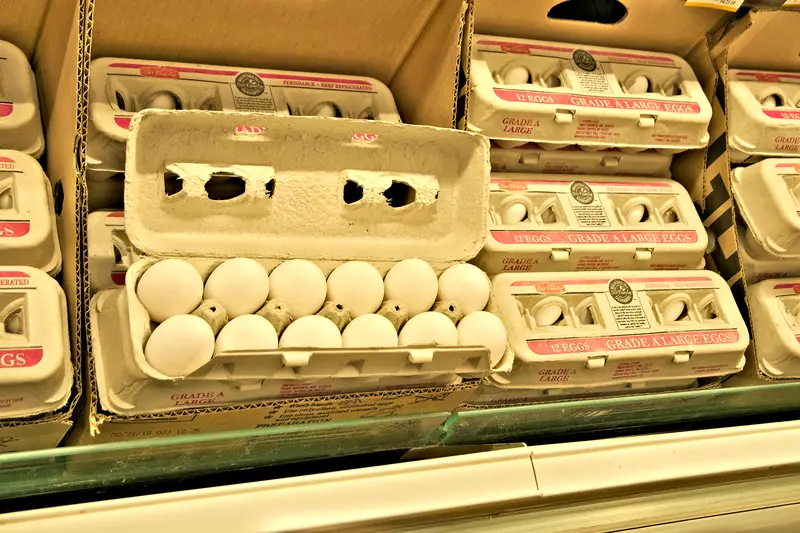
The difference between a carton of eggs that got yanked off a Texas grocery shelf this past summer and one that stayed put came down to a few numbers stamped on the side of the foam in date-coding ink. Same shells. Same carton. Same spot in the dairy case. Nothing you could see, smell or taste separated them.
On July 22, 2026, Midwest Poultry Services, L.P. recalled 1,589,577 dozen white and brown cage-free shell eggs produced at its Texas farms, roughly 19 million eggs, after a salmonella outbreak was traced back to them. On August 12, three weeks later, the FDA bumped the recall to Class I, which the agency defines as “a situation in which there is a reasonable probability that the use of or exposure to a violative product will cause serious adverse health consequences or death.”
That is the warning worth carrying forward: with eggs, the brand on the front of the carton tells you almost nothing. The small printed code on the side is the part that decides whether a dozen is part of a recall, and most people have never once looked at it.
The Stamp That Decided Which Cartons Got Pulled
Recalled cartons carried one of two codes, P-1950 or 0840962, printed on the left or right side in date-coding ink. A carton only fell under the recall if it also showed a Julian date between 157 and 184. The Julian date is a three-digit number for the day of the year the eggs were packed, so 157 means the 157th day, not a month and a day the way most people read a label.
The sell-by or best-by dates on the affected cartons ran from July 20, 2026 through August 17, 2026. The eggs themselves were produced at farms in Texas between June 6 and July 3, 2026. Samples taken at those farms tested positive for salmonella, and genetic sequencing matched some of them to the strain making people sick, according to the FDA.
Five Brand Names, Six States
The eggs were sold under Kroger, Simple Truth Cage Free, Brookshire’s, Country Morning and Sunups labels. They went to Arkansas, Louisiana, Mississippi, New Mexico, Oklahoma and Texas, landing in Kroger stores in Texas and Louisiana, in Brookshire Grocery stores across the six states, and in smaller independent grocers, with foodservice accounts in Texas, Oklahoma and Louisiana also getting them, reporting on the recall showed.
Shopping at one of those chains did not automatically mean you had a recalled dozen. Grocers buy eggs from more than one supplier, and plenty of cartons on those same shelves came from production runs that were never implicated. The code is what separated them.
Similar names caused real confusion. Brookshire Brothers, the chain based in Lufkin, Texas, was not affected at all, because it does not receive eggs from Midwest Poultry Services. Brookshire Grocery Company stores, which sell the Brookshire’s label, were a different story.
Restaurant Kitchens Got The Same Eggs
This was not purely a supermarket recall. Bulk Grade A and AA product went to foodservice buyers, which means restaurant kitchens, cafeterias and institutional accounts. Somebody could have eaten a plate of eggs from the recalled run without ever carrying a carton through their own front door, which is a blind spot in how most of us think about food recalls.
That matters most with runny preparations. Over-easy eggs, soft scrambles, hollandaise and house-made dressings all leave the egg undercooked by design, and a kitchen cranking out breakfast at volume is not checking Julian dates on every case.
134 Sick, 34 Hospitalized, Zero Deaths
By the time federal investigators closed the case on September 3, 2026, the outbreak strain of Salmonella Enteritidis had been confirmed in 134 people across 18 states. Thirty-four were hospitalized. Nobody died. The illnesses started on dates stretching from November 21, 2025 all the way to August 12, 2026, which is a run of nearly nine months for a single strain.
The count posted on July 24, and still the official one when the FDA upgraded the recall in August, was 98 people in 17 states, with 26 hospitalized. Symptoms usually start six hours to six days after eating contaminated food and last four to seven days, the CDC says, and children under 5, older adults and people with weakened immune systems are the ones most likely to get hit hard.
The Lab Network Saw It In April
PulseNet, the CDC’s national lab network for spotting clusters of foodborne illness, flagged this one in April 2026. The recall came on July 22. That is close to three months of eggs moving through stores and kitchens while the investigation worked toward a source, and it is the single best argument for not assuming that a product on the shelf has already cleared every check.
The story did not fully close with the recall, either. In a July 24 update, the FDA said Midwest Poultry Services “does not account for all the illnesses in this outbreak,” and added that additional investigation was ongoing to determine whether there were other sources. It did not name one.
A Clean Shell Tells You Absolutely Nothing
Most people assume egg trouble lives on the outside of the shell, picked up in the barn and washed off at the plant. Salmonella Enteritidis does not play that way. It can infect a hen’s ovaries, which puts the bacteria inside the egg before the shell has formed around it. A smooth, clean, uncracked egg can carry it in the white or the yolk.
That is why scrubbing eggs at home accomplishes nothing on this front, and why the FDA’s standing egg guidance says plainly that fresh eggs, even ones with clean and uncracked shells, may contain the bacteria. Every carton of untreated shell eggs is required to carry a safe handling statement for exactly this reason: keep them refrigerated, cook them until yolks are firm, cook egg-containing foods through.
Refrigeration helps, but it is not a fix. Holding eggs at 40°F or below slows bacterial growth. It does not kill anything already inside. A recalled carton sitting in a cold fridge is still a recalled carton.
Cook Them Until Both Parts Are Firm
Heat is the part you control. The federal standard is both the yolk and the white set firm, with scrambled eggs cooked past runny. Casseroles, quiches, stratas and anything else built on raw egg should hit 160°F on a food thermometer, and an egg dish you made yesterday and want to serve today needs to come back up to 165°F before it goes on the table.
Recipes that never see heat are the real gap. Caesar dressing made from scratch, homemade ice cream, mousse, tiramisu, cookie dough you plan to eat by the spoonful. For those, the guidance is to use shell eggs that have been pasteurized or treated to destroy salmonella, or to reach for pasteurized egg products in a carton.
The Two-Hour Rule People Break Constantly
Eggs that have been refrigerated need to stay refrigerated. A cold egg left on the counter sweats, and that moisture helps bacteria move into the egg while anything already present multiplies at room temperature. USDA guidance caps that out-of-the-fridge window at two hours, and one hour once the thermometer climbs past 90°F.
Hard-cooked eggs are more fragile than raw ones, not less. Cooking strips the protective coating off the shell and leaves its pores open to bacteria, so hard-boiled eggs go back in the fridge within two hours and get eaten inside a week, peeled or not. A batch of deviled eggs sitting out on a folding table all afternoon at a cookout is the classic miss.
If you mix up a dish containing raw egg and are not cooking it right away, it goes in the refrigerator and gets cooked within 24 hours.
What The FDA Told Shoppers To Do
The instruction during the recall was straightforward: do not eat the eggs. Throw them out, or take them back to the store where you bought them for a refund. The agency also told people to clean and sanitize any surface or container the recalled eggs had touched, and its standing advice is to wash hands, utensils and surfaces with hot, soapy water before and after handling raw eggs.
That second part is the one people skip. A carton sits on a refrigerator shelf, gets carried to a counter, and gets handled between touching a faucet, a cabinet pull and a microwave door. Wiping the cutting board while ignoring every handle in the room is how a kitchen stays contaminated after the eggs are long gone.
Anyone who got sick after eating the recalled eggs was told to contact a healthcare professional and report the illness to public health authorities so the case could be counted. Lab-confirmed cases like those are what built the 134-person total.
The Takeaway Worth Keeping
These particular cartons are long past their August 17, 2026 dates and the investigation is closed, so nothing from that run should be in circulation. The habit the recall should leave behind is simpler than any of it: when a recall is announced, the code on the side of the carton is the only piece of the label that answers the question, and a carton that looks perfect answers nothing at all.
My honest read after going through this one: the codes are the part worth knowing, but the cooking is the part worth changing. You cannot inspect your way out of bacteria that lives inside an intact shell, and recalls arrive months after the eggs do. Firm yolks, pasteurized eggs in anything raw, and two hours on the counter maximum. That covers the eggs nobody has gotten around to recalling yet.

