

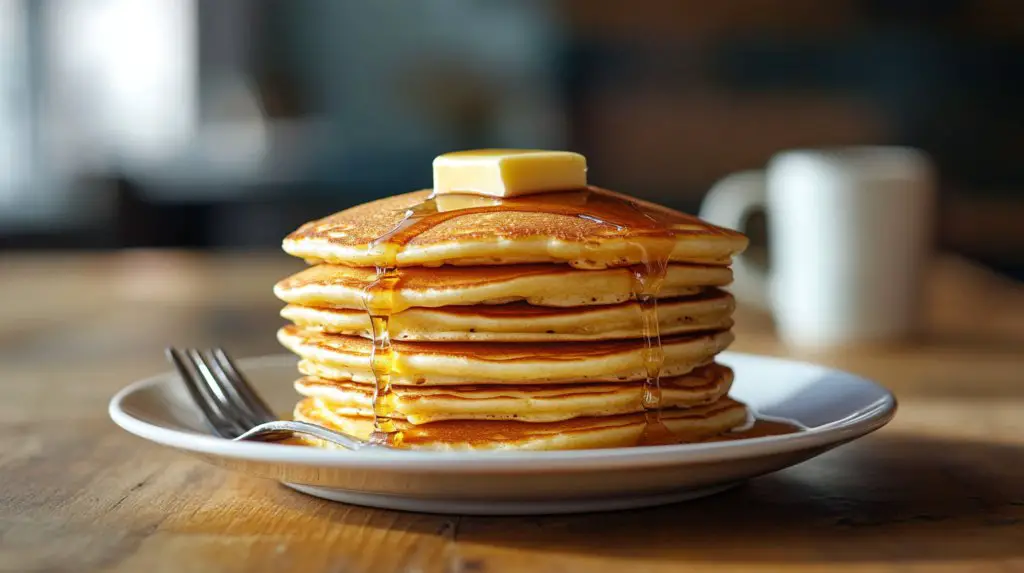
Nobody walks into a diner at seven in the morning because pancakes are difficult. Pancakes are flour, eggs, milk and a hot pan, and most of us have made them in a bathrobe with one eye still closed. Yet the stack that lands on the counter is taller than yours, browner than yours, and soft in a way yours has never quite managed. IHOP has been pulling this off since its first restaurant opened in Toluca Lake, on the edge of Los Angeles, in 1958, and in 2017 the chain put its count at more than 700 million pancakes a year. The gap between that stack and the one on your stove has almost nothing to do with the recipe. It comes down to a thick, properly hot flat top, batter that goes on refrigerator-cold and deliberately lumpy, and buttermilk reacting with baking soda before the plate ever leaves the kitchen.
The Griddle Is Doing Most Of The Work
Home cooks reach for a skillet. Restaurants cook on a flat-top griddle, and the difference shows up in every pancake that comes off it. A griddle gives the batter room, so four or six cakes cook at once without crowding, and the surface stays hot before and after the batter hits it. A skillet loses heat the second cold batter lands, then claws its way back while the first side is already setting.
Commercial plates are steel, sometimes close to an inch thick, built to hold a set temperature across a wide surface. Pancakes sit in the medium zone, roughly 350 to 375 degrees. IHOP sets its griddles at 350 degrees Fahrenheit, and Jon Kotez, the chain’s senior manager of field operations support, has said IHOP splits its flat-tops into stations, two of them just for pancakes, so burgers and onions stay well away from the batter.
You cannot install a commercial flat top next to the toaster, but a $40 electric griddle or your widest cast iron pan gets you most of the way there, which is more than a standard frying pan will ever do. Preheat it for a full 10 to 15 minutes. Flick a few drops of water on the surface: if they skitter and vanish in a couple of seconds, you are close. If they disappear instantly, back the heat off.
Your Batter Should Be Refrigerator Cold
This one runs against instinct, because every baking recipe you have ever read tells you to bring eggs to room temperature. Pancakes are the opposite. Marie Grimm, then IHOP’s vice president of culinary innovation, has said the wet ingredients should be “ice cold”: eggs, milk, butter, oil, water. Warm liquid starts heating the gluten in the flour before the batter ever reaches the griddle, and you lose the springy bounce that makes a diner pancake feel like a diner pancake.
IHOP’s own home tip is to chill the water for pancake mix below 50 degrees Fahrenheit, with ice if it needs help, and the same thinking applies to everything wet. In practice that means buttermilk straight from the fridge, eggs straight from the carton, and melted butter cooled before it goes anywhere near the bowl. Mix, then cook. Do not leave the bowl on the counter while you make coffee and check your phone.
Lumps Are Not A Mistake
Smooth batter is the single most common home-kitchen error. Grimm’s guidance is that “pea-sized” clumps are fine and expected. Whisking until every lump disappears stretches the gluten proteins thin and tight, which leaves no room for air bubbles to expand. It also pops the bubbles the leavening has already made.
Ten strokes with a fork or a rubber spatula is usually enough. The batter should look wrong, shaggy and uneven, with dry patches of flour still visible at the edges. Those will hydrate while the batter rests. Weigh your flour instead of scooping it, too, because a heavy-handed cup measure is how a tender pancake turns into a hockey puck before you have done anything else wrong.
Buttermilk, And Two Leaveners
Aurele Berdoz, director of food and beverage for Café Maud, which has two locations in New York City, puts the flavor squarely on one ingredient. “Using buttermilk is essential to get that signature flavor and fluffy pancake, as it creates a chemical reaction with the baking soda,” he says. IHOP says real buttermilk is a key ingredient in its classic pancakes, and former Denny’s workers posting online describe a line setup where the dry mix gets combined with liquid eggs, cold water and buttermilk.
Baking soda alone does nothing without acid, which is what the buttermilk supplies, and the carbon dioxide it throws off is the lift. Baking powder works twice, once when it gets wet and again when it hits heat. Using both covers you on either end. Check the date on your baking powder while you are at it, because an old can is a standard reason for flat pancakes, and that one is free to fix.
Whip The Whites, Fold Them In
Berdoz adds a second step most people skip at home: “whipping the egg whites into stiff peaks and folding them into the batter mixture adds air pockets that create a soft and lifted pancake.” It takes three extra minutes with a hand mixer and one extra bowl, and it is the difference between a pancake that is merely fine and one that visibly stands up on the plate.
Fold, do not stir. Cut down through the middle with a spatula, scrape along the bottom, turn the bowl a quarter and repeat until the white streaks are mostly gone. A few streaks left behind are better than a deflated batter. The same whipped-white technique, taken to its extreme with ring molds and steam, is what produces those towering Japanese soufflé pancakes.
Let The Batter Sit
Berdoz says resting “allows the gluten to relax, making the pancake have a tender texture,” and puts the window between 10 and 30 minutes. With buttermilk and baking soda in the mix, lean toward the longer end, since the two keep producing carbon dioxide while they sit.
One exception worth knowing: if you are using a single-acting baking powder, skip the rest entirely and cook right away, or the lift will be gone by the time the batter hits the griddle. Most supermarket baking powder in the U.S. is double-acting, but read the can.
Keep The Butter Off The Griddle
Butter smokes sooner than shortening or most cooking oils, starting at around 300 to 350 degrees, which is exactly where a pancake griddle lives. Melt it in the pan and it browns, then burns, then leaves that scorched taste on the bottom of the first batch.
Grimm’s advice is to keep butter and oil off the pan altogether. Where a little help is needed, she recommends rubbing a small amount of Crisco on a cold pan with a paper towel, because butter produces “that webbed, lacy look, instead of a uniformly golden brown” surface. A thin film is all you want. If you can see fat pooling, wipe it back out. Butter belongs on top of the finished stack, melting into the syrup, not underneath it.
Flip Once, Then Get Them To The Table
Grimm says to watch for two signs rather than a timer: bubbles just beginning to form, and the edges starting “to round out, forming an edge or lip.” IHOP chef Scott Randolph flips his after about two minutes, so on a 350-degree surface plan on two to three minutes for the first side and a bit less on the second. One flip only, and never press down with the spatula.
The last restaurant advantage is simple logistics. Diners cook pancakes to order and plate them straight off the griddle, because a pancake that sits turns chewy fast and nothing brings it back. A home cook working two at a time in a skillet is guaranteed to serve somebody a cold one. Cook four at once on a wide surface, and call everyone to the table before you pour the batter, not after.
The Recipe That Puts It All Together
Every technique above lives in this one stack: cold buttermilk batter, two leaveners, whipped whites folded in, a 20-minute rest, a 350-degree griddle wiped with shortening, and butter saved for the table. It is not a secret formula. It is the same handful of moves a line cook makes all shift long, done once, carefully, in your kitchen on a Saturday.
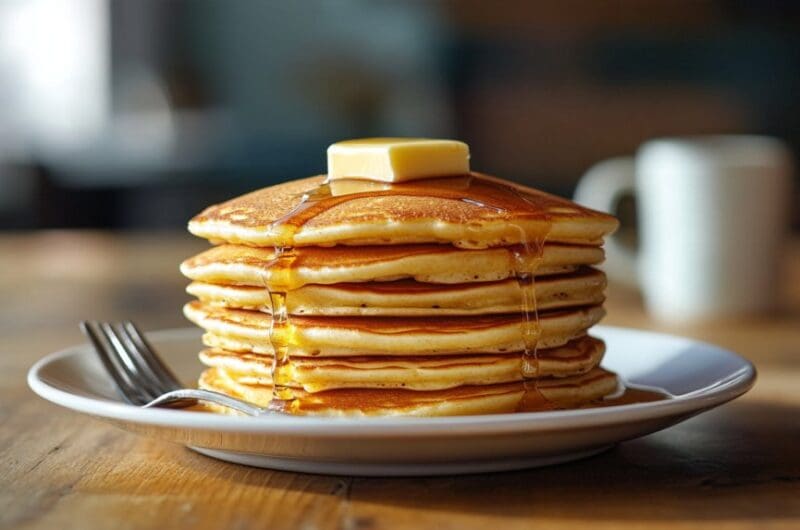
Diner-Style Buttermilk Pancakes
Course: BreakfastCuisine: American4
servings35
minutes20
minutes430
kcalThe cold-batter, hot-griddle method that finally makes home pancakes stand as tall as the ones at the counter.
Ingredients
2 cups all-purpose flour (about 9 ounces if you weigh it)
2 tablespoons granulated sugar
2 teaspoons baking powder, plus 1/2 teaspoon baking soda
1 teaspoon kosher salt
2 cups cold buttermilk, straight from the refrigerator
2 large cold eggs, separated
3 tablespoons unsalted butter, melted and cooled, or 3 tablespoons neutral oil
1 teaspoon vanilla extract (optional)
Shortening for the griddle, plus butter and warm maple syrup to serve
Directions
- Whisk the flour, sugar, baking powder, baking soda and salt together in a large bowl until evenly combined. Weigh the flour if you own a scale, since a packed cup measure is the fastest way to a heavy pancake. Set the bowl aside.
- Separate the cold eggs, dropping the yolks into a second bowl and the whites into a clean, dry third bowl. Whisk the yolks with the cold buttermilk, the cooled melted butter and the vanilla if you are using it. Keep this mixture in the refrigerator until the moment you need it.
- Pour the cold wet mixture into the dry ingredients and stir with about ten strokes of a rubber spatula. Stop while the batter still looks shaggy, with pea-sized lumps and a few dry patches at the edges. Those lumps are what keep the finished pancake tender.
- Beat the egg whites with a hand mixer until they hold stiff peaks. Add about a third of the whites to the batter and fold gently to loosen it, then fold in the rest in two more additions. Cut down, scrape the bottom, turn the bowl, and stop as soon as the big white streaks disappear.
- Let the batter rest for 20 minutes while you heat the griddle. The flour finishes absorbing the buttermilk and the gluten relaxes, which is what gives you a soft crumb instead of a chewy one. Do not stir it again after resting.
- Rub a thin film of shortening over the cold griddle or skillet with a paper towel, then set it to 350 degrees Fahrenheit and preheat for 10 to 15 minutes. Test it by flicking on a few drops of water: they should skitter and evaporate in a couple of seconds. If they vanish on contact, turn the heat down and wait.
- Scoop a generous 1/3 cup of batter per pancake onto the hot surface, leaving at least two inches between them so they cook evenly and stay round. Cook for 2 to 3 minutes, until bubbles are just starting to form on top and the edges round out into a visible lip. Flip once, and never press down with the spatula.
- Give the second side 1 to 2 minutes, until the pancake is golden and springs back when touched lightly. Move it straight from the griddle to a warm plate and serve immediately, since pancakes turn chewy the longer they sit. Top with cold butter and warm maple syrup at the table.
Notes
- If your baking powder is single-acting, skip the 20-minute rest and cook the batter right away, or the pancakes will come out flat.
- Keep every wet ingredient under 50 degrees Fahrenheit and as close to refrigerator temperature as you can manage. Cold batter meeting a hot surface is the whole point.
- Swap 1/4 cup of the buttermilk for half-and-half if you want richer, browner edges on the finished pancakes.
Frequently Asked Questions
Q: Can I use regular milk instead of buttermilk?
A: You can, but you will lose the tang and some of the lift, because the baking soda needs an acid to react with. Stir a spoonful of white vinegar into cold milk and let it sit a few minutes before using it, and keep the baking powder in the recipe either way.
Q: What temperature should my griddle be?
A: IHOP sets its griddles at 350 degrees Fahrenheit, and commercial charts put pancakes in a band of roughly 350 to 375. If you have no dial, use medium to medium-low heat and the water drop test instead of guessing.
Q: Why do my pancakes keep coming out flat?
A: Usually overmixing, which pops the air bubbles and tightens the gluten, or baking powder that has been open too long. Warm batter and a pan that was not fully preheated are the next two suspects.
Q: Do I really have to whip the egg whites?
A: No, and the pancakes will still be good without it. But folding stiff whites into the batter adds the air pockets that give you that lifted diner stack, and it costs you three minutes and one extra bowl.

