
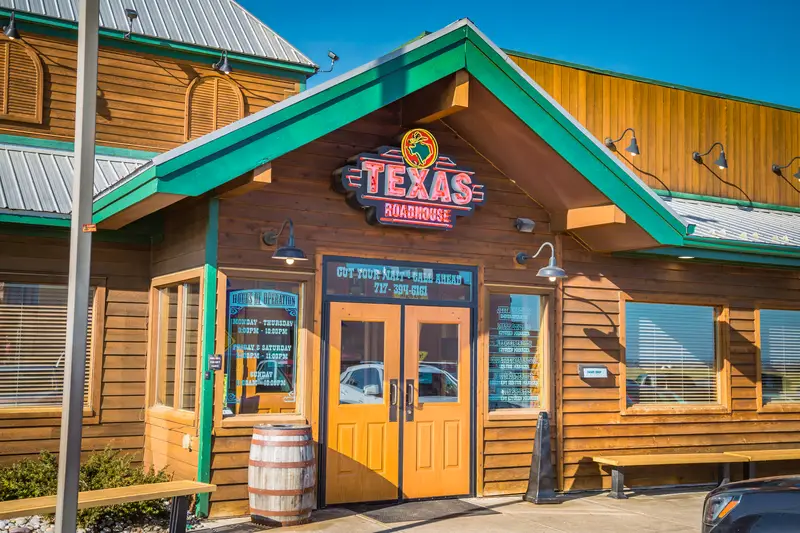
In a menu check in October 2024, a 6-ounce sirloin at the Texas Roadhouse in Parlin, New Jersey, cost $14.49. The same steak at the nearest LongHorn ran $1.80 more. At the closest Outback, it was $3.30 more. Chili’s in East Brunswick charged $16.99 for its 6-ounce sirloin, and Applebee’s over in Edison asked $19.99, which meant the steakhouse was undercutting the places that aren’t even steakhouses. The beef is not cheaper beef. Texas Roadhouse serves the same USDA Choice grade its big rivals serve. The price gap comes from the way the Louisville, Kentucky, company runs the building, the cooler, the clock and the check.
Same Grade of Beef, Smaller Number on the Menu
Every steak on the menu is USDA Choice, the grade that sits below the better-marbled Prime and costs far less per pound without giving up much on the plate. The grade rests mainly on marbling, with the animal’s age factored in. Breed, diet, how the meat is trimmed and how it’s cooked all move the needle too, and none of them show up in the letter grade.
The competition knows this. Outback also uses Choice. At an Austin, Texas, Texas Roadhouse, a New York Strip is $23.99, while the same steak at a nearby Outback is $26.49, more than 10% higher. At a Columbus, Ohio, Roadhouse the strip costs a dollar more than Austin’s, and it still comes in under the Columbus Outback.
The Founder Priced It This Way on Purpose
Late founder Kent Taylor laid the whole thing out in his 2021 memoir, “Made From Scratch.” “I wanted to have the same quality of beef that Outback and LongHorn featured at the time, but with price points more similar to Chili’s and Applebee’s,” he wrote. The first restaurant opened in 1993 in Indiana.
Three decades later the chain has blown past that target. It isn’t just matching Chili’s and Applebee’s on steak, it was beating them by two and five dollars on the sirloin in that 2024 check. Prices do creep. The chain has raised menu prices five times since the fall of 2024, most recently by 1% at the start of the fourth quarter of 2026. Announcing it in August 2026, CEO Jerry Morgan said that level of pricing strikes an appropriate balance while keeping the chain’s everyday value.
Beef Contracts That Run Two Years Long
Beef makes up roughly half of the chain’s food costs, which makes the buying strategy the single biggest lever on the menu price. A 2015 analysis on a Harvard Business School course blog found Texas Roadhouse signing 24-month beef contracts, while Logan’s Roadhouse signed for six to 12 months and stayed closer to market rate.
That’s a bet, and it costs money up front. Lock in for two years and there will be stretches where you’re paying above what the open market would charge you that week. The payoff lands when cattle prices spike and your cost doesn’t move. On the Oct. 24, 2024, earnings call, then-CFO Chris Monroe said the year had been a surprise in that the company didn’t see the beef-driven inflation it had expected.
There’s a Butcher in Every Single Store
Most casual chains buy steaks already portioned and vacuum-sealed. Texas Roadhouse buys uncut sides of beef, which are cheaper per pound, and cuts them in-house at every location in coolers held at 34 degrees Fahrenheit.
Cutting to order also means the kitchen isn’t stuck with whatever portions a supplier shipped. Trimming and cutting are skills, and a trained cutter gets a cleaner, more consistent steak than a machine-portioned, pre-packaged one. The chain saves on supplier markup and gets a better-textured steak out of the same grade of beef. That’s rare: a cost cut that improves the product instead of thinning it.
No Weekday Lunch, No Downtown Rent
Try getting a steak at Texas Roadhouse at noon on a Tuesday. The doors generally don’t open until 3 or 4 p.m. on weekdays, with weekend lunch service and Friday openings at some locations. Outback and LongHorn are usually open for lunch all week.
Skipping lunch saves on labor and utilities, but the bigger savings is where the restaurant gets built. The chain says the dinner-only model “reduces our real estate costs since we do not have to be located in high-traffic business districts.” Office-district rent is some of the most expensive square footage in any American city, and Texas Roadhouse simply doesn’t compete for it. The founder’s other reason, according to the company, was keeping the best staff rested and focused on the dinner rush instead of spreading them across a lunch shift nobody shows up for.
The Menu Almost Never Changes
Outback rolls out limited-time menus. Chili’s and Applebee’s chase whatever is trending. Texas Roadhouse mostly doesn’t. The steaks on the menu years ago are the steaks listed now, with the only visible change being the price. Asked back in 2018 about the chain’s most recent menu addition, a company spokesperson pointed to a steakhouse filet salad and said that had been four or five years earlier.
Every new item costs money nobody sees on the menu: recipe testing, new inventory, kitchen retraining across hundreds of stores, and the advertising to tell people it exists. The chain skips nearly all of it and largely avoids national advertising, leaning on repeat customers instead. The peanut shells and plywood-and-neon look aren’t an accident either. Fancy build-outs and china cost money that gets charged back to the diner.
Barbell Pricing Is the Whole Trick
The industry term is barbell pricing: stock the menu with very cheap items and genuinely expensive ones at the same time, and let customers sort themselves. Budget tables order the sirloin and a couple of sides, which run roughly $3.49 to $4.98. Bigger spenders order the ribeye and a round of drinks. That same 2015 Harvard Business School course post found Texas Roadhouse already working this way, noting that it “allows them to drive traffic with inexpensive bar food and to somewhat mitigate inflation in higher grade protein offerings.”
Menu prices also shift by market. In wealthier areas, the chain charges a little more, which is common enough in restaurants but not universal among its direct rivals. That’s how a cheap sirloin stays cheap in a small town without the company losing money in an expensive one.
The $14.49 Steak Is Bait, and the Add-Ons Are the Catch
On the 2024 menu, mushrooms and onions on top: $2.29. A slice of Jack cheese or blue cheese crumbles: another 50 to 79 cents. Grilled shrimp: $3.99. Order the cheapest steak on the menu with a few of those and you’ve quietly cleared $20 on a hunk of beef that started under $15.
Servers, called Roadies, are pushed hard on this. Servers posting online describe a system where managers run upsell numbers on every server and have conversations with the ones falling behind, and the pressure around toppings comes up specifically. Appetizers, loaded sides and the bar carry much fatter margins than the steak does. The low steak price gets the family in the door; the check that leaves the table is a different number than the one on the menu board.
Volume Covers the Rest
Back in 2022, with close to 600 locations serving around 5,000 guests a week each, the chain was putting out roughly 300,000 meals a day. The company now runs more than 830 restaurants across its brands. Revenue reached $5.9 billion in 2025, and comparable restaurant sales rose 6.2% in the second quarter of 2026, at a time when plenty of chains were losing customers outright.
Thin margins on a steak stop mattering when you’re selling that many of them. The managers have skin in it too: a managing partner puts down a $25,000 deposit and signs a five-year contract in exchange for 10% of the store’s profits, and many have earned between $100,000 and $200,000 over time. About 70% of guests are repeat customers.
So Is It Actually a Bargain?
Yes, if you order like you mean it. The sirloin is the cheapest steak and the best-selling item on the menu, it’s hand-cut in the building that morning, and it’s the same grade of beef the chain down the road is charging three dollars more for. In the same 2024 check, the 6-ounce filet at $23.49 beat LongHorn by $2.30 and Outback by $4.50, so the gap actually widened on the tender cuts.
The cheap steak is a real cheap steak. It’s also the front door of a business designed to sell you mushrooms, a loaded potato and a second margarita on the way through. Order the steak, skip the toppers, eat the free rolls, and the math stays in your favor.

