

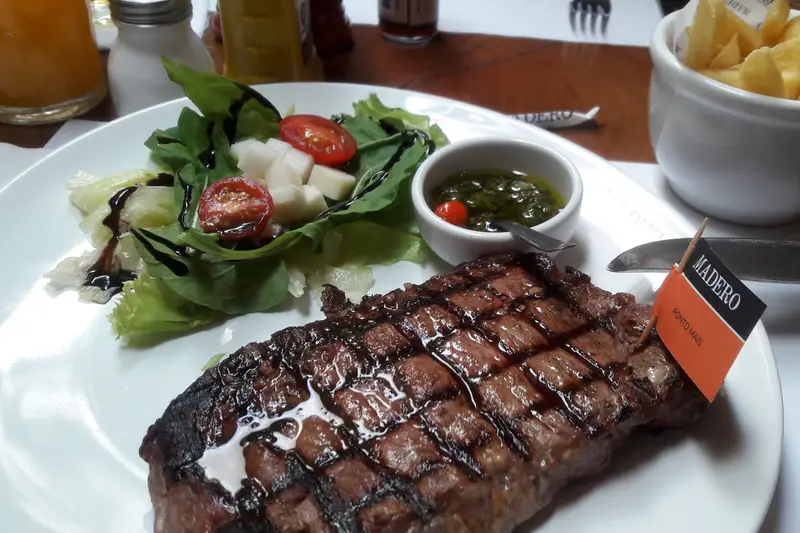
Your steak lands in front of you with a dark crust on it, resting in its own juices, and it cost $60 or more before you added a side. You look up at the server and ask if they have any A1.
That’s the one. Asking for bottled steak sauce, especially before you’ve taken a bite, is the fastest way to embarrass yourself at a steakhouse, and at a serious one you probably won’t be offered A1 in the first place. Bottled sauce is built to be loud. It will flatten the flavor of beef that somebody aged for weeks and then cooked on a broiler hotter than anything in your kitchen. Ketchup is worse.
The House Sauce Is Usually The Better Order
Good steakhouses make their own sauces, and they’re made to go with that specific beef: creamy béarnaise, tangy garlic butter, peppercorn sauces with real heat, vinegary chimichurri loaded with herbs. Scott Weiner of Fifty/50 Group, a partner in The Alston in Chicago, says a steakhouse’s house sauces can be the “crown jewel of the menu.” His advice when the plate hits the table is to slow down: “We encourage guests to taste the steak on its own first to appreciate its quality.”
So order the cut, tell the server the doneness, then ask what sauce they’d put next to it. You’ll get a better answer than the one in the bottle, and you’ll have tried the steak the way the kitchen intended before you change it.
Well-Done Isn’t The Crime People Think It Is
There’s a pecking order people imagine at steakhouses, where rare makes you serious and anything past medium makes you a rube. Andrew Hunter, executive chef for Niman Ranch, sees the opposite problem. “The most common mistake is ordering a rare steak because you think it’s how you should order. If you like your steak medium, then order it medium,” he says. He remembers a friend who “ordered his filet burned,” and the server brought out a juicy well-done steak with a hard sear on it, no commentary required.
Where it goes wrong is pairing, and Tasting Table’s rule of thumb is a good place to start. Lean cuts like top sirloin handle rare well. A marbled ribeye is at its best around medium-rare, because that’s when the fat is doing its job instead of running onto the plate. A thick porterhouse takes medium. If you want it medium-well, a New York strip is the cut to do it with. Order well-done and a good server may steer you to a different cut, and some restaurants won’t guarantee the quality of a well-done steak at all.
The Word That Marks You As A Fussy Customer
“Plus” crept into steak ordering at some point, and it needs to go back out. People ask for medium-rare-plus or medium-plus thinking they’re dialing in something precise. The gap between doneness levels is tiny to begin with, hitting them consistently is a skill, and the kitchen can only guess what your “plus” means. Stick to the standard words.
The other thing not to say is some version of “can you rush it?” Steak needs time around the cooking, not just during it, and rushing it ruins the thing you’re paying for. If you’ve got a 7:45 curtain, eat somewhere else.
Cutting The Whole Steak Up Before Your First Bite
Sawing the entire thing into cubes the second it arrives is a kid’s move, and it costs you. The steak cools fast once it’s in pieces, and the juice you paid for ends up pooled on the plate instead of in the meat. Cut one bite, eat it, then cut the next one.
While you’re at it, look at the surface of the steak before the knife goes in. Those faint lines running one direction are the muscle fibers. Cutting against the grain, with your knife perpendicular to those lines, shortens the fibers and makes every bite more tender. Cut the other way and you’re chewing long strands of muscle. Thin, even slices beat thick ones, and this matters most on cuts that worked hard for a living.
The 32-Ounce Ribeye Is A Trap
Big steaks look like a celebration and eat like a chore. Hunter’s question for the table is blunt: “They order the biggest steak possible. Who can eat a 32-ounce bone-in ribeye?” His fix is to split one and spend the rest of the budget on everything around it. “My advice is [to] order one steak per two people and ask for it to be rested for ten minutes and sliced. Then order a bunch of starters and sides to be served with the steak.”
Ken Hoffman, chief operating officer of Dividend Restaurant Group, which runs Sullivan’s Steakhouse and Eddie Merlot’s, lands in the same place: “Often, a well-chosen steak with one or two shared sides is the most satisfying way to dine.” The sides are not filler at a real steakhouse, either. Creamed spinach, bone marrow, Brussels sprouts with bacon, lobster mashed potatoes. Order several for the table instead of one each and nobody goes home with a doggy bag full of regret.
You’re Probably Not Eating Prime
Here’s where a lot of money gets wasted. “Many people assume steakhouses serve prime beef,” Hunter says, when plenty of them are serving USDA Choice, even when the menu language suggests otherwise. He tells diners to check before they go, because “the good ones will talk about their beef program and the standards they apply to purchasing.” A restaurant proud of its sourcing will not make you dig for it.
Price and reputation are weaker signals than people think. As Hoffman puts it, “marbling and how a steak eats have a far greater impact on the overall experience than size or reputation alone.” Lucas Dudley, vice president of franchise operations at Steak & Ale, says the lesson of a brand founded in 1966 is that “value isn’t about the biggest steak,” it’s about picking the cut that delivers.
Skipping The Butcher’s Cuts
Hanger, flat iron, bavette. Steakhouses often run these as a butcher’s special, they cost less than the marquee cuts, and they taste more like beef than anything on the filet side of the menu. Chefs will tell you filet mignon is overrated for exactly that reason: it’s tender, it’s lean, and lean means mild.
If tenderness is what you’re actually after, that’s a real preference and nobody’s judging it. Luis Haro, senior director of culinary operations at Logan’s Roadhouse, says the question to ask is about tenderness and fat, not prestige. “Some guests don’t like heartier steaks like sirloins and would probably be better off ordering a filet. A quick question can really help guide you,” he says. Haro also points out that people complain about a ribeye having too much fat, which is like complaining that a lemon is sour.
Walking In Wearing A Tank Top
Most steakhouses have a dress code, usually semi-formal, and finding out at the host stand is a bad start to an expensive night. Check the website or call. Tank tops, T-shirts and sneakers are not going to clear the bar. Slacks and a dress shirt work for men, a blazer if you feel like it. A nice dress, or a blouse with dressy trousers, works for women. If you want jeans and a collarless shirt, go to a chain and enjoy yourself.
The table has its own small rules, and they’re easier than people fear. Napkin on your lap when you sit. Utensils are set in the order you’ll use them, so work from the outside in and you’ll never grab wrong. And do not pick up the bone and gnaw on it. Ask for a box.
Salting It Before You’ve Tasted It
Restaurant cooks season at several points, at the start, during, and at the finish, so the steak reaching your table has already been salted more than once. Shaking more on before the first bite dulls your read on the meat and tells the room you assumed the kitchen forgot.
Two more, if someone else is picking up the check. Don’t order the most expensive steak on the menu, even when the host waves you toward it, because it reads as greedy no matter how graciously it’s offered. And tip properly. A steakhouse server is tracking doneness, cuts, sides and wine for a table that’ll sit for two hours; the person who drops a flat five on a $200 check becomes a story the staff tells for years.
So What Actually Gets You Treated Well
Talk to the server. Hoffman calls a great steakhouse meal collaborative, and says the real failure is not communicating what you want: “Waiting too long to speak up or not asking questions can impact the experience.” Hunter does it himself at other people’s restaurants. “I always ask the server if I’ve ordered enough or too much,” he says. “They almost always give an honest answer.”
The embarrassing mistake was never ordering your steak wrong. It’s acting like the kitchen is in your way. Put the phone down, taste the beef before you touch it with anything, ask one honest question about the cuts, and you’ll eat better than the guy at the next table with the 32-ounce ribeye and the bottle of A1.

