

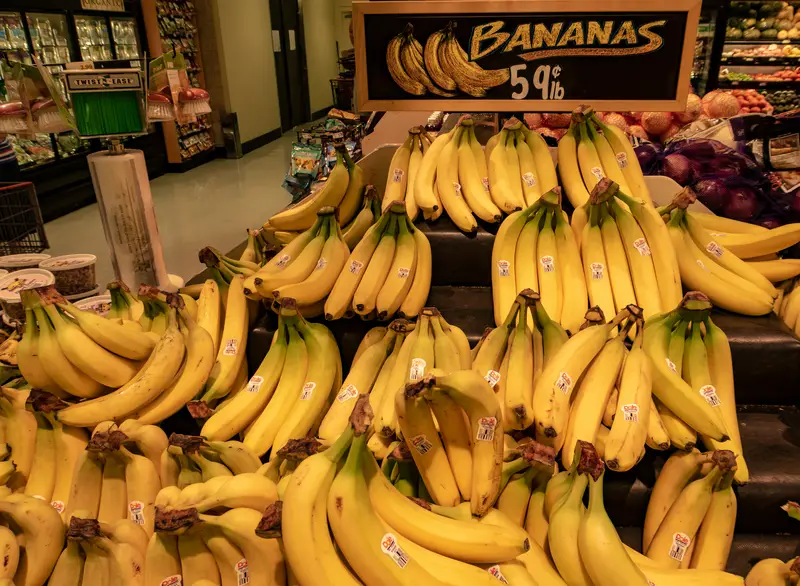
Cut a banana into a bowl of cereal, step away to answer the door, and the slices have already gone gray at the edges. That discoloration starts within minutes of cutting, and it is the work of a single enzyme called polyphenol oxidase. A biotech company in Norwich, England found the gene that makes that enzyme and switched it off. Two new banana varieties came out of the company’s labs, both launched commercially in 2025, and they are the first new commercial bananas in more than 75 years. The company says shoppers can expect new formats from 2026.
One Gene Off, And The Brown Stops
Tropic used CRISPR to disable the gene that encodes polyphenol oxidase, the enzyme that oxidizes phenolic compounds in the fruit and turns the flesh brown. Nothing else about the banana changed. The company says the taste, smell and sweetness profile are the same as any Cavendish you have ever eaten.
What that opens up is the cut fruit aisle. Bananas are cheap and people like them, but they have been mostly locked out of fruit salads and prepared fruit cups because they look wrecked long before anyone buys the container. In the company’s own words, the variety “stays fresh, yellow, and appetising long after peeling and slicing, dramatically reducing spoilage across retail, food service, and supply chains.” That is a new market, not a new flavor.
$105 Million And A Supply Problem
In March 2026, Tropic raised $105 million in an oversubscribed Series C co-led by Forbion, through its Bioeconomy Fund, and Corteva, through its Corteva Catalyst platform. Just Climate and IQ Capital joined in, along with new investors ABN Amro and Invest International, and existing backers including Temasek, Five Seasons Ventures, Aliment Capital, Sucden Ventures, Genoa Ventures and Polaris Partners.
Before that round, the company had raised roughly $73.5 million in total: a $10 million Series A in 2018, a $28.5 million Series B in 2020 led by Temasek, and a $35 million round in 2022 led by Blue Horizon.
CEO Gilad Gershon said the money is there because the bananas already sold out faster than the company could grow them. “2025 proved that our technology delivers, not in the distant future, but right now,” he said. “With two banana varieties already on the market and demand outstripping supply, this investment enables us to scale global production and expand into new crops faster than ever before.” The first job for the cash is plant production capacity, which is the boring part and also the part that decides whether any of this reaches a store near you.
The Other New Banana Is About Shipping
The second variety does not touch browning at all. It targets the genes responsible for producing ethylene, the plant hormone that kicks off ripening by breaking starch into sugar, softening cell walls and breaking down chlorophyll so the peel turns from green to yellow. Switch that down and the fruit stays green longer.
Tropic says the variety adds up to 12 days of green life and cuts transportation waste by up to 50%. Gershon described the practical version as buying companies “at least 10 extra days, which is huge for the banana industry,” and added flatly that demand already exceeds supply.
A week and a half of extra green life changes the math on a banana boat. Growers can harvest later, ship slower, spend less on refrigeration and packaging, and reach markets that were previously too far away to bother with. Ripening is not stopped, just delayed until somebody wants it. For a fruit that has spent a century being rushed across oceans in chilled containers, that is a bigger deal than the color of a cut slice.
Where These Bananas Are Cleared To Sell
Regulatory clearance came first in the Philippines, Colombia, Honduras, the United States and Canada. Japan and Brazil followed. By April 2026 the company said it held regulatory determinations, notifications or exemptions for its banana products in eleven countries, covering more than 70% of the production market and more than 30% of the consumption market.
Gershon called the Japan and Brazil decisions a sign of growing international confidence in new agricultural technology built for modern supply chains. The United Kingdom is not among the countries it has named, which is a strange footnote for a banana invented in Norfolk.
It Is Not A GMO, By The Rules That Count Here
No foreign DNA goes into these bananas. CRISPR is used to make precise changes to genes the plant already has, which is why the company says it counts as non-GMO in the United States and Canada, and why the Philippines declared it non-GMO in 2023.
Americans have already met a fruit that skips the browning. Arctic apples have been sold in the US since 2017, though they are an older kind of GMO, made by inserting genes rather than editing the plant’s own. The European Union adopted new rules for gene-edited crops in June 2026, but they only apply from around 2028, and until then these bananas face stricter rules.
The Fungus Behind All Of This
Panama Disease Tropical Race 4, the fusarium wilt strain known as TR4, has now been confirmed in more than 20 countries. It moves through soil and water, and there is no cure. The Cavendish accounts for over 90% of the banana export market, which means one variety, one fungus, and no backup plan.
TR4 was first detected in Southeast Asia and has spread through Asia Pacific, Africa and South America, reaching growers in Colombia, Peru, Venezuela and Ecuador, one of the largest banana producers on earth. Fresh Del Monte CEO Mohammad Abu-Ghazaleh raised it on the company’s October 2025 earnings call: “People really don’t understand how serious this issue is. There will come a time that people realize that there are not enough bananas… and prices will shoot up in a way that will be a shock to the market.”
Tropic shipped plants in 2025 to establish a mother plantation, the first stage of production at commercial scale, with deployment of TR4-resistant Cavendish varieties targeted for 2027.
Teaching The Plant To Attack The Fungus
The disease work uses a different tool than the non-browning banana. The company’s patented approach, Gene Editing Induced Gene Silencing, edits non-coding genes rather than knocking out coding ones. Gershon explained the problem with the blunt version: to make a banana resist a fungal disease by disabling a coding gene, you might have to sort through more than 30,000 genes to find the right one, and you might create new problems on the way.
Instead, the plant’s own RNA interference machinery gets pointed at the invader. “In the case of TR4, we’re redirecting a banana non-coding RNA to attack a gene within the fusarium strain causing the disease,” Gershon said. It also allows for dialing a gene down rather than shutting it off, and for limiting changes to the root, stem or fruit.
Next in line is Black Sigatoka, another fungal disease that growers fight with round after round of fungicide spraying. The same technology has been licensed out to Corteva for disease resistance in corn and soybean, to British Sugar for sugar beet, and to animal genetics company Genus.
Why The Banana Never Changed Before
The Cavendish is already a survivor of one collapse. It took over in the 1950s because its predecessor gave out, and the industry has spent the 70 years since selling one genetically identical fruit worldwide. There is no third variety waiting backstage.
Bananas and plantains grow in over 140 countries, with around 153 million tons produced globally each year, feeding about 400 million people. Researchers at the International Institute of Tropical Agriculture in Nairobi, Kenya have used gene editing to build resistance to banana Xanthomonas wilt and banana streak virus, and to develop semi-dwarf plants and fruit with more beta-carotene. The non-browning trait shows up in that same scientific literature as a food waste fix.
What It Is Actually Worth
In Britain, research by the waste charity WRAP and Sainsbury’s found households throw away 1.4 million edible bananas every day. Browning is a big part of why a perfectly fine piece of fruit goes in the trash.
My read: the non-browning banana is real, it is on the market, and the people who will notice it first are grocery buyers stocking cut fruit cups and restaurant kitchens that prep in the morning for the whole day. At home, you are getting a banana that tolerates being sliced ahead of time. Useful, not life-changing.
The trait that matters is the one still in development. Fixing the browning proved the technology works and got regulators comfortable with it in eleven countries. Whether bananas stay a 60-cent-a-pound staple depends on the TR4-resistant Cavendish scheduled for 2027, and that is a much harder job than turning off one enzyme.

