

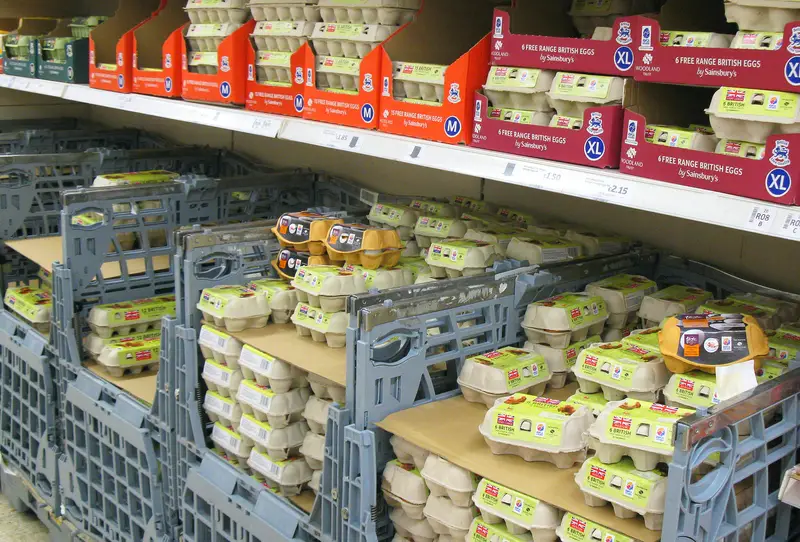
The FDA has a grading system for recalls, and Class I is the ceiling. The agency only reaches for it when it believes there is a reasonable probability that eating or using a product could cause serious harm or even death. That label is heavy, and it does not get thrown around. On August 12, 2026, a recall of more than 19 million eggs got exactly that classification, which turns a quiet voluntary recall from July into one of the biggest food safety actions of the year.
If you buy eggs at Kroger or a regional grocery chain, this one deserves two minutes of your attention. Not because your carton is definitely part of it, but because a store name and a shell color tell you nothing. The details are hiding in tiny code printed on the side of the box, and most people never look there.
The FDA Gave This Its Worst Rating
Here is what changed. The eggs were pulled back in July as a normal recall. Then the FDA reviewed the situation and pushed it to Class I, the highest risk tier it has. The reason is Salmonella Enteritidis, a strain that can spread from a bad egg to your countertop, your hands, and whatever else you touch in the kitchen.
The outbreak tied to these eggs has made 98 people sick across 17 states, and 26 of them ended up in the hospital. So far, no deaths have been reported. The Class I stamp is about what could happen, not what has, and that is the part worth understanding. The FDA is signaling that the potential is serious enough to act on hard.
Nineteen Million Eggs From One Company
The company behind the recall is Midwest Poultry Services, L.P., based in Indiana. On July 22, 2026, it voluntarily pulled 1,589,577 dozen eggs off the market. Do the math and that lands north of 19 million individual eggs, split between white shell eggs and brown cage-free shell eggs.
All of them came from two farms in Texas, produced and shipped out between June 6 and July 3, 2026. The sell-by or best-by dates run from July 20 through August 17, 2026. They were packed in every size you can think of, sold in cartons of 6, 12, 18, 24, 30, 36, and even 60 eggs, so both regular shoppers and bulk buyers could have grabbed them.
To the company’s credit, it caught the problem itself. Routine environmental testing on the two Texas farms flagged the contamination before a wave of consumer complaints rolled in. A third-party lab confirmed that some samples matched the outbreak strain, those results went to the FDA on July 21, and the recall started the next day. Midwest Poultry says it stopped distributing fresh eggs from those Texas farms.
Your Carton Won’t Say Recall, So Check These Codes
This is where people trip up. There is no giant red warning on the box. Instead, everything comes down to a code printed in date-coding ink on the left or right side of the carton. Grab a carton and look for the plant code, which will read either P-1950 or 0840962. Some of the FDA’s product tables show that second code without the leading zero, as 840962, so do not let that throw you.
Next comes the Julian date. That is the day-of-the-year stamp, and only cartons with a number between 157 and 184 are part of this. Then double check the sell-by or best-by window of July 20 through August 17, 2026. If your carton hits all three, it is included. A matching store or matching shell color by itself does not confirm anything, so read the actual numbers instead of guessing.
Running a restaurant, school kitchen, or catering setup? The advice shifts a little. Check the outer cases and your supplier paperwork rather than hunting for a consumer barcode, since bulk cases carry the P-1950 plant code and the same Julian date window.
The Brands and Stores That Carried Them
These eggs did not sell under one label. They went out under Country Morning, Cal-Maine Sunups, Brookshire’s, Simple Truth, and Kroger brand names. Simple Truth and Kroger are the ones a lot of shoppers will recognize instantly, since they sit on shelves in stores all over the map.
Confirmed distribution landed in six states: Arkansas, Louisiana, Mississippi, New Mexico, Oklahoma, and Texas. The eggs reached Kroger stores in Texas and Louisiana, Brookshire Grocery stores across several of those states, and a handful of smaller retailers and foodservice spots. The FDA also noted the eggs could have traveled beyond those confirmed states, so the footprint may be wider than the official list.
The sickness map stretches further than the sales map, which is normal for an outbreak like this. Cases have popped up in Arizona, California, Colorado, Georgia, Illinois, Louisiana, Michigan, Missouri, Mississippi, North Carolina, New Mexico, Nevada, New York, Oklahoma, South Carolina, Texas, and West Virginia. Texas got hit hardest by a mile, with 73 of the sick, followed by five in Louisiana and four in Arizona.
The Six-Month Detail That Doesn’t Add Up
One piece of this story is genuinely strange, and it is the reason the FDA keeps saying these eggs explain only some of the illnesses instead of all of them. The recalled eggs left those Texas farms starting June 6, 2026. But the first illness in this outbreak began on November 21, 2025. That is more than six months before the earliest recalled egg even existed.
That gap is a big deal. You cannot get sick in November from an egg laid the following June. So investigators are treating the recall as one likely source, not the whole story. The timeline suggests the contamination trail could be broader, and the FDA and CDC have not ruled out other sources. The investigation is still open.
What links all the cases together is genetics. The CDC used whole genome sequencing to show the bacteria from sick people are closely related, which points to a common food source. Of the 44 patients with details on record, 40 of them, or 91 percent, said they ate eggs before getting sick. Illness onset dates run all the way from that November 2025 start through June 30, 2026.
What to Do If a Carton Is Sitting in Your Fridge
Found a match on the codes? Do not try to cook your way around it. The FDA says to either throw the eggs out or return them to the store where you bought them for a full refund. Cooking them longer or hotter is not the answer here, so skip that idea entirely.
Because Salmonella can hitch a ride to other foods and surfaces, clean up after those eggs. Wash and sanitize your refrigerator shelves, any containers, countertops, and utensils that may have touched them. And skip the compost move too. Do not toss recalled eggs into a backyard pile, worm bin, or municipal organics cart without local approval, since the contamination can carry over.
If you have questions about a specific carton, Midwest Poultry Services set up a recall line at 574-405-9531 and an email at recall@mps.farm for business hours. You can also pull up the full product list and the outbreak details straight from the FDA if you want to match every number yourself.
One last thing worth keeping in mind. Officials say the real case count is almost certainly higher than 98, because plenty of people who get sick recover at home and never see a doctor or send in a sample. That does not mean panic. It means the smart move is boring and simple: pull your egg carton out, flip it to the side, and read the code before you crack the next one.

