

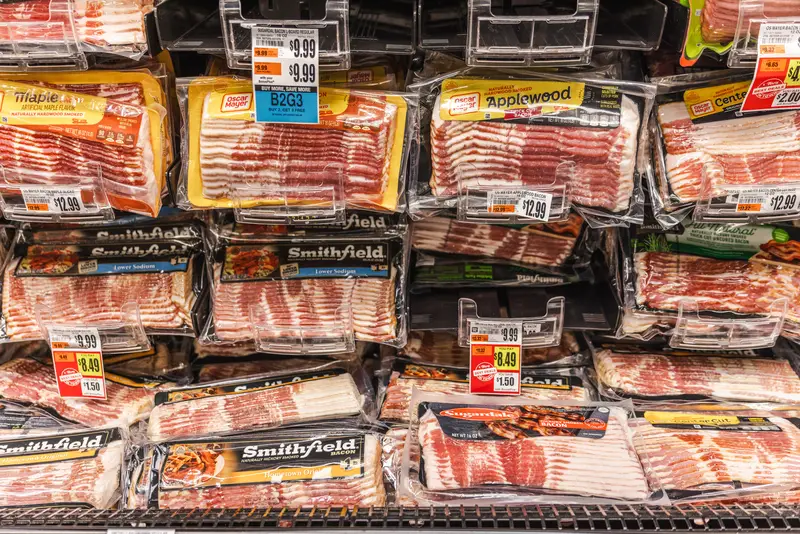
Half a pack of bacon in the fridge is a countdown. The USDA gives raw bacon about seven days in the fridge, and anybody who has peeled back that plastic flap on day nine knows the clock is real: stiff edges, dull color, a package that will not close anymore. Time is not really the enemy here. Air is. Pull the air out, freeze it, and that same bacon holds its quality for about four months.
Vacuum Sealing Buys You Months, Not Days
Taking the oxygen out of the package before it seals does three things at once. Oxidation slows down, so the fat stops going rancid. Mold needs air and does not get any. The bacteria that turn a good pack sour are stalled out. Sealed tight and frozen, bacon holds its quality for the USDA’s 4 months, and the seal is what keeps freezer burn off it.
The pack you bought is already vacuum sealed, which is why it behaves so differently before and after you cut it. An unopened package keeps until its use-by date, and one with only a sell-by date should be used or frozen within 7 days of buying. Tear it open and you are down to about a week.
No sealer in the drawer? A zip-top bag with a drinking straw stuck in the corner gets you most of the way there. Zip it almost shut, suck the air out through the straw, pull the straw and finish the seal. It is not restaurant grade, but it beats folding the flap back over and hoping.
Label whatever you seal with the date. Freeze or refrigerate it right away rather than letting it sit on the counter while you finish cooking, and thaw it overnight in the fridge instead of on the countertop.
Aluminum Foil Beat Six Other Methods
For an opened pack you plan to finish in the next few days, the best thing in your kitchen is a sheet of foil. In a side-by-side test of seven storage methods, bacon laid on foil with the sides folded up into a sealed pouch came out of the fridge looking close to how it went in. It outperformed a zip-top bag, a plastic container, and the viral bacon sleeve hack where you cut the package in half and slide one piece inside the other. The sleeve finished near the bottom.
Moisture is what separates the winners from the losers. Plastic containers let too much of it build up, leaving the bacon sitting in a wet environment. The original packaging does the opposite, drying the strips out until they go discolored and stiff. Glass containers did well. Plastic wrap, wound tight against the meat, did well. Foil did best.
The Numbers the USDA Actually Publishes
Regular bacon gets 7 days in the refrigerator and 4 months in the freezer. Beef bacon gets the same. Poultry bacon gets the same. Pancetta gets the same. Sliced Canadian bacon is the short straw of the group at 3 to 4 days in the fridge and 4 to 8 weeks frozen.
Those freezer numbers are about quality, not spoilage. Food held at 0°F stays safe indefinitely, so a pack that has been in there five months is not dangerous, it is just going to taste tired and feel wrong in the pan.
Two dates on the package mean two different things. A sell-by date means use or freeze the bacon within seven days of buying it. A use-by date is the manufacturer telling you the party is over, and the guidance is to observe it, so do not hang on to bacon past that one.
One Kind of Bacon Gets Three Weeks in the Fridge
Bacon cured without nitrites gets 3 weeks in the fridge and 6 months in the freezer on the USDA’s table. Its label has to read “Not Preserved, Keep Refrigerated Below 40°F At All Times,” and it means it.
Dry-cured bacon is the other long hauler. Dry-cured sliced runs 4 weeks in the fridge and 3 months frozen. Dry-cured slab runs 4 to 6 weeks in the fridge and 3 months frozen. Both have a pantry column too, 10 days for sliced and 3 weeks for slab, but that column is not a blanket permission slip. Only the label on the package you bought can tell you it is shelf stable.
Freeze It in Slices, Not in a Brick
Dumping an opened pack straight into the freezer gives you a solid pink block that you will have to thaw entirely to use two strips of. The fix is a baking sheet. Lay the slices flat on parchment in a single layer, freeze them a couple of hours, then move them to a heavy-duty freezer bag. They stay separate, so you pull two or four or six and leave the rest alone.
If you would rather not run a baking sheet, portion the bacon into stacks of three or four slices, wrap each stack tight in plastic and then in foil, and write the date on it.
How long it holds depends on who you ask. The USDA says 4 months for quality. One producer, Godshall’s, puts an unopened pack at up to eight months in the freezer and an opened one closer to a month. Either way, squeeze every bit of air out of the bag before you seal it, because air is what burns frozen bacon.
Cooked Bacon Runs on a Different Clock
Already-cooked strips get 4 to 5 days in the refrigerator and about a month in the freezer. Let them cool on a rack so the grease drains, then put them in an airtight container or a zip-top bag. Do not crumple the original package shut around them and call it storage.
Batch-cooking on Sunday is the move if you eat bacon on sandwiches and salads during the week. Freeze cooked strips the same way as raw: single layer on a sheet, then into a bag once they are solid. An air fryer brings them back crisp in a few minutes. The oven works at 350 degrees Fahrenheit for 5 to 10 minutes, and the microwave works if you sandwich the strips between paper towels.
The Grease Lasts Longer Than Any of It
Pour the fat into a jar and it keeps in the fridge for up to six months, or up to nine months in the freezer. Estimates for fridge life range from about a month to that six-month figure, and straining it helps. Run it through a fine sieve or a coffee filter first. The browned bits sitting at the bottom of the jar are what turns it.
Use it for eggs, for frying potatoes, for greasing a cornbread skillet. A jar of strained fat is the most useful thing a pack of bacon leaves behind.
Where You Put It in the Fridge Matters
The door is the worst spot in the appliance. Every time somebody opens it looking for the orange juice, the temperature in there swings. Bacon belongs in the meat drawer or at the back of the bottom shelf, where it stays coldest and steadiest. Your fridge should be running at or below 40°F.
Write the date you opened the pack on it with a marker. Nobody remembers whether it was Tuesday or the Tuesday before, and that uncertainty is what sends good bacon into the trash.
When to Give Up on a Pack
Good bacon is pink with white streaks of fat, firm, slightly moist. Gray, green or brown means it is done. A slimy or sticky surface means it is done, and that slick is not water. A sour or sulfurous smell means it is done, though a smoky or spiced smell is just the cure doing its job.
Visible mold ends the conversation for the whole strip. Cutting around a fuzzy spot does not work, because what you can see is never all of it.
If you buy bacon by the pound because the price is right, a vacuum sealer earns its shelf space fast: sealed portions in the freezer are the difference between finishing a pack and throwing half of it out. If you buy one package at a time, skip the gadget. Foil pouch for the week, single-slice freeze for the rest, date written on the bag. That is the whole system, and it costs you about ninety seconds.

