

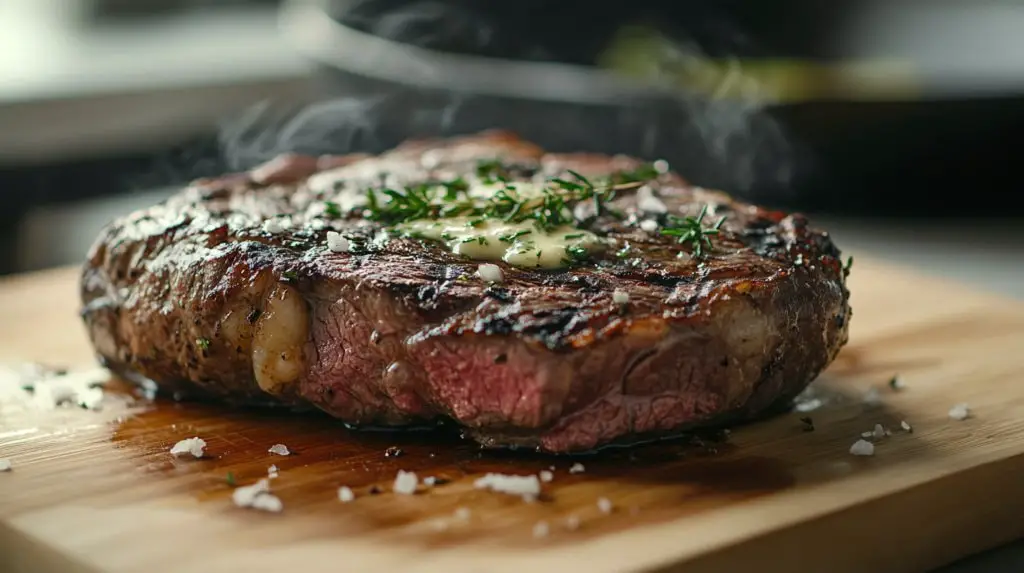
The ribeye cost more than you wanted to spend and you treated it accordingly. Kosher salt, hot skillet, no phone, no distractions. You cut into it and it was fine. Good, even. Just not the steak from the place with the heavy napkins, the one with a dark crackling crust and a center so evenly pink it looked painted on. That gap is real and it has almost nothing to do with your skill. A steakhouse cooks with heat your range cannot reach, salts hours before the meat sees a pan, uses more butter than you would ever admit to, and checks doneness with a thermometer instead of a hunch. Three of those four are free, and here is how you take them home.
Your Stove Was Never Built To Get That Hot
A commercial broiler or open-flame grill runs far hotter than a home burner with everything cranked. That difference is the entire crust.
Browning comes from the Maillard reaction, which speeds up sharply above roughly 300 degrees and needs to happen fast, before the middle of the steak sails past medium-rare. A restaurant grill gets there in seconds. A home burner takes its time, which is why a steak cooked at home usually ends up with a thinner, paler crust than the one you remember from dinner out.
You close most of that gap with the pan, not the stove. Heavy cast iron holds enough heat that the steak does not cool it down the moment it lands. Carbon steel does the same job and is lighter to lift. Preheat it on high for 5 to 10 minutes, until you see wisps of smoke, then add an oil with a high smoke point like avocado, grapeseed or plain vegetable oil. Skip olive oil and skip nonstick entirely. Nonstick is not built for this kind of heat.
Cooking outside instead? Jonathan Gill, executive chef of RingSide Steakhouse, uses a hand test: hold your hand about six inches above the coals and count. Two to four seconds before you pull away means high heat. Five to seven is medium, eight to 10 is low. Anything longer and the fire is not ready for a steak.
The Salt Goes On Hours Before The Pan Does
Most home cooks salt a steak about two minutes before it hits the heat, and that is the single biggest reason restaurant steak tastes seasoned all the way through while yours tastes seasoned on the outside.
Salt pulls moisture to the surface of the meat. Given time, that moisture dissolves the salt and gets drawn back in, carrying seasoning deep into the muscle and leaving the surface drier, which is exactly what a good crust needs. Most chefs recommend a generous coating of salt 45 minutes before cooking. Overnight on a rack in the fridge is better still. Salting anywhere from a few minutes to about 40 minutes ahead is the worst of both worlds: wet surface, seasoning sitting on top doing nothing.
Amounts matter too, and home cooks almost always go light. A workable rule of thumb is about five grams of kosher salt per pound of steak. Carlos Anthony, executive chef at Hawkeye & Huckleberry Lounge, uses about 2% of the weight of the steak in salt.
David Figueroa, president and co-founder of Melinda’s Foods, salts twice. “I salt my steaks about an hour before cooking, letting them sit out to sweat,” he said. “After they release some moisture, I pat them dry with a paper towel, salt them again, and add fresh ground black pepper just before they hit the pan or grill.” Pepper late is deliberate. It scorches if it sits in a screaming hot pan too long.
The Beef Is Better, But Not Always The Way You Assume
Plenty of steakhouses are not serving USDA Prime. Prime is the highest grade sold in this country, and many restaurants work one grade down with USDA Choice, which costs less and still turns out beautifully with good technique. The steak on your plate at dinner is often the same grade sitting in your grocery case.
What restaurants do choose carefully is fat and thickness. Marbling, those little white flecks running through the muscle, melts as the steak cooks and bastes the meat from the inside, so a well-marbled steak forgives you an extra minute on the heat. Kylian Goussot, executive chef of Lafayette Steakhouse, put the stakes plainly: “It’s difficult to make a good steak bad, but even harder to make a bad steak taste good.” He recommends a cut with fat on it, like a ribeye or a cowboy steak, because, in his words, “The fat melts during cooking and penetrates the meat, keeping it moist.” Other fatty cuts, like New York strip and T-bone, work too.
Dry-aging is the one thing you genuinely cannot copy at home. Large cuts sit in refrigerated rooms with cold air circulating around them while enzymes break down muscle fiber and moisture evaporates off the surface, which tenderizes the meat and concentrates the beef flavor. Menus flag it with a day count, like 21-day or 30-day. Some steakhouse chains do this in house; others age their beef in vacuum bags instead. Either way, it is equipment and weeks of patience, not a trick.
Butter, And Then More Butter
Anthony Bourdain gave away the whole trade in his New Yorker piece “Don’t Eat Before Reading This.” “Meat and fish are seared with a mixture of butter and oil,” he wrote, one of the ways butter turns up “in almost every restaurant worth patronizing.”
Butter basting is what separates a steakhouse steak from a competent home one. In the last stretch of cooking, a knob of butter goes into the pan with crushed garlic and sprigs of thyme or rosemary, and the cook spoons the foaming butter over the meat again and again. Each pass builds the crust a little more and drives flavor into the surface. Tilting the pan toward you pools the butter at the edge so you can scoop it fast.
Timing is the whole game, because butter has a low smoke point and will go black and bitter if it sits in a 500-degree pan from the start. Sear in neutral oil first, then add the butter late. America’s Test Kitchen waits until the steak has seared for about four minutes. Clarified butter handles more heat if you want insurance. Flipping the steak every 30 seconds while you baste sounds fussy, but it warms the meat more evenly and keeps the band of gray under the crust thin, which is a basting technique worth copying exactly.
Then there is the butter that shows up after cooking. Compound butter is softened butter whipped with things like fresh herbs, roasted garlic, citrus zest or chili, chilled into a log and sliced. Fleming’s offers a trio of steak finishes, herbed horseradish among them. A coin of it melting down the side of a hot steak is doing real work, not just looking good.
A Thermometer Beats A Hunch
A line cook might put fifty steaks through a grill in one night, which builds a sense of doneness you are never going to get cooking two ribeyes a month. That is not a failing. It is just math.
An instant-read thermometer erases the difference for about twenty bucks. Cook to the number and pull early, because a steak keeps climbing after it leaves the heat. Rare lands around 120 to 125 degrees, pulled at 115 to 120. Medium-rare lands around 130 to 135, pulled at 125 to 130. Medium lands around 140 to 145, pulled at 135 to 140. The USDA’s safe minimum for whole cuts is 145, followed by a three-minute rest. Restaurants plan for that carryover cooking on every single plate.
Resting is the back half of the same idea. Serious Eats testing found that, sliced at the same internal temperature, rested and unrested steaks lose about the same juice, though America’s Test Kitchen’s tests disagree. What resting does is give the center time to finish climbing to its target before a knife goes in, instead of being cut while it is still hot enough to push liquid out under pressure. A thin sirloin barely needs a pause. A thick ribeye takes closer to 10 minutes. A useful shortcut is to rest the steak for about half as long as you cooked it, on a warm plate.
The Last Thirty Seconds Do A Lot Of Work
Kathleen Smith, home cooking expert and recipe developer at Gonna Want Seconds, named the gap that keeps home steak stuck at decent. “A lot of home cooks go too light on seasoning or skip the finishing touches,” she said.
Her finish is a garlic-herb butter plus acid. “I like to use a garlic-herb butter and a splash of something acidic, like lemon juice or a bit of vinegar, to brighten everything up,” Smith said. “That final flourish really brings the dish together.” A pinch of flaky salt on the sliced surface, the browned butter from the pan spooned back over the meat, maybe a peppercorn sauce on the side. Small moves. They are the difference between a steak that tastes finished and one that tastes like something is missing.
The Mistakes That Keep Home Steak At Fine
Cooking straight from the fridge wrecks a good cut. Lior Lev Sercarz, chef and owner of La Boîte, explained that cold meat drops the temperature of the grill immediately, so it cooks less effectively and unevenly, charring outside while the middle stays raw. Let the steak sit out 30 minutes to an hour first.
Buying thin is the other common error. A thin steak cooks through before you have time to build a crust or baste it properly, so thickness buys you working room. Patting the surface dry before it hits the pan matters for the same reason wet steaks steam instead of browning. And once the steak is down, leave it alone for three to four minutes. Every time you nudge it, you interrupt the contact that is making the crust. If your kitchen fills with smoke, you did it right, so open a window and keep going.
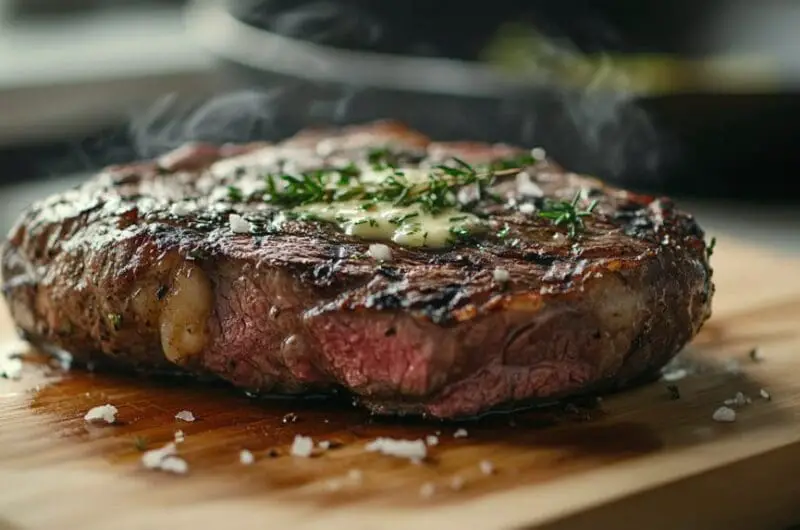
Steakhouse-Style Butter-Basted Ribeye
The dry brine, the screaming hot cast iron and the butter spoon that finally make home steak taste like the $62 one.
2
servings50
minutes15
minutes650
kcalIngredients
2 bone-in ribeye steaks, about 1 1/2 inches thick (roughly 1 pound each)
1 tablespoon kosher salt (about 5 grams per pound of meat)
2 teaspoons coarsely ground black pepper
2 tablespoons avocado, grapeseed or vegetable oil
4 tablespoons unsalted butter
4 garlic cloves, lightly crushed
4 sprigs fresh thyme or 2 sprigs fresh rosemary
1 small shallot, halved (optional)
Flaky sea salt and a squeeze of lemon juice, for finishing
Directions
- Pat the steaks dry with paper towels and salt them generously on both sides and around the edges. Set them on a wire rack over a sheet pan and refrigerate uncovered for at least 45 minutes, or up to 24 hours. The salt pulls moisture out, then carries the seasoning back into the meat and leaves the surface dry for a better crust.
- Take the steaks out of the fridge 30 to 60 minutes before cooking and let them sit on the counter. Cold meat drops the pan temperature the second it lands and cooks unevenly, charring outside while the center stays raw. Pat the surface dry again and season both sides with the black pepper right before cooking.
- Set a heavy cast iron or carbon steel skillet over high heat for 5 to 10 minutes, until you see wisps of smoke coming off the surface. Turn on the vent hood and crack a window, because this will smoke. Add the oil and swirl it to coat the bottom of the pan.
- Lay the steaks in the pan away from you. You should hear a loud, immediate sizzle. Do not move them, poke them or peek underneath for 3 to 4 minutes, because uninterrupted contact is what builds the crust. Flip and sear the second side.
- About four minutes into the sear, drop in the butter, crushed garlic, herb sprigs and shallot. Waiting until now keeps the butter from burning in the hot pan. Let it melt and start to foam before you do anything else.
- Tilt the pan toward you so the butter pools at the edge, then use a metal spoon to scoop it over the top of the steak quickly and continuously. Concentrate on any pale spots that need more color. Flip the steaks every 30 seconds as you baste so neither side sits on the heat long enough to overcook under the crust.
- Check the center with an instant-read thermometer and pull the steaks early, since they keep cooking off the heat. Pull at 115 to 120 degrees for rare, 125 to 130 for medium-rare, or 135 to 140 for medium. Those land at roughly 120 to 125, 130 to 135 and 140 to 145 by the time they hit the plate.
- Move the steaks to a warm plate and leave them alone for 5 to 10 minutes, roughly half as long as you cooked them. Discard the garlic and herbs, then pour the browned butter from the pan into a small bowl. Slice against the grain, drizzle the butter over the cut surface and finish with flaky salt and a squeeze of lemon.
Notes
- Thickness matters more than grade. A steak about 1 1/2 inches thick gives you time to build a crust and baste without blowing past medium-rare in the middle, while a thin steak cooks through before the butter does anything.
- If your butter keeps burning, clarify it first: melt it slowly in its own pan and skim the milk solids off the top. Clarified butter handles far more heat than whole butter.
- For a compound butter finish, mash softened butter with minced garlic, chopped parsley and cracked pepper, roll it into a log in plastic wrap and chill. Slice a coin onto each steak as it rests.
Frequently Asked Questions
Q: Do I need USDA Prime beef to pull this off?
A: No. Prime is the highest grade sold in the US, but plenty of steakhouses work with USDA Choice, which costs less and still turns out well with good technique. Pick the thickest, most marbled steak in the case and spend your money on thickness rather than grade.
Q: Can I do this on a grill instead of a skillet?
A: Yes. Use the hand test over the coals first: two to four seconds before you pull away means the fire is at high heat. Sear over the flame, then move the steak into a cast iron pan set on the grates to baste it with butter, garlic and herbs.
Q: Why does my butter go black and bitter?
A: Butter has a low smoke point and cannot survive a preheated cast iron pan from the start. Sear in a neutral high smoke point oil, then add the butter about four minutes in, or clarify the butter ahead of time by melting it and skimming off the milk solids.
Q: How long should the steak rest before I cut it?
A: About half as long as you cooked it is a solid rule. A thin sirloin barely needs a pause, while a thick ribeye wants closer to 10 minutes so the center can finish climbing to temperature before a knife goes in.

