
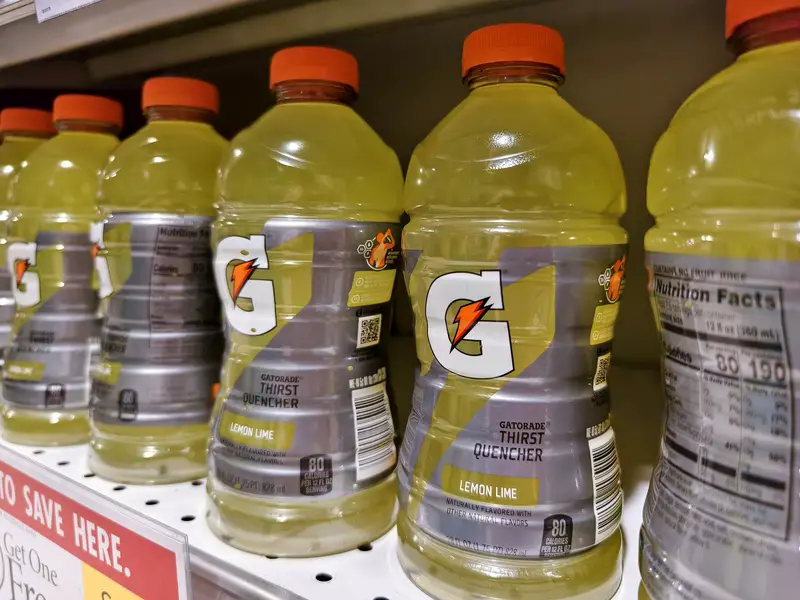
The 28-ounce Gatorade bottle is the one that lives in the gym bag, the cooler and the cup holder on a long drive. If yours is lemon lime or orange, the small print near the date on the label suddenly matters. PepsiCo has recalled 122,021 cases of Gatorade sold across 37 states because the bottles contain yellow food dyes that never made it onto the ingredient list.
Four Flavors, One Bottle Size
The recall covers 28-ounce bottles of Gatorade Lemon Lime, Gatorade Lemon Lime Zero, Gatorade Orange and Gatorade Orange Zero. The U.S. Food and Drug Administration says those bottles contain Yellow No. 6 and/or Yellow No. 5, artificial colors that were not declared on the labels. The FDA notice lists only those four products in that bottle size.
The affected bottles carry best-by dates from April 18 to June 8, 2027. The recall number is H-0009-2027.
The Lot Codes To Check First
Flip the bottle and find the code stamped near the date. The FDA’s notice names multiple affected lot numbers, among them:
- Lot 091026 DL, JUN 07 27
- Lot 091126 DL, JUN 08 27
- Lot 072226 DT, APR 18 27
- Lot 072426 TL, APR 20 27
- Lot 073126 TL, APR 27 27
- Lot 072926 TL, APR 25 27
- Lot 073026 TL, APR 25 27
That is not the whole list. The FDA’s recall notice lists 15 lots in all, eight more than these seven, which is why matching your bottle against the agency’s posting matters more than matching it against a flavor name. Two bottles of Orange sitting side by side in the same fridge can land on opposite sides of this recall depending on the code.
37 States Got Them
The cases were sold in Alaska, Alabama, Arkansas, Arizona, California, Colorado, Florida, Georgia, Hawaii, Iowa, Idaho, Illinois, Indiana, Kansas, Kentucky, Louisiana, Michigan, Minnesota, Missouri, Mississippi, North Carolina, North Dakota, Nebraska, New Jersey, New Mexico, Nevada, New York, Ohio, Oklahoma, Pennsylvania, South Carolina, South Dakota, Tennessee, Texas, Utah, Washington and Wisconsin.
Spread across that many states, 122,021 cases is a serious volume of product moving through gas stations, grocery chains, club stores and vending routes. Texas, California, Florida, Louisiana, New York and Pennsylvania are all on the distribution list.
How The Recall Moved
PepsiCo started the recall voluntarily on Sept. 25, 2026, meaning the company went to regulators rather than the other way around. The FDA then classified it on Oct. 2 as a Class II recall, the middle tier of the agency’s three-level system. A Class II designation means exposure to or use of the product “may cause temporary or medically reversible adverse health consequences,” with the probability of serious consequences described as remote.
For Yellow 5, the FDA has said the dye can cause allergic-type reactions, including asthma, in some people, and that the sensitivity is uncommon overall but shows up more often in people who react to aspirin. The recall remains ongoing.
A Legal Ingredient Can Still Trigger A Recall
Yellow 5 and Yellow 6 are both approved for use in food in the United States. Nothing about this recall changes that. The problem is the label.
Federal rules do not let a manufacturer bury these colors under a generic phrase. In the U.S., food labels must list certified colors like Yellow 5 and Yellow 6 by name in the ingredients, not lump them in with “artificial color.” That requirement exists precisely so shoppers who avoid a particular dye can spot it in two seconds. When the dye is in the bottle and the name is not on the bottle, the product is misbranded, and misbranded is a recall whether or not anyone gets sick.
It is the same logic that pulls a cookie off the shelf when the label forgets to mention peanuts. The food did not change. The information the shopper was handed did.
No Refund Program Has Been Announced
Here is where it gets unsatisfying for anyone holding a case in the garage. Neither the FDA nor Gatorade has published guidance telling buyers what to do with affected bottles, and as of early October no refund or replacement program had been announced for the recalled product. The agency’s posting lists lots and states, not a claims process.
The practical move is to compare your lot code against the FDA’s list before you drink anything, and to take questions straight to PepsiCo, which owns Gatorade. Hang onto the bottle and the receipt if you have one. Retailers generally handle recall returns at the service desk, and the lot code printed on the package is the thing that proves your item is covered.
What Yellow 5 And Yellow 6 Actually Are
Yellow 5 goes by tartrazine, and it produces that bright lemon-yellow you see in cereal, soda, gelatin, frosting, sauces and sports drinks. It dissolves in water, which is why it turns up in beverages so often. Outside the grocery aisle it shows up in toothpaste, shampoo, vitamin pills and pet food.
Yellow 6 is Sunset Yellow FCF, a warmer orange-yellow used in candy, bakery products, cereals, gelatin desserts and orange-flavored drinks. It is one of the most heavily used synthetic dyes in the country, which helps explain how easily they slip into a supply chain without anyone upstream flagging a label change.
Both are legal here and in the European Union, though EU rules force products containing either one to carry a line about effects on children’s activity and attention. Plenty of European manufacturers reformulated rather than print it, which is why the same brand can look different depending on which continent you buy it in.
The Dyes Were Already On The Way Out
Both colors sit on a federal phase-out list. On April 22, 2025, HHS Secretary Robert F. Kennedy Jr. and FDA Commissioner Marty Makary announced a plan to pull petroleum-based synthetic dyes out of the American food supply, naming six certified colors with a target of the end of 2026. Yellow 5 and Yellow 6 are two of them, alongside Red 40, Blue 1, Blue 2 and Green 3.
That plan is voluntary. Kennedy described it as an understanding with food companies rather than a binding order, and it has not issued a rule banning the dyes. Makary said the agency wanted to “start in a friendly way and see if we can do this without any statutory or regulatory changes” when the plan was announced. Progress since has been uneven, with some large manufacturers making concrete pledges and others staying quiet. The FDA now says it is working with companies to phase the dyes out by the end of 2027.
Several states have also passed laws limiting synthetic dyes, which is part of why a mislabeled bottle carries more weight now than it would have five years ago. A shopper in one state may be buying under different rules than a shopper in another.
Our Take On What To Do With Your Bottles
This is a paperwork failure that happened to involve 122,021 cases. The liquid in the bottle is made with colors the FDA already permits, and the agency’s own classification puts the odds of anything serious at remote. For most people, the sensible response is to check the lot code, and if it matches, stop drinking that bottle and take it up with PepsiCo or the retailer.
The people with a real grievance are the ones who read labels on purpose. Parents buying for a kid who reacts to a specific dye, anyone with an aspirin sensitivity, shoppers in states writing their own dye rules: those buyers made a decision using information that turned out to be wrong, and no amount of “the dye is approved” fixes that. Label accuracy is the entire product promise on a bottle of flavored water with electrolytes in it.
If you want to keep buying Gatorade in the meantime, the recall is narrow. Four flavors, one bottle size, specific lots. Everything else on the shelf is untouched, and the brand’s powdered mixes are not part of this at all. Check the code, keep the receipt, and do not toss a case on a hunch when a six-digit number on the label will tell you for certain.

