

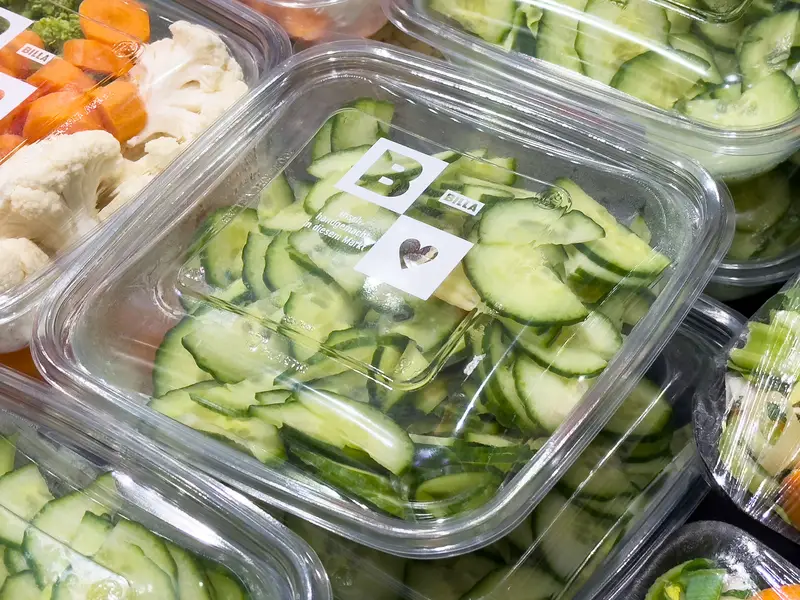
Here’s a scene you probably know too well. You buy a couple of cucumbers with big plans. Maybe a salad, maybe you’ll slice them into your water like a person who has their life together. Then five days later you open the fridge and find a sad, wrinkly, slightly slimy tube where a cucumber used to be. Straight into the trash it goes, along with the buck fifty you spent on it.
The good news is that cucumbers dying fast is almost never the cucumber’s fault. It’s how we store them. Get a couple of small things right and one cucumber can stay firm and snappy for two weeks or more. Here’s how to actually pull that off.
The wrap trick that does most of the work
The single biggest upgrade is wrapping your cucumber before it goes in the fridge. Cucumbers are about 95% water, and that water is exactly what keeps them crunchy. Left out in the open, they slowly leak that moisture and shrivel up like a deflated balloon.
One simple version is to wrap the whole cucumber tightly in plastic wrap. That’s actually why English cucumbers show up at the store already shrink-wrapped. The plastic locks in the water they’ve got and protects that thin skin. Done right, this buys you up to two weeks, though the cucumber is at its absolute best in the first three days.
Don’t have plastic wrap? A zip-top bag works too. The catch is you should tuck a piece of paper towel inside with it. The towel soaks up any extra moisture so the inside of the bag doesn’t turn into a swamp, which is what leads to that slimy film nobody wants to touch.
The showdown that proved it works
If you’re the type who wants proof before you change your routine, somebody already did the homework. A kitchen site tested nine different methods for storing whole cucumbers and let them sit for days to see what happened.
The results were not close. Cucumbers left naked on an open fridge shelf started shriveling after just four days, and by day seven every last one was soft and sad. The winners? Wrapping each cucumber tightly in plastic and setting it in the crisper drawer. Those held on with barely any dimpling until around day 10, and didn’t go squishy and slimy until an impressive day 12. A dry cucumber wrapped in a paper towel inside a loosely closed bag came in a strong second, staying firm about a week before soft spots showed up.
The takeaway is pretty blunt. Cucumbers need a little protection from the dry air of your fridge. Leave them out in the open and you’re basically watching them wilt in real time.
Stop shoving them in the back of the fridge
Here’s the part that trips up almost everyone. Colder is not better for cucumbers. They’re weirdly sensitive to cold, and if they sit somewhere too chilly for more than a day or two, they get soft spots, water-soaked patches, and pitting. That’s not spoilage from age, that’s cold damage, and it can’t be undone.
So where should they go? The crisper drawer is fine, but keep them toward the front of the drawer. That’s the warmest part because it catches room-temperature air every time you open the door. Cucumbers like to stay just above 50 degrees, and the back corners of your fridge often dip well below that. Same logic applies if you skip the drawer and use the top shelf, which also runs a touch warmer.
If you know you’ll eat them in the next couple of days, you can honestly just leave them on the counter at room temperature. They handle that fine as long as they’re out of direct sun.
The metal spoon thing you saw on TikTok
You may have scrolled past a video where someone drops a metal spoon in the bag with their cucumbers and swears it keeps them fresh. It sounds like nonsense, but there’s a real idea behind it.
Every time you open the fridge, the temperature inside jumps around. Those swings are rough on cucumbers. Metal holds its temperature better than the air does, so a spoon in the bag can help keep things steadier when the door opens and closes all day. TikTok users who tried it said their cucumbers did seem to last a little longer with the spoon than without. It’s not magic, but it’s free, so there’s no harm in trying it in a busy household fridge.
Keep them away from the fruit bowl
This one is easy to ignore and it matters more than you’d think. Some fruits give off a gas called ethylene as they ripen. Apples, bananas, tomatoes, and melons are big offenders. Cucumbers absolutely hate the stuff.
Postharvest scientists at UC Davis found that even tiny amounts of ethylene, in the range of 1 to 5 parts per million, speed up yellowing and decay. That’s a real number, not a guess. So if your cucumber is sitting next to a bunch of bananas, it’s aging faster than it should. Give it its own corner, away from ripening fruit, and you’ve bought yourself extra days for free.
The glass jar upgrade
If you want to go a step past plastic, try a glass container. Drop a clean paper towel in the bottom of a glass jar or container, lay your cucumber inside, and pop the lid on. Stored this way, some people get two to three weeks out of a single cucumber.
The reason it works so well is that the paper towel wicks away any condensation while the glass keeps the humidity around the cucumber in a nice middle zone, not too dry and not too wet. A little fog on the inside of the glass is normal and won’t hurt anything. The bonus with glass is that it doesn’t hold onto smells or pass anything from the container into the skin the way an old plastic bag sometimes can.
One warning though. Don’t seal a whole cucumber in a fully airtight container with zero airflow and no towel. All that trapped moisture with nowhere to go is a recipe for mold. The cucumber wants to breathe a little.
Already sliced them? Here’s the pantry hack
Cut cucumbers are a different animal. Once you slice into one, all that water wants to escape, and that’s how salads and cucumber sushi turn into mush. There’s a fix, and it uses two things already in your kitchen.
Layer your cut cucumbers in a colander and hit each layer with a pinch of salt and sugar. The salt pulls the extra water out (same trick people use on zucchini and eggplant), and the sugar keeps things from tasting bitter and brings out a little sweetness. For dishes where you want that loud crunch, like a spicy Korean cucumber salad, let the mix sit for up to an hour, then drain and rinse before you use them. Whatever you don’t salt, store in an airtight container with a paper towel and eat it within a couple of days, because sliced cucumbers just don’t have the shelf life of whole ones.
Yes, you can bring a floppy one back
Say you forgot about a cucumber and it’s gone a little bendy, but it’s not slimy or mushy yet. Don’t toss it. You can often revive it.
Cut it in half lengthwise, stand the pieces up in a glass or jar, and cover them with cold water. Leave it in the fridge for a day. The cucumber drinks that water back up and firms right back into something you’d actually want to eat. It won’t be perfect, but it beats throwing money in the garbage.
When to just let it go
Some cucumbers are past saving, and no water bath is going to change that. The signs to toss are pretty clear once you know them. Wrinkly, shriveled skin. A slimy coating you can feel with your fingers. Squishy or sunken spots. Yellowing all over. Any visible mold. When you hit any of those, it’s done.
You can also stack the deck at the store. Pick cucumbers that feel firm and heavy for their size with smooth, blemish-free skin. Give one a gentle squeeze, and if it has soft spots already, leave it in the bin. Smaller cucumbers tend to stay crisp longer than the big overgrown ones too.
Put it all together and the routine is simple. Buy a firm one, dry it off, wrap it or jar it, park it near the front of the fridge away from your fruit, and it’ll still be snapping fresh two weeks later. That’s a lot of salads saved from the trash.

