

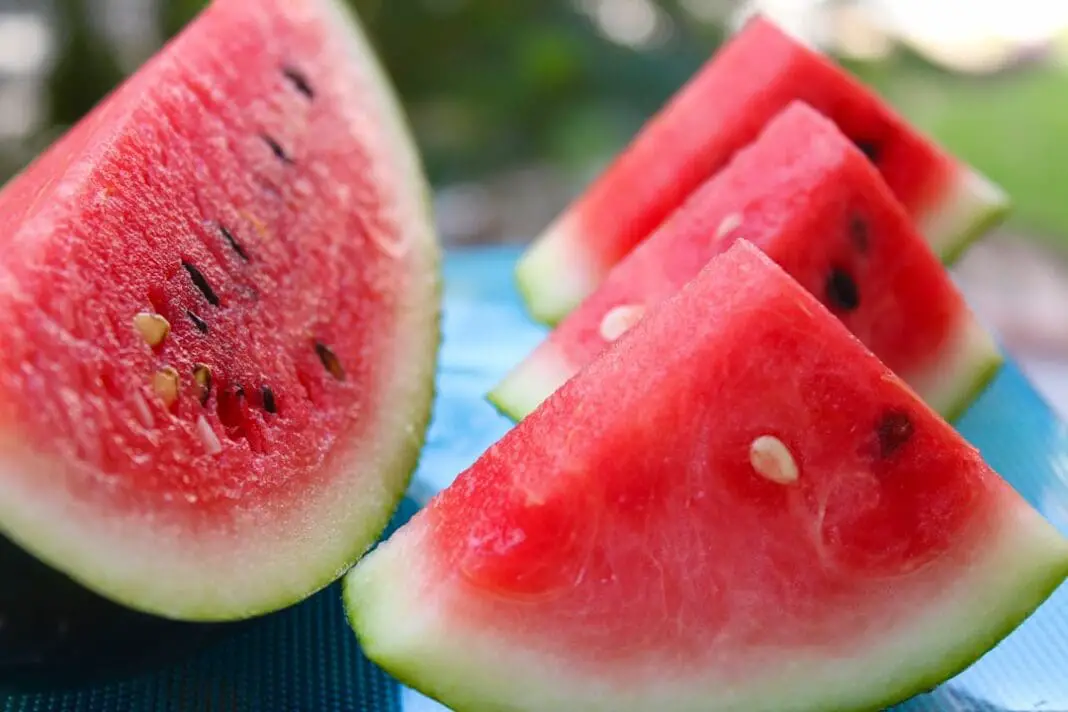
A watermelon gives you exactly one shot. You cut it open on the counter and it is either sweet and dark red or it is a pale, crunchy letdown, and there is nothing you can do about it after the fact. A watermelon stops getting sweeter the second it leaves the vine.
That is the whole reason the pick matters so much. A peach or a cantaloupe keeps softening and sweetening on your windowsill for days. A watermelon that got hauled off the field too early will never catch up, because it stops building sugar and stops deepening in color the moment it is cut. So every choice you actually care about happens at the bin, before that thing ever rides home in your cart.
The Yellow Patch on the Bottom Is Your Best Clue
Flip the melon over. On one side you will find a patch where it sat on the dirt while it grew, and that spot is the closest thing to reading the inside without a knife. Juan Anciso, a vegetable specialist at Texas A&M AgriLife, says the field spot may be the best sign of ripeness short of slicing the fruit open.
You want that patch to be a deep, creamy yellow, close to the color of soft butter. The bigger and creamier it is, the longer the melon hung on the vine soaking up sugar. A spot that stays white or pale green is the giveaway that somebody cut it too soon. Most university extension guides list the field spot first, which is about as close to a consensus as watermelon advice gets.
One catch is worth knowing. On a variety called Black Diamond Yellow Belly the ground spot ripens to a bright yellow rather than soft cream, so a vivid yellow belly on that one is the ripe melon, not an odd one. The shade shifts a little with the type in your hands, so read the sticker if there is one.
Those Brown Webs Do Not Mean What You Have Been Told
You have probably read that the prettiest melon is a trap, and that what you want is one covered in rough brown webbing, those raised tan lines that look like scars running across the rind. It is the most repeated watermelon tip going. It is also the one with nothing behind it.
The story goes that the marks are pollination points, that sugar seeps out through the rind where the bees did their work and dries into netting. No extension service says this, and nobody describes sugar crossing a watermelon rind at all. What poor pollination actually gives you, per Clemson, is a misshapen melon rather than a bland one.
Scarring is graded as damage in the USDA watermelon standards, not as a mark of quality. So do not reject a webbed melon, but do not go hunting for one either. If the rind is marked, check the spots are firm and grainy rather than soft or fuzzy, because soft is rot. Then go back to the field spot, which actually works.
Pick It Up and Feel the Weight
Grab two watermelons that look about the same size and heft them one at a time. Buy the heavier one. It really is that blunt.
A watermelon is about 92 percent water, so weight is a straight read on how much juice is packed in there. Matthew Huchteman, a horticulture specialist at University of Missouri Extension, puts it plainly: heavy for its size means juicy. A melon that feels light for how big it looks either dried out or never filled in properly.
For a sense of what good tastes like, growers work off a Brix scale where 10 is standard and 11 or 12 counts as extra sweet. Texas A&M reported growers consistently finding 11 Brix in 2025, and USDA calls anything from 10 up very good internal quality, so 11 really is near the top of what a store melon offers. You are not testing sugar with a meter at the register, but dense and heavy is the shortcut that gets you closest.
Dull Beats Shiny Every Single Time
Shine is usually the enemy here. A watermelon with a glossy, gleaming rind was probably pulled off the vine too soon. Our instinct is to reach for the one that looks polished, and that instinct works against you with this fruit.
You want a dull, matte surface with no gloss to it. As a melon matures on the vine that shine fades on its own, so a bright rind is a flag that it got picked early. Two caveats: how much the sheen shifts depends on the variety, and a melon that has sat drying in a warm store goes dull too. Use it alongside the field spot, not instead of it.
The stripes count too. Look for strong contrast between the light and dark green bands, well defined rather than faded and washed together. Bold, clear stripes on a matte rind are a good combination to trust.
Look for the Dried Tail
Find the stem end, the little spot where the melon connected to the vine. If there is a curly tendril hanging near it, you want that tendril brown and dried, not green and springy. Wilted is the sweet spot. Bone dry and shrivelled can mean the melon is already past its best.
The stump itself tells you nothing. Every watermelon is cut from the vine by hand, so the color of that cut only records how long ago somebody cut it. It is the tendril you are reading, not the stem.
One myth to drop while you are here. Watermelons never slip from the vine the way a cantaloupe does, so a melon with no stem was cut flush or had it torn off in handling. A torn stem end is not a badge of ripeness, it is where rot gets in.
The Thump Test Is Overrated
Everybody in the produce aisle knocks on watermelons like they are checking to see if anyone is home. It is the least reliable trick of the bunch. That does not make it useless, but it does mean you should not bet the whole thing on it.
Rap the underside with your knuckles and listen. A ripe melon comes back low and dull, like a knock on a heavy door. An underripe one rings higher and tighter, closer to metallic. Fair warning: extension services use the word hollow to mean opposite things here, which is part of why this test is such a mess.
The problem is the sound is subtle and the store is loud, and even the specialists admit it is the shakiest sign on the list. Use the thump to break a tie between two melons that already passed every other check. Do not use it to make the call by itself.
Give It a Quick Sniff
This one is thin, and it is worth knowing why. Missouri Extension does list a sweet smell as a ripeness sign, but almost every other extension guide leaves aroma off the watermelon list entirely and files it under cantaloupe, which is a far more fragrant fruit. Treat it as a tiebreaker at most.
No smell at all tells you very little, given how faint a watermelon is through the rind. A sour or unpleasant funk is the one to act on, because that means it went past ripe and started to turn. You want the light, sugary note, nothing stronger.
Once You Cut It, the Clock Starts
You did the work and picked a good one. Do not throw it away by letting it sit. USDA gives a whole, uncut melon about ten days in dry storage below 75 degrees, dropping to five days if the room runs warmer than that. Keep it somewhere genuinely cool, around 50 to 60 degrees, and you get two to three weeks instead. Do not park a whole one in the fridge for long, though, because below 45 degrees the rind pits and the flavor goes.
The moment you cut in, that changes. Wrap the pieces tight in plastic so the juice does not seep out and the air does not dry the edges into that sad, tacky film. Cut chunks and slices belong in the fridge, and Kentucky Extension puts the window at two to three days.
One more habit, and this one is a food safety rule rather than a quality tip. Cut melon needs temperature control. UGA Extension says never leave it out more than two hours, or one hour if it is above 90 degrees. Slice what you plan to eat, cover the rest, and put it straight back cold.
Run the whole checklist and it takes about ten seconds at the bin. Flip it for the creamy yellow spot, pick the heavier of two, skip the shiny ones, and check the tail for a dried tendril. The thump and the sniff are bonus points, and the webbing is folklore. Do that and you stop rolling the dice at the register, because the melon already told you everything before you ever picked up a knife.

