

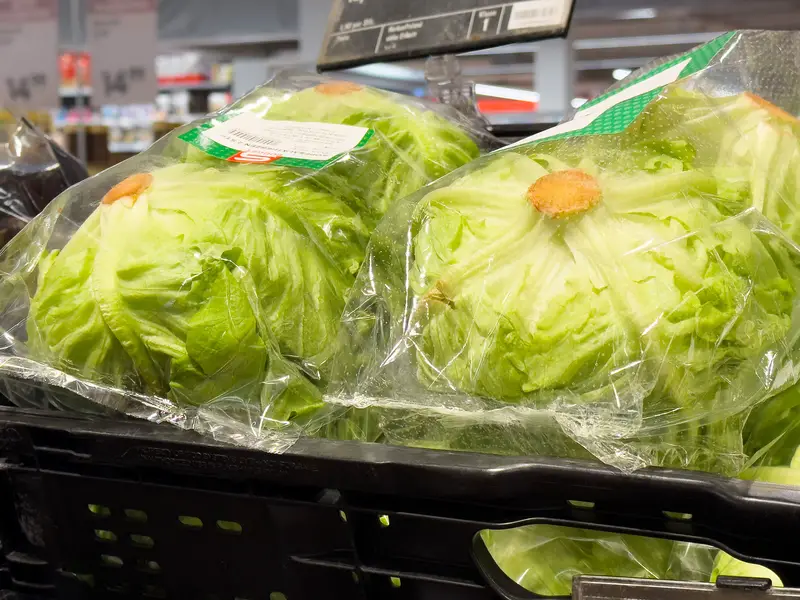
Nearly 2,000 people spent part of their summer stuck near a bathroom, and the culprit was sitting in a plastic bag the entire time. Health officials say one type of shredded iceberg lettuce is behind one of the largest parasite outbreaks this country has ever recorded. The latest count puts it at 1,947 people sick across nine states, and every single one of them had one thing in common. They ate at Taco Bell.
If you think a bag of lettuce is one of the more boring things in your fridge, you’re not wrong. That’s exactly why this one is worth paying attention to. Here’s what actually happened, what to check in your kitchen, and why the numbers keep climbing even after the recall went out.
The bag behind all of it
The lettuce traces back to Taylor Farms de Mexico, based in Guanajuato, Mexico. Investigators zeroed in on shredded iceberg grown on a single independent farm in central Mexico, which the FDA said accounts for less than 1% of the entire U.S. iceberg supply. One small farm. Almost 2,000 sick people. That’s how thin the margin is with fresh produce.
On July 17, 2026, the company voluntarily pulled all iceberg lettuce sourced from central Mexico off the U.S. market. Taylor Farms also said it stopped sourcing iceberg from that region for the rest of the growing season. The company says its branded salad kits were never part of this recall. Only the loose iceberg lettuce grown and processed in central Mexico got flagged.
Nearly 2,000 sick, and the count isn’t done
As of the July 24 update, 1,947 people were confirmed sick across nine states: Illinois, Indiana, Kansas, Kentucky, Michigan, Ohio, Oklahoma, Pennsylvania, and West Virginia. It started as a five-state problem and grew from there. There have been at least 98 hospitalizations reported, and no deaths.
The first illnesses began on June 22, and people were still getting sick through July 20. Officials also say the real number is almost certainly higher than what’s on paper. Plenty of people ride out a stomach bug at home, never see a doctor, and never get tested. So the official total is the floor, not the ceiling.
The Taco Bell thread that tied it together
Here’s the part that makes the case airtight. Every one of the 1,947 sick people reported eating at Taco Bell. When investigators find that kind of overlap, they know they’re close. In Michigan, health officials interviewed 190 people who got sick after eating there, and 90% of them reported eating the lettuce in question. That’s not a coincidence. That’s a pattern with a flashing arrow pointing at it.
Taco Bell moved fast once the source came into focus. The chain says it stopped using Taylor Farms de Mexico lettuce as of July 17. So if you grabbed a crunchwrap after that date, the lettuce you got wasn’t from the recalled supply. Small comfort if you were already sick, but at least the pipeline got shut off.
If it’s in your fridge, check these exact bags
This didn’t only hit restaurants. Some of the recalled lettuce landed on store shelves under the Marketside brand at Walmart. The specific products are Iceberg Salad in 12-ounce and 24-ounce bags, and Shredded Lettuce in 8-ounce and 16-ounce bags. Look for Best if Used By dates ranging from 7/18/2026 to 8/3/2026.
Want to get specific? The UPC codes flagged are 681131328944 and 681131328951 for the Iceberg Salad, and 681131328968 and 681131532099 for the shredded product. The shredded iceberg was distributed from June 29 through July 16 across 27 states, including Alabama, Arkansas, Connecticut, Florida, Georgia, Iowa, Illinois, Indiana, Kansas, Kentucky, Louisiana, Massachusetts, Maryland, Michigan, Missouri, Mississippi, North Carolina, New Hampshire, New Jersey, Ohio, Oklahoma, Pennsylvania, South Carolina, Tennessee, Texas, Virginia, and Wisconsin.
The reach went beyond Walmart and Taco Bell too. The lettuce moved through Jack in the Box and Sysco, the biggest food distributor in the country. Sysco pulled all Taylor Farms processed iceberg from Mexico and flat-out told customers to destroy it. When a distributor that size says throw it in the trash, that tells you how seriously everyone took this.
Why cases kept climbing after the recall
You’d think pulling the lettuce would stop the bleeding overnight. It doesn’t work that way. Symptoms of this bug usually show up about a week after eating the contaminated food, but the range runs anywhere from two days to two weeks or more. So people who ate the lettuce before the recall were still getting sick days and weeks later.
On top of that, it can take as long as six weeks for officials to confirm whether a sick person is truly part of this outbreak. The paperwork lags behind reality. The FDA said upfront to expect the confirmed case count to keep rising even with the recalled product gone.
There’s another wrinkle. Cases across the country have popped up in at least 41 states, though not all of those are tied to this specific Taco Bell and Taylor Farms cluster. Because cases kept climbing even after the recall, some investigators wondered whether the lettuce was the only source. No other source has been confirmed. But it’s the kind of loose end that keeps this story from being fully closed.
What this parasite actually is
The bug here is called Cyclospora, and it causes an intestinal infection known as cyclosporiasis. It’s a microscopic parasite, and it spreads through contaminated fresh produce or water, not from person to person. That means you can’t catch it from a sick coworker. You catch it from something you ate or drank.
The most common sign is watery, frequent, and sometimes explosive diarrhea. Other reported symptoms include loss of appetite, stomach cramps, bloating, extra gas, nausea, and plain old exhaustion. Some people get it and feel nothing at all. One tricky detail: it gets missed on routine stool tests. A doctor has to specifically order the right test to catch it, so patients sometimes have to ask for it by name.
Lettuce keeps showing up in outbreaks like this for a simple reason. It’s eaten raw, so there’s no cooking step to kill anything living on it. Bagged, pre-washed, ready-to-eat greens go through a lot of handling before they reach you, and that’s exactly where problems can slip in.
The lab test that muddied the water
Here’s a weird twist that made headlines. On July 19, the FDA said a lettuce sample collected at the border came back as a false positive. The agency later apologized to Taylor Farms over the mix-up. The company was quick to point out that, as of July 24, there were no confirmed positive product tests for Cyclospora at all.
So does that let the lettuce off the hook? No. The FDA was clear that the false positive doesn’t change anything about the case against the product. The recall stands on traceback records and the mountain of interviews connecting sick people to that lettuce, not on a single lab result. And Cyclospora is notoriously hard to detect in food, so a negative or withdrawn test doesn’t prove the food was clean. Taylor Farms, for its part, says it spends more than $200 million a year on food safety and has experts on the ground in Mexico digging into how this happened.
What to do right now
If you bought any of the recalled Marketside bags, don’t eat them. Toss them or take them back to Walmart for a full refund. Officials also suggest cleaning and sanitizing anything the lettuce touched, like your crisper drawer, a cutting board, or a salad bowl. This bug can hang around.
And if you ate shredded iceberg lettuce in the two weeks before feeling awful, and the symptoms match, that’s worth mentioning to your doctor. Bring up the lettuce specifically, because that detail can point them toward ordering the right test instead of a standard one that would miss it.
The honest takeaway here isn’t to swear off salad forever. It’s that a single bag of lettuce moved through fast-food counters, a Walmart shelf, and the country’s biggest distributor before anyone realized what was riding along with it. Nearly 2,000 people found out the hard way. Checking a Best if Used By date takes about four seconds. This time, those four seconds actually matter.

