

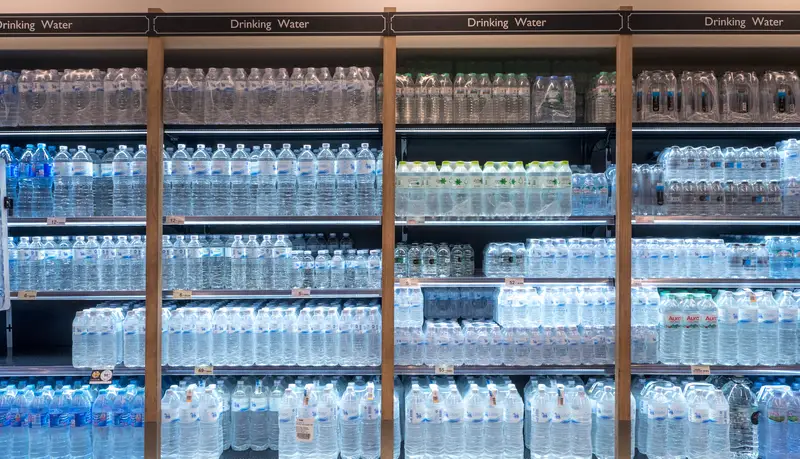
Here’s a question that should bug you more than it does. When did we all agree that water, the stuff that literally falls out of the sky for free, was worth paying more per gallon than gasoline? Because that’s the deal you’re getting at the checkout line. You grab a cold bottle, you feel hydrated and responsible, and you hand over real money for something already piped into your kitchen for next to nothing. I used to do it too. Then I actually ran the numbers, and now I can’t unsee it.
This isn’t some lecture. It’s just an honest look at where your money goes when you buy bottled water, and why most of it is going to a label, a marketing team, and a truck driver instead of to anything you can actually taste.
The markup is honestly ridiculous
Let’s start with the number that made me put the bottle down. If you buy a single $1 bottle of water, you are paying roughly 2,279 times more than you would to fill that same bottle from your tap. Two thousand times. For the same water.
Drink the recommended 64 ounces a day from those bottles and you’re spending about $3 a day, or $1,095 a year. The exact same amount from your faucet runs you about 48 cents for the whole year. The day you buy your first bottle, you’ve already spent double what a full year of tap water costs. Depending on how much you buy, bottled water can drain anywhere from $450 to over $1,400 per person every year. That’s a car payment. That’s a vacation. That’s a lot of money for something you can get out of the wall.
A lot of it is just tap water anyway
Now here’s the part that really stings. Roughly 64 percent of bottled water sold in America comes from the same municipal supply that feeds your sink. It’s tap water that took a road trip, got dressed up in a fancy bottle, and came back with a price tag.
Two of the biggest names prove the point. Dasani is Coca-Cola, and Aquafina is Pepsi, and both are basically city water that’s been run through a filter and bottled under a brand name. So when you pay a premium for one of those, you’re not buying superior water. You’re buying the work it took to put your own tap water into a plastic container and ship it to a store near you. Read that again and it’s almost funny.
Your tap water gets tested way more often
Most people assume bottled water is held to a higher standard. The truth is closer to the opposite. Tap water is overseen by the EPA under the Safe Drinking Water Act, and your local utility has to send you a water quality report every single year by July 1. You can literally see what’s in it.
The testing schedule is the real eye-opener. Bottlers only have to test for coliform bacteria once a week. City tap water gets tested 100 or more times a month. So the cheaper option is the one getting checked roughly four hundred times more often. You’re paying extra for the product with the lighter homework load. That’s backwards, and it’s the kind of thing the bottling industry would rather you never think about.
People can’t even taste the difference
Okay, but bottled tastes better, right? That’s the whole reason most folks pay up. Except taste might be the most misleading part of this entire thing. When you actually blindfold people and make them guess, the results get embarrassing for bottled water fast.
In one blind taste test run by Good Morning America, plain old New York City tap water came out the clear favorite among tasters. Not the spring water with the mountain on the label. Not the imported stuff. The tap. And this happens over and over in these tests. Tap water rates as good or better than the bottled brands when nobody can see the packaging. The fancy taste you think you’re paying for lives mostly in your head, propped up by a nice label and a cold bottle. Once the brand is hidden, the magic disappears.
You’re paying for the label, not the water
So if it’s not better and it’s not safer and it doesn’t even taste better, what exactly are you buying? Branding. Packaging. Trucking. Retail markup. The water is the cheap part. Everything wrapped around it is what you’re funding, and the bottled water business in the U.S. has grown into a $46 billion machine built almost entirely on that idea.
Here’s the kicker on transparency. When researchers checked the top 10 domestic brands to see if they disclosed where the water came from, how it was treated, and what testing showed, most of them failed to provide it. The FDA doesn’t even require them to tell you the source. You’re paying a premium for the idea of purity while the company stays quiet about what’s actually in the bottle. For something marketed on trust, that’s a lot of secrecy.
Even those pretty labels are getting sued
Those soothing words on the front of the bottle? They’ve landed companies in court. A wave of lawsuits has gone after six big brands, including the ones behind Poland Spring, Fiji, Evian, Arrowhead, Crystal Geyser, and Ice Mountain, arguing that calling the water “natural” or “100 percent spring water” is misleading.
And this fight isn’t new. Back in 2003, Nestle settled a similar case over its water for $10 million, though it denied doing anything wrong. The plaintiffs basically argue that if shoppers knew the full story, they would never have paid extra in the first place. The word “natural” isn’t even tightly regulated by the FDA, so companies sprinkle it on the label because it sells. You’re buying a feeling, and that feeling has a markup.
Regular people are already bailing on it
Here’s the encouraging part. A lot of Americans have already done this math and walked away. In a 2024 report, bottled water was the top choice for drinking water at 73 percent. By 2025, that number crashed to just 17 percent. That’s not a small dip, that’s people changing their whole routine.
What took its place? Cheap pitcher filters like the kind you toss in the fridge are now the most common option at 31 percent, with built-in fridge filters right behind. The number of people who still see bottled water as the most trustworthy source has been sliding for years, down to about a third. Slowly but surely, the spell is wearing off, and a lot of households are quietly keeping that $1,000 a year instead of handing it over at the register.
What to do instead if you want to keep your money
You don’t have to choose between overpriced bottles and choking down whatever your faucet gives you. The smart middle ground is a filter. A basic pitcher or a faucet attachment costs a few bucks up front, and after that you’re paying pennies. Even with a nicer home filtration setup, filtered tap stays pennies on the dollar next to bottled.
The real trick is to stop comparing a filter to free tap water and start comparing it to what you actually buy, which is bottled. Once you frame it that way, the filter pays for itself almost immediately. Grab a decent reusable bottle, fill it before you leave the house, and you get the same cold-water-on-the-go convenience without the recurring charge. People who switch can cut their drinking water spending by as much as 95 percent, and they stop hauling cases of plastic into the house every week.
So, is it ever worth it?
Look, there’s a place for a bottle of water. You’re at the airport, your kid’s game ran long, you forgot your reusable bottle in the car. Convenience is real and sometimes it’s worth a dollar. I’m not going to pretend I’ve never bought one.
But as a daily habit, the case falls apart the second you stop and add it up. You’re paying up to 2,000 times more for water that’s often pulled from a city tap, tested less often than your faucet, dressed in a label that companies keep getting sued over, and that real people can’t even pick out in a blind test. That’s not a premium product. That’s a habit tax. Cancel the subscription your wallet never agreed to, and put a filter on the sink. Your bank account will notice, and your water will taste exactly the same.

