

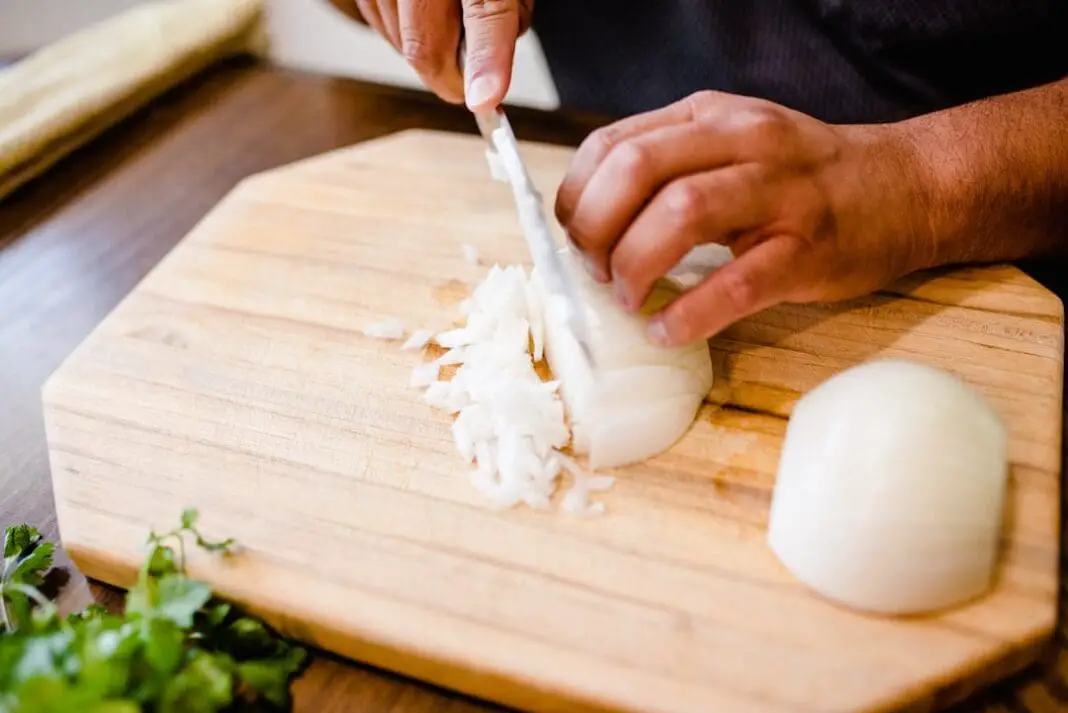
You slice off half an onion for a pot of chili, wrap the leftover half in plastic, and shove it in the fridge door. Done. You’ve probably done this a hundred times. So has everyone you know. Here’s the annoying part: it’s one of the worst ways to keep a cut onion, and it’s quietly messing up the rest of your fridge while it sits there.
Onions are cheap, so most of us never stop to think about how we store the leftover half. But a sad, rubbery onion that smells like a gym bag is still a waste of money and a waste of a perfectly good dinner ingredient. Let me walk you through what not to do, why it goes wrong, and the one method that actually keeps a cut onion firm for over a week.
The Plastic Wrap Habit Has To Go
Plastic wrap feels like it’s doing something. You stretch it tight over the cut face, press it down, and it looks sealed. It isn’t. The sulfur compounds that give onions their bite are tiny molecules, small enough to slip right through the wrap within a couple of hours. The edges where you tucked the plastic under almost never form a real seal, so air keeps sneaking in around the sides.
The payoff is a cut onion that only stays decent for about 2 to 3 days before the surface turns tough and leathery. People who actually tested different storage methods found plastic wrap to be the most popular choice and also the worst performer. You’re basically grabbing the option that fails first.
Your Butter Is Paying The Price
Here’s the part nobody warns you about. Those sulfur molecules don’t just float off into nowhere. They drift onto whatever is sitting nearby and soak right in. Butter, soft cheese, a bowl of last night’s pasta, anything porous becomes an onion sponge. Ever bitten into a stick of butter that tasted faintly of onion? Now you know who did it.
The fix is simple: keep cut onions in a real sealed container, and don’t park them next to your dairy. Storage guides flat out say to keep onions away from cheese and fish because the smell travels both ways. Your onion can pick up funk from strong foods, and it can hand its own funk right back. A snap lid container traps the smell where it belongs.
The Water Bath Trick That Backfires
Somewhere along the way the internet decided that dunking chopped onions in a bowl of water keeps them fresh. Skip it. Submerging cut onions just leaves you with soggy, waterlogged pieces that lose their snap. Thinly sliced onions get mushy in a plastic bag by hour three, and sitting them in water speeds the slide even more.
According to people who dug through hundreds of food forums chasing this exact water storage myth, soaked onions can spoil in as little as 2 days. You took a vegetable that lasts a week and cut its life in half because a video told you to. Keep them dry. Onions want air kept out and moisture kept low, not a swimming pool.
Leaving It Out On The Counter
We’ve all done it. You chop an onion, get pulled away by a phone call or a kid or a delivery driver, and the cut half sits on the cutting board for who knows how long. As a rule, cut produce shouldn’t hang out at room temperature for more than 2 hours. In a hot summer kitchen above 90 degrees, that window drops to about an hour.
The reason has nothing to do with the onion being special. Cut vegetables just don’t belong in the warm part of the kitchen for long stretches, and the two hour rule applies to pretty much anything you’ve sliced into. The smart move is to get that cut onion into a sealed container and into the fridge within about 15 minutes of cutting, while it’s still firm. Don’t let it lounge.
Not Every Onion Lasts The Same
This one surprises people. The onions that make you cry the hardest are the ones that keep the longest once cut. Yellow and red onions are loaded with the sharp sulfur compounds that sting your eyes, and those same compounds act like a built in preservative. They outlast the gentle ones every time.
Sweet onions are the opposite. A Vidalia is mild and pleasant raw because it’s high in water and low in sulfur, but those exact traits make it spoil fastest. Treat sweet onions like fresh herbs, not pantry staples. If you bought a Vidalia for a salad or a burger, use it that day or the next and don’t expect it to hang around. White onions land in the short lived camp too.
That Brown Spot Isn’t What You Think
Pull a cut onion out of the fridge, notice the flat face has gone a little brown, and into the trash it goes. Hold on. That browning is almost always just oxidation, the same thing that happens when you slice an apple or an avocado and the surface meets the air. It’s a color change, not a sign the whole onion has turned on you.
If you want, scrape off the top layer and the rest is fine to use. What you actually want to watch for is a slimy or mushy feel, cloudy liquid pooling at the bottom, gray patches, or a sharp sour smell. Those are the real throw it out signs. Plain old surface browning is not. Tossing a perfectly good onion over a little discoloration is how you end up buying onions twice as often as you need to.
The Way You Should Actually Store It
Enough about the mistakes. Here’s the method that wins. Put the cut onion flat side down in an airtight container, the kind with a real silicone seal, and get it in the fridge fast. Stored this way, a half onion stays firm and fresh for 7 to 10 days with no smell leaking out onto your other food. That’s roughly four times longer than the plastic wrap method gets you.
A few small things stretch it even further. Keep the root end on a half onion, since that end holds moisture and acts as a natural barrier. For diced onion, drop a folded paper towel in the container to soak up the liquid that pools at the bottom, which keeps the pieces from turning to mush. And store the container toward the back of the fridge, not the door. The door warms up every time you open it, while the back stays steadily cold and keeps the texture longest.
Quick cheat sheet. A half onion in an airtight container lasts 7 to 10 days, in a zip bag 5 to 7, in plastic wrap only 2 to 3. Sliced onion runs a little shorter, and diced shorter still, around 5 to 7 days sealed up tight. A zip bag with the air pressed out beats plastic wrap, but it leaks at the zipper, so it’s the runner up, not the champ.
About That Viral Poisonous Onion Story
You’ve probably seen the chain post claiming a leftover cut onion turns into a magnet that pulls germs out of the air and becomes poison. It’s nonsense, and it’s been floating around forever. The claim traces back to a single blog post from March 2008 that was deleted in 2009, but pieces of it keep getting forwarded around to this day. Even the fact checkers shut it down years ago.
The funny twist is that an onion’s own juices are antimicrobial, so the cut surface actually works against germs rather than attracting them. The people who grow onions point out that nothing in the kitchen pulls bacteria out of thin air, since germs spread by contact, not by floating around looking for an onion to land on. A cut onion handled with clean hands and a clean knife is no riskier than a sliced cucumber. The only real rules are the boring ones: clean board, clean hands, sealed container, cold fridge.
So What’s The Takeaway
Plastic wrap is the loser here. It dries your onion out, leaks the smell into your butter, and quits after a couple of days. The water bowl trick is worse, turning crisp onion into a soggy mess fast. And letting a cut onion sit out on the counter all afternoon is just asking to throw it away.
Do this instead. Cut side down, airtight container, paper towel for the diced stuff, root end on, back of the fridge, lid on within 15 minutes. That’s the whole game. One five dollar container saves you a steady drip of wasted onions and keeps your fridge from smelling like a diner. Your next batch of chili, and your butter, will thank you.

