

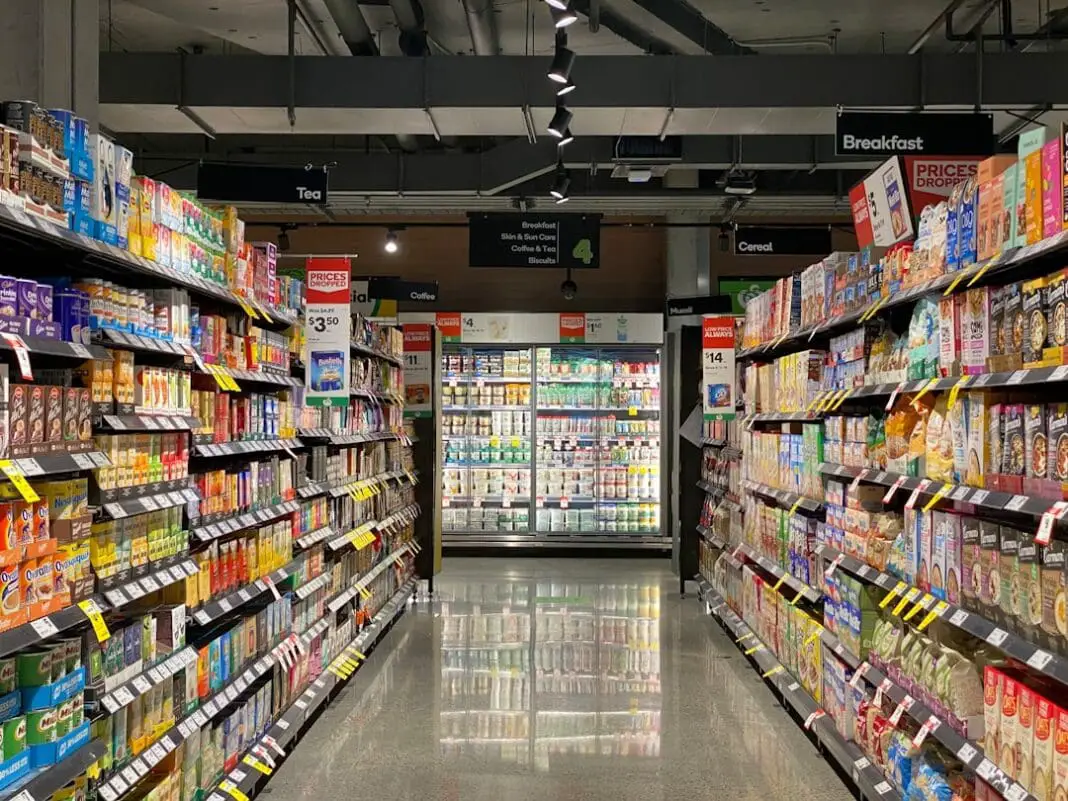
If you’ve got a Safeway, a Vons, or a plain old Albertsons a few blocks from your house, you might want to make sure it’s still standing next month. The company behind all three is one of the biggest grocery operators in the country, and right now it’s shutting locations, cutting hundreds of jobs, and trying to explain to investors why a deal it bet the farm on fell apart. This is not a small regional chain having a rough quarter. This is a giant.
Albertsons runs 2,243 stores across 35 states under 22 different names. You know a bunch of them even if you never realized they were connected: Safeway, Vons, Jewel-Osco, Shaw’s, ACME, Tom Thumb, Randalls, Pavilions, Star Market, and more. So when a company this size starts pulling back, it’s worth paying attention. Here’s what’s actually going on and why it matters if you buy groceries in America.
The $24.6 Billion Deal That Blew Up
To understand the mess, you have to go back to October 2022. That’s when Kroger agreed to buy Albertsons in a deal worth $24.6 billion. Put those two together and you’d have a grocery monster big enough to go toe to toe with Walmart on price. Albertsons was counting on it. The company saw the merger as its ticket to real scale.
Then the whole thing collapsed. Courts blocked the merger, and by December 2024 the deal was dead. Here’s the part that stings: during the roughly two years the deal was in limbo, Albertsons basically hit pause on cleaning up its own store list. It stopped closing weak locations and left things running while it waited for the buyout that never came. Now all that delayed housekeeping is catching up at once, and the bill is coming due in 2026.
Which Stores Are Actually Closing
Albertsons already shut around 20 to 30 stores during 2025, and the closures rolled right into the new year. In April 2026, the Vons stores in Escondido and Redlands, California both closed. An Albertsons near Riverside, California went dark back in March 2026. Two Albertsons-owned stores in North Texas, out in Tarrant County, shut their doors too, along with a Safeway in Northern California and a Safeway in Washington, D.C.
Add it up and you’re looking at roughly a dozen stores closing in 2026 across California, Texas, New Jersey, Connecticut, Nevada, and Washington, D.C. More than half of them sit in California and Texas, so if you live in either of those states, the odds your neighborhood store is on the list go up. The company hasn’t dropped one big public list, so a lot of this news has come out store by store, town by town, as local reports confirm each shutdown.
Hundreds of People Are Losing Their Jobs
This is the part that doesn’t make the flashy headlines but hits real people. The recent round of closures wiped out more than 400 jobs. The two Vons in Escondido and Redlands accounted for about 135 of them. The Tarrant County closures in Texas took out another 138. And that’s just the stores.
On top of the store-level cuts, Albertsons is laying off 295 people in corporate and divisional support roles. Workers are getting WARN notices and transfer offers, and the company says it plans to place as many store associates as it can at nearby locations. That’s a nice thing to say, but a transfer offer only helps if there’s a store close enough to make the commute worth it. For a lot of these folks, the next closest Albertsons banner is a long drive away.
Is the Company Actually Broke?
Here’s where it gets a little more complicated, because Albertsons isn’t circling the drain the way some struggling chains are. Founded back in 1939, it’s still one of the largest food and drug retailers in the country, and the numbers aren’t a total disaster. In the third quarter of its 2025 fiscal year, net sales actually rose 1.9% to $19.1 billion, and comparable sales climbed 2.4%. Selling and administrative costs even dropped a hair as a share of sales.
So why the closures? Because “not shrinking” and “winning” are two different things. The company is trying to cut its way to health, chopping weak stores and pouring money into automation and technology to save cash. The stated goal is to free up around $1.5 billion to reinvest in growth. Translation: close the losers, keep the winners, and hope it’s enough to hang with the big boys. Which brings us to the elephant in the parking lot.
Walmart and Costco Are Eating Everyone’s Lunch
The reason the failed merger hurt so much is simple. Albertsons wanted scale to fight Walmart, and without it, the fight got a lot harder. Walmart is the top grocery retailer in America, grabbing about 23.6% of the market with more than 5,200 stores and roughly $276 billion in revenue. Kroger sits second at 10.1% with over 2,700 stores. Costco keeps piling on too. Regional discounters keep chipping away at the edges.
When a shopper can fill an entire cart at Walmart for less, a traditional supermarket has to work twice as hard to compete on price. That’s the corner Albertsons is stuck in. Analysts have laid out two roads ahead: the company either stabilizes by leaning on technology and focusing on its profitable markets, or the pressure keeps mounting and it faces even more downsizing. Nobody’s predicting the ending, but the direction of travel is clear.
It’s Not Just Albertsons
If you think this is a one-company problem, it’s not. Another big name is in even rougher shape. Grocery Outlet, the California-based discount chain famous for its closeout bargains, announced in March 2026 that it’s closing 36 stores, about 6% of its whole fleet. And the money behind that decision is ugly: a $235 million operating loss and a net loss north of $218 million in a single quarter.
CEO Jason Potter didn’t sugarcoat it, telling investors the chain expanded too quickly and stretched itself thin. Two dozen of the closing stores are on the East Coast, which alone makes up about 30% of the company’s locations in that region. Potter took the blame directly, telling analysts “I own this and own fixing the issues.” A lapse in SNAP funding during the long government shutdown also hurt, since a big chunk of Grocery Outlet’s core shoppers rely on those benefits. Odd twist: even while closing 36 stores, the company still plans to open 30 to 33 new ones this year.
Kroger and Others Are Trimming Too
Kroger, the same company that tried to buy Albertsons, is doing some cutting of its own. Back in June 2025 it announced an 18-month plan to shut 60 stores, roughly 5% of its Kroger-branded network. As of March 2026, nearly 40 Kroger and Kroger-owned stores had already closed across more than a dozen states, from California and Colorado to Georgia, Texas, Virginia, and Wisconsin. Some of those locations got sold off to other chains like Piggly Wiggly, Super 1 Foods, and Food City instead of just going dark.
Even the Midwestern favorite Hy-Vee is offloading 21 of its standalone Fast & Fresh convenience stores in a deal with a Nebraska chain. Aldi and Dollar General have been in the closure conversation too. This is a whole industry shifting its weight around, not one company having a bad day.
What This Means for You at the Checkout
Here’s the honest takeaway. When a store near you closes, it’s more than an annoyance. Fewer stores in an area means less competition, and less competition usually means the ones left standing feel a little less pressure to keep prices low. You might have to drive farther for basics. In smaller towns and rural spots, losing the one nearby supermarket can be a genuine headache.
The bigger picture is sobering. U.S. retailers are expected to close roughly 7,900 stores in 2026, and that number covers a lot more than groceries. The supermarket business specifically is squeezing down to the strongest players and squeezing out the rest.
The good news, if you want to call it that, is that Albertsons isn’t vanishing. The company actually expects to end its 2026 fiscal year with a net positive store count, meaning it plans to open more than it closes overall. Safeway and Vons aren’t going extinct tomorrow. But the era of a comfortable, sleepy supermarket giant coasting along is over. Albertsons is fighting for its spot, and if you shop there, the smart move is to keep an eye on your local store, because the list of casualties isn’t finished growing yet.

