
If you’ve got a carton of eggs sitting in your fridge right now, this is worth two minutes of your time. A big egg recall has grown into a mess that reaches 17 states, and the numbers keep climbing. We’re talking about nearly 1.6 million dozen eggs pulled from shelves. That works out to more than 19 million individual eggs. If your brain does the math, yeah, that’s a lot of scrambled eggs and omelets nobody should be making right now.
The recall comes from Midwest Poultry Services, a company that produced these eggs at two farms in Texas. Federal officials say the eggs may carry Salmonella Enteritidis, and they’ve been tied to an outbreak that has made close to 100 people sick. Here’s the frustrating part for regular shoppers: the eggs were sold under brand names you probably recognize and grab without thinking twice. So let’s break down exactly what to look for, where these eggs ended up, and what you should do if you find a match in your kitchen.
The recall now covers 17 states from coast to coast
Here’s what makes this one stand out. The eggs themselves were only distributed to stores in a handful of states, mostly Texas, Oklahoma, and Louisiana. But the outbreak of sickness stretches across 17 states, coast to coast. As of the latest count, 98 people have gotten sick, and 26 of them ended up in the hospital. No deaths have been reported, which is the one piece of good news here.
The gap between where the eggs were sold and where people got sick is part of why investigators are still digging. When eggs go to foodservice customers, they can travel a lot farther than a grocery shelf. Think restaurants, cafeterias, and other places that buy in bulk. That’s likely how a Texas farm ended up connected to illnesses spread across the whole country. Officials have been tracing where sick people bought or ate eggs to piece the whole thing together.
Check your carton for these exact codes
This is the most important section, so pay attention. Not every carton of these brands is part of the recall. You need to check the codes printed on the side of the carton. Look for plant codes P-1950 or 0840962. Then check for a Julian Date between 157 and 184. The Julian Date is just the day of the year counted out, so 157 means the 157th day and so on. It’s printed in that date-coding ink on the left or right side of the box.
You should also check the sell-by or best-by date. The recalled eggs carry dates between July 20, 2026 and August 17, 2026. If your carton matches all of that, it’s part of the recall. If the codes don’t line up, your eggs are fine. One thing to know: contaminated eggs look completely normal. You can’t smell it or see it. That’s why the codes matter so much. The Hill pointed out that officials are urging people to check the codes carefully instead of guessing.
The brand names you might have in your fridge
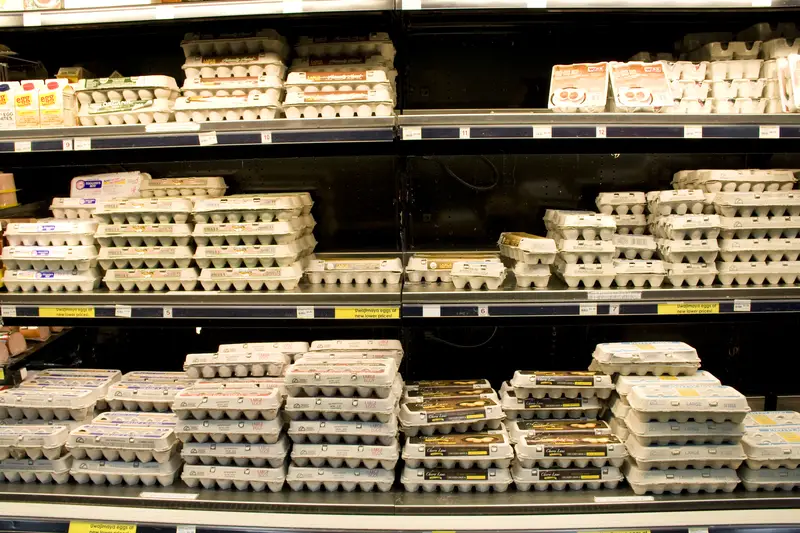
This is where a lot of people get tripped up, because the recall covers several different brand names, not just one. The recalled eggs were sold under Kroger, Simple Truth, Brookshire’s, Country Morning, and Cal-Maine Sunups. If you shop at Kroger, that Simple Truth label is their store brand, so plenty of folks have those cartons without realizing it’s the same producer.
The recall includes both white shell eggs and brown cage-free shell eggs. They came in a bunch of sizes too, from medium all the way up to jumbo. And they were sold in every carton size you can imagine: 6, 12, 18, 24, 30, 36, and even 60-egg packs. So whether you buy a small half-dozen or one of those giant flats for a big family, you’re not off the hook based on size alone. Quartz noted the eggs went out under multiple brand names, which is exactly why checking the codes beats trusting the label on the front.
Where these eggs were actually sold
If you want to know whether you could have bought these, here’s the store list. The eggs were available to shoppers at Kroger stores in Texas and Louisiana. They also showed up at Brookshire Grocery stores across a wider area: Texas, Oklahoma, Arkansas, Louisiana, New Mexico, and Mississippi. On top of that, they went to smaller retail outlets that weren’t named in the notice, plus foodservice customers in Texas, Oklahoma, and Louisiana.
So the retail footprint is mostly concentrated in the South and lower Midwest. But remember, foodservice is the wild card. If you ate out somewhere and a restaurant got these eggs in a bulk order, that’s harder to track on your end. The company said it stopped distributing fresh eggs from its two Texas farms after finding the problem. Today reported the eggs reached shoppers at Kroger and Brookshire’s locations before the recall went out.
How the company caught the problem
Here’s a detail I found interesting. Midwest Poultry Services says it didn’t wait for someone to force its hand. The company found the issue through its own routine environmental testing on the two Texas farms, then ran a root cause analysis to figure out what happened. After spotting the possible problem, the company said it started diverting eggs to a breaking plant for pasteurization, which is a process that treats eggs to deal with bacteria.
The company also said it launched the recall as a precaution and told reporters it wasn’t aware of any illnesses linked specifically to its products. That’s the company’s stance. Meanwhile, testing tells a different part of the story. Samples collected at the Texas farms tested positive, and lab work matched some of those samples to the exact strain making people sick in this outbreak. Those third-party test results were shared with federal officials on July 21.
The timeline has investigators scratching their heads
Here’s the strangest wrinkle in this whole story. The eggs in the recall were produced between June 6 and July 3, 2026. But people started getting sick on dates ranging all the way back to November 21, 2025, and continuing through June 30, 2026. That’s roughly seven months of illnesses, and a chunk of them started well before these specific eggs were even produced.
That mismatch is why officials aren’t calling this case closed. The recalled eggs are described as a likely source “in part,” which is careful wording that leaves the door open. Investigators are openly asking whether the two Texas farms are the only source, or whether other farms or distribution chains are feeding into the same outbreak. Federal officials have flatly said the investigation is ongoing and they’re checking for additional sources. Translation: there may be more news on this one down the road.
What to do if you have these eggs right now
Simple game plan. If your carton matches the codes, do not eat the eggs. Don’t try to cook them extra long and hope for the best. You’ve got two clean options. You can throw them out, or you can take them back to the store where you bought them for a full refund. Keep the carton so you can show the codes if you’re returning them.
One step people skip: clean up after. Officials recommend disinfecting any surfaces the eggs may have touched, like the shelf in your fridge or the counter where you set the carton down. Give it a wipe with your usual cleaner. If you’re not sure whether your eggs are part of the recall, the safe move is to check those codes one more time and toss anything that falls in the range. Midwest Poultry Services also set up a phone line at (574) 405-9531, open Monday through Friday, if you have questions about a specific carton.
The bottom line for shoppers
This recall is a good reminder that the front label on your groceries doesn’t tell the whole story. Five different brand names, one producer, one problem. The eggs might look perfectly fine, which is exactly why the printed codes matter more than anything else. Take 30 seconds, pull your carton out, and check for P-1950 or 0840962 with a Julian Date between 157 and 184 and a best-by date between July 20 and August 17, 2026.
If it matches, toss it or return it. If it doesn’t, make your omelet and move on with your day. And keep half an eye on this story, because officials made it clear they’re still figuring out whether these Texas farms are the whole picture or just one piece of a bigger puzzle. For now, checking your carton is the smartest thing you can do before your next breakfast.

