

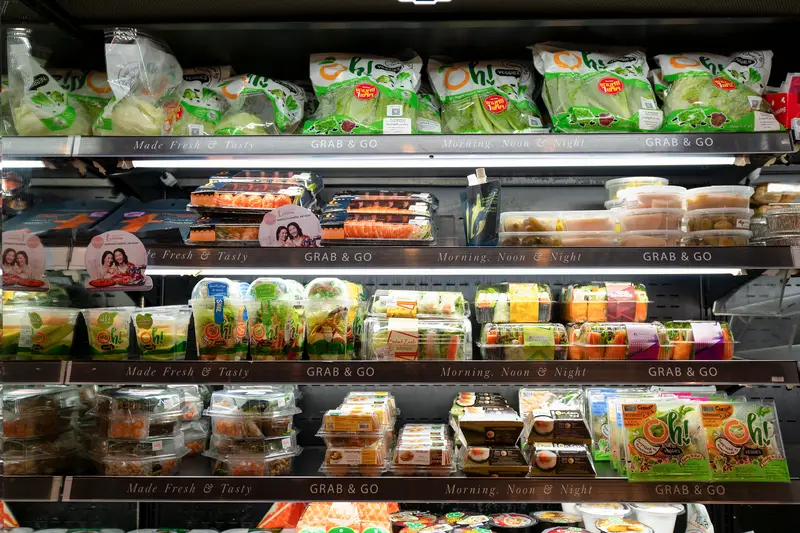
Quick question. When was the last time you cleaned out your fridge? Because if you live in Minnesota or Wisconsin and you have a habit of grabbing lunch at the gas station, there might be a chicken wrap in there you want to deal with right now. The USDA just put out a warning telling people to stop eating a specific grab-and-go wrap, and it has a name you have probably walked past a hundred times.
The government doesn’t tell you to throw out food for fun. So let me break down exactly what got flagged, why it happened, and what you should do if one of these is sitting on your shelf right now.
The Exact Wrap You’re Looking For
This is not a vague “check your chicken” situation. The warning is laser specific. On June 25, 2026, the USDA’s Food Safety and Inspection Service named one product: the 8.7-ounce “FRESH SEASONS Kitchen Chicken Caesar Wrap.” It comes in clear plastic, so you can see the wrap right through the packaging.
Flip it over. On the back label, right above the ingredients, you’re looking for “Sell By: 6/24/2026.” There’s one more clue too. Inside the round USDA mark of inspection, you’ll see the establishment number “P-45091.” If your wrap checks those boxes, that’s the one. These were made on June 16, 2026, which gave them a pretty short shelf life to begin with.
Where You Would Have Picked One Up
You didn’t find these at a fancy grocery store. They were sold at Holiday convenience stores, the gas station chain, in just two states: Minnesota and Wisconsin. If you’ve never set foot in a Holiday, this whole thing probably doesn’t touch you. But across the Upper Midwest, Holiday is everywhere, and their refrigerated grab-and-go shelf is a go-to for people who want something fast that isn’t a hot dog spinning under a heat lamp.
A regional outlet covering that exact area pointed out that shoppers in both states could have grabbed one without thinking twice. That’s the tricky part with convenience store food. You buy it, you eat it in the car, you never look at it again. Which is why a warning like this matters even when the actual number of stores is small.
Why This Is an “Alert” and Not a Recall
Here’s a wrinkle that confuses people. The USDA did not request a formal recall. It issued something called a public health alert instead. The reason is almost funny in how simple it is: the sell-by date was June 24, and the warning came out June 25. By the time the news hit, the product was already off the shelves and no longer for sale. You can’t recall something stores aren’t selling anymore.
So how did anyone catch this? Routine testing. According to the food safety reporting, a sample of the wrap came back positive for Listeria monocytogenes during normal FSIS product checks. The good news buried in all this: there have been no confirmed reports of anyone getting sick from these wraps. The warning is more of a “just in case you stashed one” heads-up than a response to a wave of illness.
Who Actually Makes These Wraps
The “Fresh Seasons” name might not ring a bell, and that’s because it’s a store brand, not a company you’d see advertised. The wraps are made by Taher, Inc., a Minnesota food service company that’s been around since 1981. It was started by Bruce Taher, and these days it serves something like 34 million meals a year with a team of more than 3,000 people. They run dining for schools, college campuses, senior centers, and corporate cafeterias.
The Fresh Seasons line is their grab-and-go retail brand, built specifically with Holiday Stationstores to put fresh, chef-made food on convenience store shelves. The whole pitch was “chef inspired” salads and wraps instead of the usual gas station fare. That’s the irony here. This wasn’t some no-name mystery food. It was the upscale option, the one you’d grab thinking you were doing better than a bag of chips.
Why Cold Doesn’t Always Save You
Most of us assume that if food is sitting cold in the fridge, it’s fine. Listeria is the weird exception to that rule. Unlike a lot of other bacteria, it can keep growing at refrigerator temperatures, even below 40 degrees. So tossing a wrap in your fridge for a couple days doesn’t put the brakes on it the way you’d expect.
Ready-to-eat foods like wraps are the kind of thing that gets flagged most, and the reason is simple. According to the federal guidance, these foods never get cooked before you eat them, so there’s no heat step to kill anything off. You unwrap it and bite in. That’s exactly why the advice on a wrap like this is short and blunt: don’t try to be clever about it, just get rid of it.
It Wasn’t the Only Chicken Flagged That Day
June 25 turned out to be a busy day for the USDA. The chicken wrap was actually one of three chicken-related actions announced at the same time, which is unusual to see all stacked on one date. The agency described it as a single-day sweep across a few different product types and stores.
The other two had nothing to do with the wrap and nothing to do with Listeria. They were label problems. One involved Private Selection Honey Dijon chicken breasts sold at Kroger and Fred Meyer, where eggs were in the product but not listed on the label. The other was a pasta salad recall from Reser’s that turned out to actually be chicken salad with egg and milk that weren’t declared. Different issues, different brands, just bad luck landing on the same calendar day.
What To Actually Do Right Now
If you’ve read this far and you’re thinking, “wait, I think I have one of those,” here’s the plan. Go check your fridge for the 8.7-ounce Fresh Seasons Kitchen Chicken Caesar Wrap with the 6/24/2026 sell-by date. If you find it, do not eat it. Don’t pick around it, don’t taste-test it. Throw it out, or take it back to the Holiday where you bought it for a refund.
If you have questions, you can reach Taher’s communications team at communications@taher.com, or call the USDA Meat and Poultry Hotline at 888-674-6854. You can also report a problem with the product through the USDA’s online complaint system, which runs 24 hours a day. The official details are public, so you don’t have to take my word for any of it.
The Honest Takeaway
Realistically, the odds that you still have one of these wraps are low. The sell-by date passed before the warning even came out, so most of them got eaten or tossed long ago. But fridges are weird places. Stuff gets shoved to the back, forgotten behind the leftovers, hidden under a takeout container. That one rogue wrap is exactly what this alert is trying to catch.
The bigger lesson is just a good habit. When you grab fast food from a cooler shelf, glance at the date, and don’t let it sit around for days assuming the fridge will keep it safe forever. These food safety actions happen more often than people notice, usually quietly, and the easiest way to stay ahead of them is to actually clean out your fridge once in a while. Go look now. Worst case, you find an old wrap and a science experiment that used to be salad dressing. Both belong in the trash anyway.

