

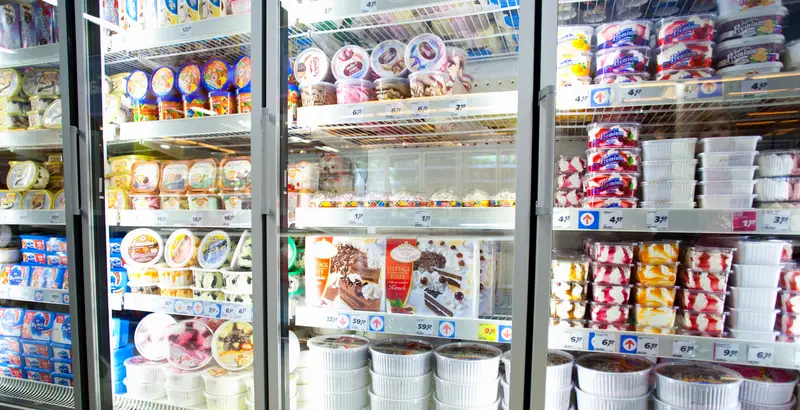
Here’s a scene that plays out in freezer aisles all over the country. You want a little treat. You reach for a pint. Then you flip it over, see the sticker, and suddenly you’re doing math you didn’t sign up for. Ice cream is not cheap anymore. The average half gallon hit $6.49 in June 2025, which is nearly 33% higher than it was just four years ago. And that’s the regular stuff. The fancy pints? Those regularly ring up at $10, $12, and sometimes $13 for one little tub.
So the real question isn’t whether the expensive brands taste good. Some of them do. The question is whether they taste so much better than the competition that they’re worth double the money. And after looking at blind taste tests, ingredient labels, and some genuinely annoying package sizes, the honest answer is no. There’s one brand in particular that gets called out again and again, and I think that reputation is earned.
Jeni’s Is The One That Stings The Most
If we’re naming names, Jeni’s Splendid Ice Creams is the brand that makes wallets cry. It’s the most expensive mainstream ice cream in America, and a single pint runs close to $10 in a lot of stores. That’s the going rate for a pint. Not a quart. Not a half gallon. A pint. And if you really love the stuff, Jeni’s will happily sell you a year-long subscription for $780, or a three-month plan for $195. Read that again. You could pay almost $800 a year to have ice cream mailed to your door.
Nobody’s saying Jeni’s is bad. It’s a solid product with real cream and interesting ideas. But at that price, “solid” isn’t good enough. As one breakdown put it, the issue isn’t quality in a vacuum. It’s whether Jeni’s is so far ahead of everything else that it justifies costing nearly twice as much. Spoiler: it isn’t.
Where Jeni’s Actually Falls Flat
Here’s where it gets interesting. In a ranked tasting of nine premium brands, Jeni’s shined with its weird, creative flavors. The Brambleberry Crisp got called “sublime,” and the Bubble Gum was described as refreshing and sweet. So far so good. But the moment you order something normal, the magic fades fast. Jeni’s honey vanilla came out much less sweet and much less vanilla-forward than what other premium brands were serving.
That’s a problem. Most people don’t eat exotic flavors every night. They eat vanilla, chocolate, cookies and cream, the classics. And when multiple brands deliver fun flavor combos for several dollars less, it gets hard to rank Jeni’s higher on creativity alone. The verdict was blunt: Jeni’s falls short on value compared to the field. You’re paying top dollar for a brand that only wins when it gets weird.
You’re Paying For The Story, Not The Scoop
A lot of what you pay for at the high end has nothing to do with what’s inside the tub. It’s the pretty packaging. It’s the artisanal backstory. It’s the little paragraph on the lid about small farms and single-origin whatever. That stuff costs money to produce, and guess who pays for it? You do, at checkout.
The uncomfortable truth from repeated blind tests is that mid-priced pints keep beating the most expensive options. When people can’t see the label, the branding stops mattering and the ice cream has to stand on its own. A lot of the time, the $6 pint wins. That makes premium pricing really tough to justify, because novelty and a nice font are quietly standing in for actual superior quality.
What “Premium” Even Means
Let’s clear something up, because “premium” and “super-premium” get thrown around like they mean something official. They kind of do inside the industry, but they’re not legally enforced terms. The International Dairy Foods Association has a formal list of standards that sorts products into quality tiers, and the real dividing line comes down to a word most shoppers have never heard: overrun.
Overrun is the amount of air whipped into the ice cream while it’s churned and frozen. Budget brands pump in a lot of air, which is why cheap ice cream feels fluffy and light and disappears fast. The pricey stuff has low overrun, so it’s denser, creamier, and heavier. Low overrun usually comes with a higher percentage of butterfat, and that’s what gives you that rich, thick mouthfeel. Fun twist: not everyone even likes the dense version. Plenty of people find super-premium ice cream too rich. Back in 2013, a Breyers rep told the New York Times the brand rolled out a line of frozen dairy desserts specifically because customers actually preferred that lighter texture.
You’re Literally Paying For Air
Here’s a trick worth knowing. Brands don’t print the overrun on the carton, but you can guess it by weight. The heavier a container feels, the less air is packed inside, and the denser the product. Super-premium brands like Häagen-Dazs run around 20% air. A lower-tier brand like Breyers vanilla sits closer to 45% air. So yeah, with the cheap stuff, a real chunk of what you carry to the register is basically whipped-in nothing.
Fat content, on the other hand, is right there on every label, and it’s a reliable tell for premium quality. Higher-fat ice cream melts slower and has fewer ice crystals, so it feels smoother. But here’s the catch that matters for your money: the actual improvement from premium to super-premium is incremental. A little more fat. A little more density. Meanwhile the price can jump 3 to 5 times higher. Small upgrade, giant bill. That math does not add up.
The Incredible Shrinking Pint
Now for the part that really burns. You’re not just paying more per pint. In a lot of cases, you’re getting less pint. Häagen-Dazs quietly shrank its standard U.S. containers from 16 ounces to 14 ounces all the way back in 2009. That means technically those tubs aren’t even pints anymore, even though the shape and the branding still say “pint” to your brain. Canada got hit again in 2025, dropping from 500 ml to 450 ml.
The novelties took it on the chin too. Klondike Bars used to weigh 5 ounces and now weigh 4, a 20% cut with no price drop. Magnum bars shrank from 120 ml to 100 ml. Nestlé Drumstick cones slipped from 4.6 ounces to 4.1 ounces, an 11% cut with no public notice. Companies swear the recipes didn’t change, but a smaller product for the same price is a price hike wearing a disguise. And people notice. A YouGov survey found 72% of U.S. shoppers have clocked shrinkflation in their food, and they are not thrilled about it.
Even The Government Noticed
When your grocery gripe makes it into an official federal report, you know it’s real. In July 2025, the U.S. Government Accountability Office put out a report on shrinking product sizes, and ice cream got named as a direct example. The report pointed out that a pint of ice cream that used to be 16 fluid ounces might now be 14, with subtle package tweaks that make the shrink hard to spot.
The report confirmed that shrinkflation raises the effective price you pay, and that for specific categories like coffee, cereal, candy, and ice cream, the hit to your buying power is real. It even looked at policy ideas like requiring labels on downsized products, though it admitted that would be tough to enforce. The takeaway is simple. When you drop $10 on a “premium pint” that’s measurably smaller than it used to be, you’re feeling a squeeze the government itself has acknowledged.
The Brands That Didn’t Play The Game
Not everybody shrank, and that matters. Ben & Jerry’s kept its full 16-ounce pint and ran a 2024 campaign called “Still a Pint” to rub it in. They even bought a giant digital billboard in Times Square that launched on August 12, 2024, calling out rivals who cut their tubs to 14 ounces while still saying “pint” on the label. This isn’t new for them either. They first went after Häagen-Dazs over the exact same move back in 2009.
One consumer researcher made the sharpest point of all. Because some brands kept their packaging consistent, it proves the shrinking was a choice, not some unavoidable cost of doing business. If rising costs truly forced everyone’s hand, every brand would have done it. They didn’t. And even the “honest” pint from Ben & Jerry’s still costs $5 to $7 at the store, so nobody in this aisle is exactly handing out bargains.
So What Should You Actually Buy
Here’s my honest advice as the friend who reads the labels so you don’t have to. Skip the $10 status pint. Jeni’s is fine, but it only earns its price when you buy the oddball flavors, and it loses to cheaper brands the second you want a classic scoop. If you love genuinely rich, dense ice cream, Häagen-Dazs vanilla is the real deal, with a milky base, actual vanilla bean flavor, and a clean sweet finish. Funny enough, in that nine-brand ranking it still only landed in third place, which tells you how strong the competition is once you stop chasing the most expensive name.
The smartest move is to taste across the whole range, including the mid-priced pints and even the lighter frozen dairy desserts. Some people genuinely prefer that fluffier texture, and if that’s you, congratulations, you get to save a fortune. The freezer aisle is packed with brands charging more and quietly giving you less. Don’t let a fancy lid and a $10 sticker convince you that you’re getting something twice as good. Most of the time, you’re not.

