

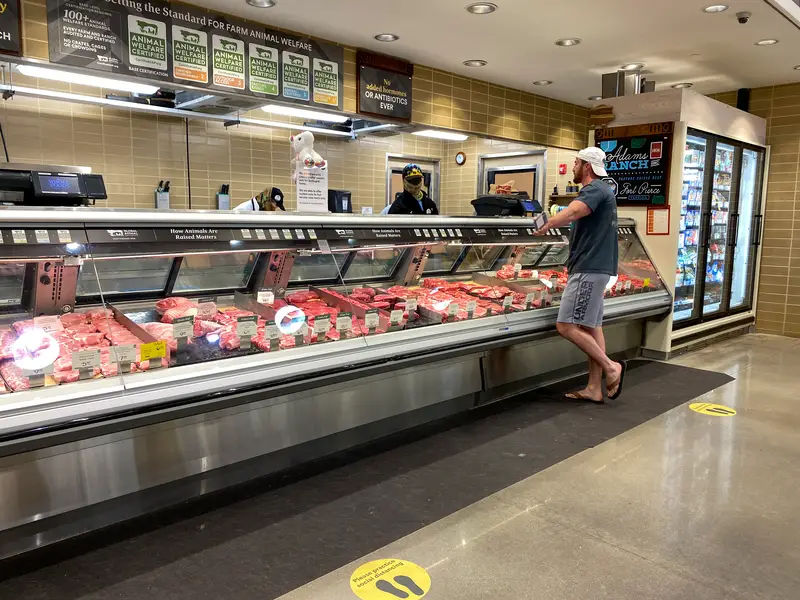
Buying meat at the grocery store shouldn’t feel like gambling. But depending on where you shop, that’s basically what you’re doing. Between mislabeled weights, questionable freshness, missing butchers, and prices that make zero sense, some of America’s biggest grocery chains are genuinely bad places to buy protein. And the worst part? Most of us shop at these stores every single week without thinking twice about it.
I went through the research, the Reddit horror stories, the consumer complaints, and the expert opinions to put together a ranking of the worst grocery stores to buy meat from right now. These are listed from bad to absolute worst.
7. Kroger
Kroger gets a lot of things right. People love their seafood department, and they run solid sales. But their ground beef is a different story. Customer complaints about Kroger’s private-label ground beef center on one theme: it spoils way too fast. We’re talking about meat going bad before the listed expiration date, whether people store it in the fridge or the freezer. That’s not a storage problem. That’s a product problem.
Kroger also got caught up in the massive BrucePac recall in October 2024, where nearly 12 million pounds of meat and poultry were pulled due to possible listeria contamination. Products like their Mexican-style street corn salad were included on the USDA’s 326-page recall list. That’s not a small issue. The store isn’t the worst overall, which is why it lands at the bottom of this list, but if you’re buying ground beef there, keep your expectations in check.
6. Safeway
Safeway is one of those stores that does a lot of things okay but nothing particularly well when it comes to meat. According to Consumers’ Checkbook, which evaluates grocery stores on both quality and price, Safeway rated low for the quality of fresh produce and meats. That’s a rough look for a chain that’s supposed to be a full-service grocer.
On top of the quality concerns, Safeway was also pulled into the BrucePac listeria recall through its Albertsons parent company. Twelve prepared foods sold under the ReadyMeals brand, as well as store-made deli items at Safeway locations, contained recalled meat. Reddit shoppers have also noted it’s hard to know when real deals are running, and that scoring a discount at Safeway doesn’t mean you’re getting good meat — it might just mean the store needs to move product before it expires.
5. Whole Foods
There’s a reason people call it “Whole Paycheck,” and nowhere is that nickname more deserved than in the meat department. Whole Foods charges some of the highest markups compared to other supermarkets, and the thing is, the gap between Whole Foods and the competition has shrunk dramatically.
A few years ago, Whole Foods was one of the only reliable spots to find organic chicken and grass-fed beef. That gave them a real edge. But now? Plenty of regular grocery stores carry organic and specialty meats that meet the exact same USDA national organic standards. Many stores actually use the same suppliers as Whole Foods, especially for private-label products. So you could literally be buying identical meat at another chain for significantly less money. The organic label isn’t exclusive anymore, and Whole Foods hasn’t adjusted its pricing to reflect that reality. You’re paying a premium for a brand name, not better beef.
4. Trader Joe’s
Let me be clear — Trader Joe’s meat isn’t bad. Nobody’s finding gray chicken or mold-covered shelves. The quality is solid. Customers have praised tender filets, juicy sausages, and good ribeyes. The problem is what you pay for them.
One pound of chicken at Trader Joe’s costs $6.49, while the same quality chicken at Walmart goes for $4.94. That’s more than $1.50 difference per pound. A fatty $21-per-pound New York strip had Reddit users saying flatly: “You don’t buy meat from TJ’s.” Others pointed out that for the price of a single Trader Joe’s steak, you could get multiple steaks at Costco of equal or better quality.
There’s also a weird pricing quirk. Dark meat chicken costs the same as white meat at TJ’s, which makes no sense when dark meat costs less literally everywhere else because it has more fat and takes more prep. Part of the problem is packaging — Trader Joe’s tends to package meat in smaller portions meant for smaller households. That sounds convenient, but it kills any chance of a bulk discount. For a store beloved for its snack aisle, the meat section is a place loyal fans know to skip.
3. Aldi
Aldi is genuinely great for a lot of things. Pantry staples, snacks, that random center aisle where you somehow end up buying a kayak. But the meat section has earned complaints that keep piling up. Shoppers have reported finding bones in chicken that’s labeled boneless, which is the kind of problem that turns a quick weeknight dinner into an annoying ordeal.
Other customers have reported buying meat that was slimy and gray despite being well within its use-by date. On the ground beef front, the fat content is wildly inconsistent. Some shoppers say it feels closer to a fifty-fifty split of fat and lean instead of the ratio listed on the label. Combine that with reports of off-putting smell and taste, and Aldi’s ground beef lands on the avoid list. Aldi was also involved in the BrucePac listeria recall of 2024, though that was limited to prepared meal products rather than raw meat. Still, not a great look for a chain trying to be taken seriously in the fresh food game.
2. Walmart
Where do you even start with Walmart? In January 2026, a man named Jimmy Wrigg visited Walmart stores around Atlanta with a scale and a TikTok account, weighing meat packages to check pricing accuracy. What he found was blatant mislabeling — some packages were off by as much as double the listed weight. That’s not a rounding error. That’s customers paying steak prices for air.
But the issues go beyond pricing. Reddit users have posted photos of gnarly, discolored meat sitting on Walmart shelves, and at least one employee has claimed that meat is rarely rotated properly, meaning spoiled product sits out for unsuspecting shoppers. Consumer Reports ranks Walmart among the most complained-about grocers, with criticism focused on the lack of variety and the overall quality of meat and poultry.
Walmart relies heavily on case-ready ground beef — pre-ground, pre-packaged, shipped directly from processing plants. No in-store butchers grinding fresh meat. Shoppers frequently report that it discolors almost immediately after purchase, turning an unappetizing brown. Others say the fat content is higher than what’s advertised, and the meat spoils before the expiration date. And the price? Often over $6 a pound, which used to be reasonable but now feels insulting given the quality. Walmart has plans to open a new case-ready factory to gain more control over its beef supply chain in the Midwest. Whether that actually fixes anything remains to be seen.
1. Target
Target is the worst grocery store to buy meat from right now, and it’s not particularly close. The store didn’t even start selling groceries until 1995, and it took years after that for most locations to have a real meat section. That late start shows. Target doesn’t have a dedicated meat counter. There are no trained butchers working in the store. Most of what you’ll find is sold under their Good & Gather private label, which sources from a wide range of largely unknown suppliers.
Customer complaints about Good & Gather meat are harsh. People have reported bone fragments in boneless pork and chicken loaded with excess fat and veins that need to be trimmed off. Private-label steak gets passable reviews, but that seems to be the only category that doesn’t get destroyed online. One Reddit user summarized it well — for the prices Target charges, you’d be better off buying meat from a store that actually has a department set up to handle it properly.
But the most disturbing reports come from Target employees themselves. Multiple workers have written about horrific meat handling standards. One said that pulling out and cleaning the meat shelves was one of the most disgusting things they’d ever done. Another described shelves covered in mold and dried blood. When the people stocking the shelves are telling you not to eat what’s on them, it’s time to listen.
What To Do Instead
The easiest fix is to buy meat from stores with actual butcher departments — places like Costco, H-E-B, or Publix, where someone on staff knows how to cut and handle meat properly. Local butcher shops are even better. Professional butcher Luis Mata has warned that ground meat from grocery store counters poses the highest contamination risk because most of it comes pre-ground from massive processing facilities. Specialty butchers grind their own meat from premium cuts, controlling quality and fat content in ways a big-box store simply can’t.
Yes, you’ll probably pay a bit more at a real butcher shop. But as James Peisker, co-founder of Porter Road, puts it, those higher prices exist because small butcher shops do the extra work to seek out farms that take care of their animals and land. That work should be worth supporting. And honestly, when you look at what Walmart and Target are charging for questionable meat these days, the price gap isn’t as big as you’d think.
A Consumer Reports investigation that tested 351 meat samples from stores nationwide found salmonella in samples of ground beef, pork, chicken, and turkey. Almost a third of the ground chicken tested contained the bacteria. One contaminated lot of ground beef can spread across many packages because a single package is derived from meat of multiple cows mixed together. At the very least, wash your hands in hot soapy water before, during, and after handling raw meat, and cook everything to proper temperatures. But the smarter move is just to be pickier about where you shop in the first place.

