

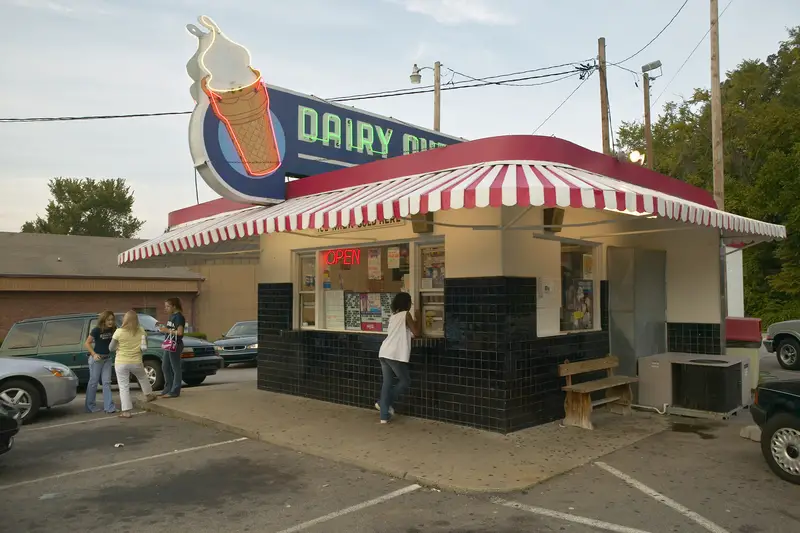
You’ve probably been going to Dairy Queen your entire life thinking you were eating ice cream. Your parents took you there after Little League games. You’ve ordered Blizzards on road trips. You’ve argued with friends about whether the Oreo or the Reese’s version is better. And the whole time, not once were you actually eating ice cream.
This isn’t some technicality that lawyers argue about in footnotes. Dairy Queen itself will tell you, right on its own website, that what it serves is not ice cream. The company has never served ice cream. Not when it opened in 1940, not when it introduced the Blizzard in 1985, and not today across its 7,700 locations. So what exactly have you been eating all these years?
The 5% Problem
Here’s the simple version. The FDA says a frozen dessert needs to contain at least 10% milkfat (also called butterfat) to legally be called “ice cream.” That’s the cutoff. It’s been the rule for decades. Dairy Queen’s soft serve contains exactly 5% butterfat. That’s half the legal minimum. Not close. Not borderline. Half.
This isn’t something they’re trying to hide, either. Their FAQ page states it plainly: “To be categorized as ice cream, the minimum butterfat content must be 10 percent, and our soft serve has only 5 percent butterfat content.” They’re surprisingly upfront about it.
That fat content matters because it’s what gives real ice cream its dense, creamy texture and its ability to hold a scoop shape. The higher the fat, the richer and thicker the product. At 5%, DQ’s soft serve is lighter, airier, and a lot less substantial than what you’d get from a pint of Ben & Jerry’s or Häagen-Dazs.
What DQ Officially Calls Its Product
If you read a Dairy Queen menu carefully, you’ll notice something interesting. The words “ice cream” don’t appear anywhere. Not on the cones, not on the sundaes, not on the Blizzards. Instead, you’ll see terms like “Blizzard Treat,” “Vanilla Cone,” and “Hot Fudge Sundae.” The word “ice cream” is deliberately left out of every single product name.
Dig into the official ingredient disclosure, though, and you’ll find the technical name for what they actually serve: “Artificially Flavored Vanilla Reduced Fat Ice Cream.” That classification, “reduced fat ice cream,” is the FDA’s term for frozen dairy products that fall below the 10% milkfat threshold but still contain enough dairy to be in the general ice cream family.
Pastry chef Dana Cree, who wrote the book “Hello, My Name Is Ice Cream” and founded Pretty Cool Ice Cream in Chicago, put it this way: “We have come up with other fun names to refer to it by.” The naming is intentional. It’s not a mistake or an oversight. It’s a legal requirement that DQ has built its entire branding around.
It Used to Be Called “Ice Milk”
Before 1995, DQ’s soft serve fell into a category the FDA called “ice milk.” That was the official classification for frozen dairy desserts with milkfat content between 2.5% and 10%. Then federal regulations changed, and the “ice milk” category was eliminated. Products that used to be called ice milk got sorted into new buckets: “reduced-fat,” “light,” or “low-fat” ice cream, depending on their exact fat content.
DQ’s soft serve landed in the “reduced-fat” category. Their shake mix, which has even less fat, qualifies as “low-fat” ice cream. But here’s the thing that really gets people: the recipe never changed. Not once. DQ has been using the exact same soft serve formula since 1940. The only thing that shifted was the government’s labeling system. The product in your cone today is the same one people were eating in Joliet, Illinois, more than 80 years ago.
About 40% of Your Cone Is Air
The lower fat content is only part of the story. The other big difference between DQ’s soft serve and real ice cream is how much air gets pumped into it. According to Wired, roughly 40% of a Dairy Queen soft serve is air. Some estimates put it between 40% and 45%.
In the ice cream world, this air content is called “overrun.” The FDA actually has rules about this for real ice cream. The final product can’t exceed 100% overrun, meaning no more than half the finished product can be air. Soft serve machines continuously churn and whip air into the mix as it’s being dispensed, which is what gives it that light, smooth, almost whipped-cream-like texture.
This is also why you’re getting less actual product per serving than you might think. That big, swirly cone looks impressive, but a large percentage of what you’re looking at is literally nothing. Air. The manufacturer gets more servings out of less raw material, which is a pretty smart business move if you think about it.
The Full Ingredient List, Decoded
DQ’s website lists the following ingredients in its soft serve: milkfat and nonfat milk, sugar, corn syrup, whey, mono and diglycerides, artificial flavor, guar gum, polysorbate 80, carrageenan, and vitamin A palmitate.
Some of those are straightforward. Milkfat and nonfat milk are your dairy base. Sugar is sugar. But the rest of the list gets more interesting.
Corn syrup isn’t just there for sweetness. It contains glucose that helps with texture and prevents the soft serve from crystallizing when it sits in the machine. Whey is a byproduct of cheesemaking, and it adds protein and dairy content, but the USDA limits how much whey can go into real ice cream because too much of it makes the product taste “graham crackery” and feel sandy in your mouth.
Mono and diglycerides are emulsifiers. They keep the fat and water from separating. Polysorbate 80 does a similar job and also acts as an anti-melting agent. Guar gum and carrageenan (which comes from red seaweed) work together as thickeners and stabilizers. Vitamin A palmitate gets added to replace vitamins that are lost when you reduce the fat content of a dairy product.
Every single one of these ingredients is FDA-approved. The combination is specifically engineered to keep the product consistent across thousands of franchise locations, which is no small feat when you think about the range of climates, altitudes, and machine calibrations involved.
Why the Blizzard Doesn’t Fall Out of the Cup
This is actually connected to the whole not-ice-cream thing. The Blizzard gets served upside down at every DQ location, and if the server forgets to flip it, you’re supposed to get a coupon for a free one on your next visit. It’s a tradition that dates back to the 1960s, even though the Blizzard itself wasn’t introduced until 1985.
The reason it doesn’t fall out has everything to do with the soft serve’s unique composition. The combination of high air content, emulsifiers, stabilizers, and that specific 18-degree Fahrenheit serving temperature creates a density and thickness that real ice cream at the same temperature wouldn’t have. Regular ice cream served that warm would slide right out of a cup. DQ’s product, because of its specific engineering, holds its shape.
When the Blizzard launched in 1985, it was an immediate hit. DQ sold more than 100 million of them in the first year alone. The upside-down gimmick turned into one of the most effective marketing campaigns in fast food history, and it works precisely because the product isn’t real ice cream.
DQ Isn’t the Only One Playing This Game
Dairy Queen gets the most attention for this, probably because it has “Dairy” right there in the name, but plenty of other products pull the same move. Nestlé Drumsticks, for example, are branded as “Sundae Cones” rather than ice cream cones because they use a mix of vegetable oils instead of enough butterfat to qualify. Walk down the frozen aisle at any grocery store and you’ll see a bunch of products carefully worded as “frozen dairy dessert” or “frozen treat” instead of ice cream. Same reason. They can’t legally use those two magic words.
The distinction between ice cream and everything else in the freezer case is basically a fat content line in the sand drawn by the federal government. On one side, you’ve got products with 10% or more milkfat. On the other side, you’ve got everything from DQ soft serve to gelato to whatever that store-brand tub in the back of your freezer actually is.
The One Time DQ Actually Sold Ice Cream
There was a brief moment in DQ history when the chain did try to sell the real thing. In 1981, Dairy Queen launched a line called “Queen’s Choice,” which was actual hard ice cream that met the FDA’s 10% milkfat requirement. It didn’t last. The product line was eventually abandoned, and DQ went back to doing what it had always done best: serving soft serve that tastes great, flips upside down, and isn’t technically ice cream.
Warren Buffett’s Berkshire Hathaway bought the entire company in 1998 for $585 million, and clearly nobody at Berkshire thought the not-ice-cream thing was a problem worth fixing. If anything, the lower fat content is a feature, not a bug. It’s what makes the product work at 18 degrees, what makes the machines viable for franchise operations, and what keeps the texture exactly where DQ wants it.
Does Any of This Actually Matter?
Honestly? Probably not in any way that changes your Friday night Blizzard order. DQ has been selling the same formula since 1940. Over 100 million Blizzards sold in a single year. More than 7,700 locations worldwide. People clearly like the stuff regardless of what the FDA calls it.
But it’s one of those things that, once you know it, you can’t unknow it. The next time you pull up to a DQ drive-through and order a large vanilla cone, just know that what you’re getting is “Artificially Flavored Vanilla Reduced Fat Ice Cream” that’s roughly 40% air, served at 18 degrees, held together by seaweed extract and emulsifiers, and legally not allowed to call itself ice cream. J.F. McCullough called it “a queen among dairy products” back in the 1930s. He just never called it ice cream.

