

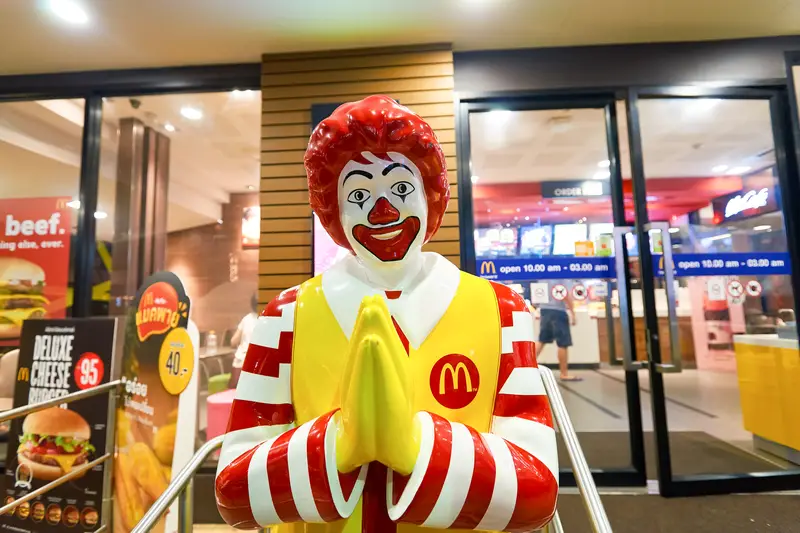
If you drove past a McDonald’s sometime during the last week of June 2025 and noticed the drive-thru line looking a little thinner than usual, there was a reason. A grassroots organization called The People’s Union USA launched a week-long national boycott of the chain from June 24 through June 30, calling on customers to skip the Golden Arches entirely. No burgers, no app orders, no breakfast runs. The group wanted to hit McDonald’s where it hurts most: the register.
But this wasn’t just about overpriced Big Macs (though that came up too). The boycott landed at the intersection of rising prices, corporate diversity rollbacks, ongoing discrimination lawsuits, and a broader wave of consumer activism that has already cost other major corporations real money. Here’s what’s actually going on.
The Boycott Organizers and Their Demands
The People’s Union USA, led by founder John Schwarz, framed the McDonald’s boycott as part of a larger “economic blackout” movement. The group describes itself as nonpartisan and unaffiliated with any political party. Their Instagram post announcing the boycott read: “This is about more than burgers and fries, this is about power.”
Their core demands included fair taxes, an end to price gouging, real equality, and corporate accountability. Pretty broad, yes. But the specific trigger was clear: McDonald’s decision in January 2025 to roll back several of its diversity, equity, and inclusion commitments. The group urged consumers to avoid McDonald’s completely for seven days, including digital and app orders.
Schwarz called the movement “people-powered change.” And this wasn’t his group’s first rodeo. The People’s Union USA had already organized similar boycotts targeting Amazon, Walmart, and Target. A nationwide “economic blackout” was also planned for July 2025, with month-long boycotts of Starbucks, Amazon, Home Depot, Walmart, Lowe’s, and McDonald’s again scheduled for August.
What McDonald’s Actually Changed on Diversity
In January 2025, McDonald’s announced it was ending some of its specific diversity goals. That included dropping requirements for suppliers to commit to certain DEI targets and stopping participation in external surveys that measure corporate diversity. The company also renamed its diversity team from whatever it was called before to the “Global Inclusion Team.”
The timing was hard to ignore. President Donald Trump had recently signed executive orders dismantling federal DEI programs, and several major corporations followed suit, either quietly or not so quietly. McDonald’s cited the “shifting legal landscape” created by the Supreme Court’s 2023 ruling in the Harvard admissions case, suggesting the decision could eventually affect corporations too.
McDonald’s insisted that inclusion remained one of its “core values” and said it “opens our doors to everyone.” But for critics, the changes felt like the company was bending to political pressure rather than standing by commitments it had loudly made in prior years.
Black Former Franchisees Joined the Boycott Call
The boycott picked up serious weight when more than 40 Black former McDonald’s franchise operators publicly backed it. These weren’t random activists. They were people who had owned and operated McDonald’s restaurants, some for decades, and who are currently pursuing a federal civil rights lawsuit against the company.
The lawsuit, filed in 2023 by Chicago-based civil rights firm Loevy + Loevy, alleges systemic racial discrimination. The claims are specific and damning: Black owners were allegedly steered into low-profit stores in high-crime areas, denied the chance to purchase locations in predominantly white neighborhoods, and forced to sell their restaurants at below-market prices to white buyers that McDonald’s “hand-picked.”
The numbers tell a stark story. From 1998 to 2020, the number of Black franchisees dropped from 377 to 186. During that same period, total McDonald’s locations worldwide more than doubled from about 15,000 to nearly 39,000. Roughly half of all Black franchisees were pushed out of the system by 2020, compared to only 10% of white owner-operators. Stores owned by Black franchisees earned only about two-thirds of the average McDonald’s store revenue.
Delores Crawford, who owned nine restaurants in Georgia and South Carolina from 1988 to 2018, said: “When the environment turned adversarial I was really, really disappointed.” For these former operators, McDonald’s January DEI rollback was not a surprise. It was confirmation of what they say they’d experienced for years.
A Separate Discrimination Lawsuit Is Headed to Trial
On top of the franchisee case, McDonald’s is also facing a discrimination lawsuit from two former high-ranking Black executives, Vicki Guster-Hines and Domineca Neal. A federal judge allowed key claims to proceed to a jury trial, including four counts alleging a hostile work environment and two counts of unlawful retaliation.
Among the incidents cited by the court: McDonald’s USA CEO Chris Kempczinski allegedly told a group of Black executives at a 2019 meeting that McDonald’s was not committed to racial diversity and that most of the Black executives in the room deserved lower-ranking positions than they held. A supervisor allegedly invoked the stereotype of “angry Black women” against the plaintiffs.
Guster-Hines, who spent 33 years at the company, said she worked every day to make McDonald’s “a better company and an inclusive place to work” and was subjected to a hostile work environment in return. McDonald’s had already settled a separate lawsuit about racial stereotyping and exclusion of Black media advertising opportunities, brought by Byron Allen, for an undisclosed amount. The legal pile-up adds real reputational pressure on top of the consumer boycott.
The Price Problem That Won’t Go Away
Even without the DEI controversy, McDonald’s was already in trouble with its core customers. Prices at McDonald’s locations have gone up roughly 40% since 2019. That stat alone has been a lightning rod for anger about food inflation, and it’s been a constant talking point on social media for years now.
The company saw same-store sales slow and then drop over 2024 and the first half of 2025, with lower-income consumers pulling back hard. In the Q3 2025 earnings call, CEO Kempczinski acknowledged the split: traffic from lower-income consumers was declining by nearly double digits, a trend that had persisted for almost two years. Meanwhile, traffic from higher-income customers was growing at nearly double digits.
In other words, the people McDonald’s was built for are the ones leaving. A chain that made its name on dollar menus and affordable family meals was losing exactly the customers who made it an American institution.
McDonald’s Response: Value Menus and New Franchisee Rules
McDonald’s didn’t sit still. The company brought back the $5 Meal Deal, launched a “McValue” menu in January 2025 with a “Buy One, Add One for $1” deal, and relaunched Extra Value Meals in September 2025, including a $5 Sausage McMuffin and an $8 Big Mac Meal. Same-store sales bounced back into positive territory in the second half of 2025.
Then in December 2025, McDonald’s announced new franchising standards effective January 1, 2026, designed to hold franchise owners more accountable on pricing. The company would now assess how franchisees’ prices deliver value to customers, evaluate their use of pricing tools, and grade their support for system-wide promotions.
Why? Because about 95% of McDonald’s locations are independently owned franchises, and prices vary wildly. A Big Mac in Seattle cost $6.99 in December 2025. The same Big Mac in Boise, Idaho was $5.19. That kind of gap makes it impossible for the corporate brand to have a consistent value message.
Franchisees Aren’t Happy Either
The new pricing standards didn’t go over well with everyone who owns a McDonald’s. The National Owners Association, an independent group of franchisees, pushed back with a “15-item Franchisees Bill of Rights.” Their concern was straightforward: being forced to lower prices below sustainable levels, especially in high-cost markets like New York or San Francisco, could bankrupt operators.
McDonald’s charges franchisees rent based on a percentage of sales, sometimes 18% or even higher. When corporate demands lower prices while still collecting the same rent percentage, the math gets ugly for the person actually running the restaurant. Franchisees also worried that the evaluation criteria could be subjective, with adverse ratings based on standards that keep changing.
So you have a situation where McDonald’s is being squeezed from every direction. Customers are angry about prices and DEI rollbacks. Franchisees are angry about new corporate rules. Former Black owners and executives are suing over discrimination. And the broader consumer activist movement is growing, not shrinking.
Do These Boycotts Actually Work?
Here’s the thing. The skeptic’s take is that a one-week boycott of the world’s biggest fast food chain won’t matter. And maybe for a single week, that’s true. But the broader pattern says otherwise.
Target is the clearest example. After megachurch pastor Rev. Jamal Bryant led a 40-day boycott over Target’s own DEI reversal, Target admitted that customer backlash contributed to falling sales. Comparable sales dropped 3.8% in Q1, with a 5.7% decline in store traffic. Net sales fell to $23.8 billion, down 2.8% from the prior year. Target CEO Brian Cornell pointed to declining consumer confidence and shopper backlash as contributing factors.
McDonald’s was already reporting its second consecutive quarter of sales declines when the boycott launched. The company was losing lower-income customers at an alarming rate. Adding organized consumer pressure on top of that wasn’t exactly ideal timing for the Golden Arches.
Whether the McDonald’s boycott alone moves the needle is almost beside the point. What’s happening is bigger than one week or one chain. Consumers are learning that their spending is a form of leverage, and they’re getting more organized about using it. McDonald’s just happens to be the biggest target on the board right now.

