

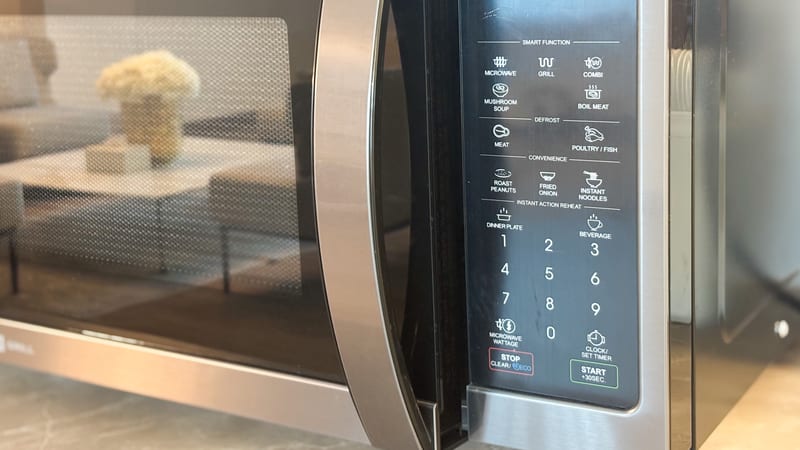
Count the buttons on your microwave. A typical panel carries well over a dozen of them, yet most households touch four: the number pad, start, stop, and the add-30-seconds key. Everything else sits there backlit and untouched for the life of the appliance.
Those presets are not as clever as their labels suggest. There is no scale, no scanner and no camera inside the cavity. “These buttons are based on averages, like a typical portion size, starting at fridge temperature,” retired home economist Paula Rhodes, who spent years developing microwave recipes, told Reader’s Digest. Food, she points out, is rarely average. “Food isn’t always ‘average’ or the same shape, which can affect cooking time, so the results can be off.”
The reason your microwave has a Pizza key and your neighbor’s has a Frozen Vegetable key is not engineering. Asked why the panels never match, Rhodes is blunt: “Honestly, it’s more marketing than science.” Every company wants to look different on a shelf.
Microwaves are in more than 96% of U.S. homes, and in almost all of them one button does more for the food than the rest of the panel combined. It is also the one almost nobody presses: power level.
10. Beverage
The worst button on the panel is the one that promises the simplest job. Beverage runs a timer of roughly 30 to 90 seconds to warm a cup of liquid, with no knowledge of whether you are heating a four-ounce espresso cup or a 20-ounce diner mug filled to the brim. Walk away and come back and the coffee is usually scalding.
Steph Chen, founder of the microwave cookware company Anyday, did not mince words about it to Reader’s Digest: “I wouldn’t bother with this one.” The better system takes ten seconds of effort once. Time your own mug, find the number that gets it where you like it, and use that number forever. For most people it lands somewhere between 20 and 60 seconds depending on the machine and how cold the drink has gone.
9. Pizza
A preset that cannot possibly do what the name implies. Pizza runs about 45 to 90 seconds a slice, and it is tuned aggressively. “This is meant for reheating a slice or two, but it’s often too strong,” Chen says. No microwave setting restores a crisp crust, because steam is the enemy of crust and steam is what a microwave makes.
Chen’s preferred method does not involve the appliance at all: “I always think reheating pizza is best on a pan, low heat, covered, so that it steams and crisps.” A toaster oven works too, if you have the extra few minutes. If you are going to microwave it anyway, ignore the preset and dial it down. “Use 50% to 70% power for gentler reheating and better texture,” she says. The cheese stays cheese instead of turning into an oil slick.
8. Express Cook
Express Cook, Instant On, One Touch, whatever your brand calls it, is the add-30-seconds button wearing a suit. Press it and the machine runs a minute or two at automatic power, which is to say full blast. For a mug of water or a damp dish towel, fine. For anything dense, it is the exact behavior that produces a lava-hot rim and a frozen core.
It ranks this low because it actively discourages thinking. The button exists to be fast, and speed at 100% power is what dries out rice, splits sauces and turns the edge of a casserole to leather. Sensor reheating, where the machine decides when to stop, beats it on almost every plate of leftovers you will ever put in there.
7. Popcorn
The most familiar preset on the panel is calibrated to a bag you may not be holding. Popcorn runs a fixed time, generally two to four minutes, built around a standard 3.2-ounce bag. Buy the smaller mini bags, or a store brand with a different fill, and the preset keeps running long after the kernels have finished.
Use your ears instead of the timer. Chen’s rule is to listen for the pops to slow to about two seconds apart and stop the machine then, even if there is time left on the display. Every extra ten seconds past that point is pure burnt kernel. The button is not useless, it is just a starting estimate that you should be prepared to override.
6. Frozen Dinner
Honest work, narrow application. The Frozen Dinner preset assumes a traditional 10- to 12-ounce frozen entree and runs roughly four to six minutes. Hold to that assumption and it performs. Stray from it, with a two-pound family tray or a 7-ounce single, and the math stops working, because the button is guessing at a weight it cannot measure.
Chen’s advice is to skip the plastic tray entirely, which she says sheds microplastics, and move the food into a glass dish with a lid before heating. That also solves the preset’s other weakness: the shallow black trays these meals ship in spread food thin and wide, which is precisely the shape that cooks unevenly in a microwave. A covered glass dish traps steam and evens things out.
5. Soup
Soup is one of the few foods a microwave is genuinely good at, which is why its preset survives the cull. The button runs longer than Beverage, usually one to two minutes, on the assumption that a bowl holds more than a mug. Foods with high water content heat well in a microwave; dry foods only get drier.
Two habits make it work. Stir halfway through so the hot ring at the outside of the bowl gets folded into the cold center, and cover the bowl to stop the pops and splatters that coat the inside of the cavity. Chen recommends both. The preset is not doing anything you could not do with the number pad, but for once the default is close enough to right.
4. Potato
The Potato button is a set timer and does not pretend otherwise, running roughly four to seven minutes per potato, with some models asking how many you are cooking. There is no sensing, no weighing, just a duration that somebody at the factory decided suits a medium baking potato.
That makes it the most repeatable preset on the panel, because potatoes are the one food that comes in a fairly standard size. Cook one successfully and the trick is to keep buying potatoes that look like it. Chen’s one caution before you press start: “Pierce the skin first so [the potato] doesn’t burst.” A single button that does a single job and does it the same way every time is more than most of this panel can claim.
3. Defrost
Defrost is the first button on the list that changes how the machine cooks rather than how long. It drops to low power and thaws gradually, and most models ask you to enter the weight or volume, running roughly one to two minutes per half pound. On many microwaves the setting sits around 30% power.
The physics explain why patience is faster here. A microwave heats liquid water far more readily than ice, so it works on the thin thawed layer at the surface and lets that layer warm the ice beneath it. “If the microwave is at full power, it will evaporate too much of that water layer for it to efficiently penetrate the ice,” Chen says. Blasting frozen chicken on high is how you get grey cooked edges around a frozen middle. Low and slow, by Chen’s account, actually gets there sooner.
2. Sensor Cook
Sensor Cook and Sensor Reheat are the only buttons that react to what is happening inside the box. As food heats, it releases steam, and the sensor reads the moisture in the cavity and decides when the job is done, adjusting power and time on the fly instead of counting down a number you guessed at. On many GE models the sensor pads cover vegetables, potatoes, fish, chicken, meat, popcorn and beverages.
It only works if you cooperate. Cover the dish loosely, with a vented lid or wrap and never sealed tight, so the steam reaches the sensor at the right pace. Start with a dry cavity and a dry dish, since stray water beads turn to steam and fool the reading. And leave the door shut until the countdown appears, because opening it early throws the reading off.
What keeps it off the top spot is that you are handing over control to a system you cannot see. “The challenge is, you don’t know which system your microwave is using, and even with the best sensors, it doesn’t know key details, like the thickness of your food, starting temp or whether you’re using a cover,” Chen says of the automatic settings. When it is right, it is the best button here. When it is wrong, you have no steering wheel.
1. Power Level
This is the button you have never used, and it is the only one that turns a microwave into something closer to a stove. Most machines offer ten power levels and default to all of them being irrelevant, because they start at full power unless you say otherwise.
“Think of adjusting your microwave’s power level similarly to adjusting the heat on your stove or your oven,” Chen says. “You wouldn’t cook everything under your broiler or on high heat on your stove. The same thing goes for the microwave.” On a standard machine the magnetron does not weaken, it pulses. At 70% power it runs 70% of the time and rests for the other 30%, and during those rests the heat already in the food keeps spreading inward. Microwaves only penetrate about 1 to 1 1/2 inches, which is the entire reason a burrito can be scorching at the edge and icy at the core. The pauses are what let the middle catch up. Microwaves built with inverter technology are the exception, delivering steady power rather than cycling.
The practical numbers are easy to remember. Around 80% suits casseroles and pasta. Roughly 40% melts chocolate without seizing it. About 30% defrosts by hand. Full power should be reserved for beverages and high-water foods like soups and some vegetables, the things that were always going to survive it. Chen cooks cheesecake at power level 4 to keep the texture silky and avoid scorching the cheese and cream, steams rice and quinoa low so they do not boil over, and says fish and chicken “both come out stunningly well at lower power.” Her summary of the whole idea: on low power, “it’s harder to overcook!”
Two more keys worth finding while you are reading the panel: the mute or sound control, which kills the end-of-cycle beeping, and the child lock, usually triggered by holding Clear/Off for about three seconds until the display reads LOCK.
The verdict is not complicated. Most of these buttons are timers with marketing names attached. One of them changes the cooking. Learn where the power level key is on your machine, drop it to 50 or 70 for anything you care about, add a minute, and stop blaming the microwave.

