

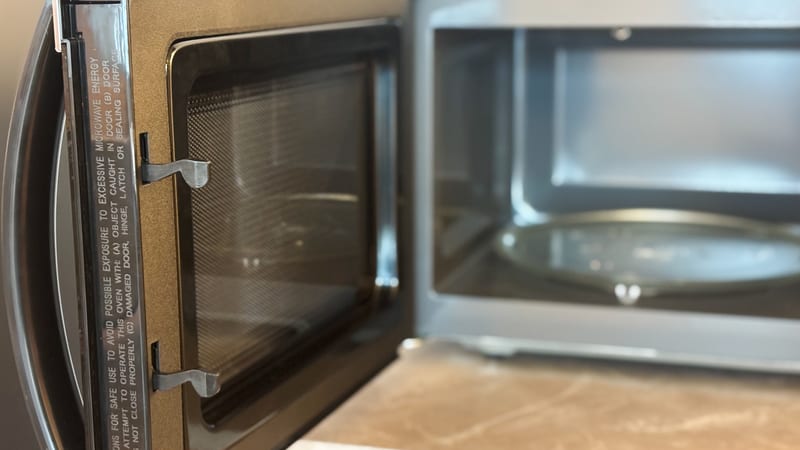
The container the pad thai came in goes straight into the microwave, three minutes on high, and dinner is handled. The USDA has a list of problems with that, and the first one is not the plastic. It is the food itself. Microwave ovens cook unevenly, which leaves cold spots where bacteria can survive, and the microwaves only penetrate food about 1 to 1 1/2 inches deep. Anything thicker gets cooked by heat creeping inward from the outside. That is why the center of a big piece of chicken can still be cool while the edges are scalding.
The Cold Spot Is The Entire Warning
Almost every microwave rule the agency publishes traces back to one thing: the food does not heat at the same rate everywhere. Arrange food evenly in a covered dish, add a little liquid if it needs it, and cover with a vented lid or microwave wrap so moist heat builds. Stir or rotate halfway through. When you check the temperature, check in more than one place, because a single reading can land on a hot spot and miss a cooler pocket an inch away. The 165°F target applies to the coolest part of the dish, not the first place the probe went in. Food sitting between 40°F and 140°F is on the clock, and a cold spot is a pocket of food sitting right in that range.
Big Cuts Need Low Power, Not High
Blasting a roast on full power is the most common way people fight the inch-and-a-half limit, and it does not work. Large cuts of meat should run on medium power, 50 percent, for a longer stretch, which gives the heat time to work its way to the center instead of cooking the outside into leather. Whole stuffed poultry is off the table entirely. The USDA does not recommend microwaving it, because the stuffing in the middle may never reach the temperature it needs while the bird around it looks done.
The Three Minutes After The Beep
Standing time is not a suggestion and it is not the same thing as letting dinner cool. Food keeps cooking after it comes out, because the molecules are still moving and still generating heat, and the temperature keeps climbing and evening out. The guidance is at least three minutes before you check anything. Pull the plate, let it sit covered, then put a clean thermometer in it. Checking the second the door opens gives you a reading that is already out of date.
The Numbers Worth Taping Inside A Cabinet
Ground meats need to hit 160°F. Beef, pork, lamb and veal steaks, chops and roasts need 145°F minimum. All poultry goes to 165°F. Eggs and casseroles, 160°F. Fish, 145°F. Leftovers of any kind get reheated to 165°F. Sauces, soups and gravies are the exception to the thermometer routine: those should come to a rolling boil. Ready-to-eat stuff like hot dogs, lunch meat and fully cooked ham gets heated until it is steaming hot, not just warm to the touch. Cooked food goes back in the fridge within two hours, and within one hour if the room is above 90°F.
Defrost, Then Cook, With Nothing In Between
Microwave defrosting starts cooking parts of the food while other parts are still frozen solid. That is why meat, poultry, egg casseroles and fish have to be cooked immediately after they come out of the defrost cycle, not set on the counter while you find the pan. Take the food out of its store packaging first. The foam trays and plastic wrap under a package of chicken thighs are not heat stable, and melting or warping can let chemicals move into the food. The same logic kills the parcooking shortcut: never partially cook something and store it for later. If you are starting a dish in the microwave to finish it on the grill, it goes on the grill right then.
The Containers That Should Never Go In
Cold-storage tubs are the big one. Margarine tubs, cottage cheese and yogurt cartons, whipped topping bowls and single-use takeout containers were never approved for cooking, and they can warp or melt. Foam cups, bowls, plates and trays are out. So is china with metallic paint or trim, takeout containers with metal handles, metal twist ties, and anything completely wrapped in aluminum foil. Thin plastic storage bags, brown paper bags, plastic grocery bags and newspaper never belong in there. The things that are fine: microwave plastic wrap, wax paper, cooking bags, parchment paper and white microwave-safe paper towels. Plastic wrap should not touch the food even when it is the right kind. Plastics cleared for heating usually say so on the bottom, and if yours says nothing, move the food to glass or ceramic.
Ziploc Has Its Own Rulebook And Nobody Reads It
The USDA’s position on thin plastic storage bags is blunt: do not use them. The brand’s own instructions are narrower than most people assume. Regular Ziploc bags are cleared only to defrost or reheat food, with the zipper left open at least one inch and the bag sitting on a microwave-safe dish. The company flags high-fat and high-sugar foods as heating up very fast, and warns that overheating the contents can melt the bag. Zip ‘n Steam bags are the ones actually built for microwave cooking, and even those are not meant for greasy or sugary food, with a full minute of waiting before you handle them.
Sparks, Gold Rims And The Carrot Problem
Arcing is the little light show that makes people think their microwave died. Gold paint on a dish will do it. So will a forgotten twist tie or any metallic material. The surprise entries are raw carrots and hot dogs, which can spark because of their mineral content. Nothing about that makes a carrot a bad vegetable. It means the inside of a microwave is a stranger environment than the one-button interface suggests.
The Foods That Fight Back
Eggs in the shell build steam with nowhere to go, and the USDA warns they can burst during cooking or after you take them out. That includes reheating a whole hard-boiled egg, so cut it up first. Whole potatoes need the skin pierced several times before they go in. Thick sauces and gravies trap steam under the surface and let it loose the second you stir, which is how people redecorate a ceiling. Whole grapes are a genuinely odd case: researchers have found that grape-sized objects full of water can concentrate electromagnetic fields and, under the right conditions, produce plasma. Hot peppers send their spicy compounds into the air, so opening the door is its own event. Frozen fruit thaws into a mess of boiling edges and frozen middle unless you use low power and short bursts.
Microwave Safe Means Less Than You Think
That little icon on the bottom of a container is the maker’s own claim, not an FDA certification. It says the plastic will hold its shape under heat without warping or melting. It does not promise nothing moves from the container into the food. A 2023 University of Nebraska-Lincoln study published in Environmental Science & Technology heated two polypropylene baby food containers and a polyethylene pouch for three minutes at full power in a 1,000-watt microwave, and some released as many as 4.22 million microplastic and 2.11 billion nanoplastic particles per square centimeter. A Greenpeace International review of 24 peer-reviewed studies cites one that found polypropylene and polystyrene containers shedding between 100,000 and 260,000 particles when microwaved after refrigerated or frozen storage, and another that found two polypropylene containers releasing an estimated 326,000 to 534,000 particles after five minutes of microwave heating, four to seven times what oven heating produced.
Condition matters more than brand. Old or scratched containers released nearly twice as many particles as new ones, and repeated washing and reuse pushed migration higher. The takeout tub you have rinsed six times is not the same object it was. One 2023 study in Food Chemistry found something stranger: when potatoes were microwaved inside plastic packaging, a UV photoinitiator from the plastic bonded with a sugar from the potato starch and formed a new compound. Greenpeace has asked regulators to ban “microwave safe” and “oven safe” claims on ready meal packaging. The European Food Safety Authority, which expects to publish an opinion on microplastics in food by the end of 2027, has found that particles do move from packaging into food, at much lower levels than some earlier studies suggested.
A Boil Test Tells You What Your Microwave Is Worth
Cooking times on a frozen dinner box assume a machine stronger than the one in a lot of kitchens. The USDA publishes a time-to-boil test to estimate wattage: water that boils in under two minutes means 1,000 watts or more, two and a half minutes means around 800 watts, three minutes puts you at 650 to 700 watts, and more than three to four minutes means you are working with 300 to 500 watts, which behaves like a slow oven. An old apartment microwave running at half the wattage the package assumed is not going to get a frozen entree to temperature on the printed time, no matter how hot the edges feel.
What A Microwave Is Actually Good At
Reheating. Defrosting, if you cook the food right after. Steaming vegetables. Melting butter without dirtying a pan. Cooking raw proteins from scratch is where the machine is weakest, and the standard advice from food safety specialists is that the stovetop, the grill and a conventional oven do that job better, because they heat food from every direction instead of an inch and a half in.
The habits that fix most of this take ten seconds. Move food to glass or ceramic labeled for the microwave. Cover it, then vent the lid so steam escapes. Stir halfway. Let it stand three minutes. Check the coolest part with a thermometer. Throw out the scratched, cloudy containers you have been reusing since 2019. None of that makes dinner take longer than the commercial break you are already waiting through.

