

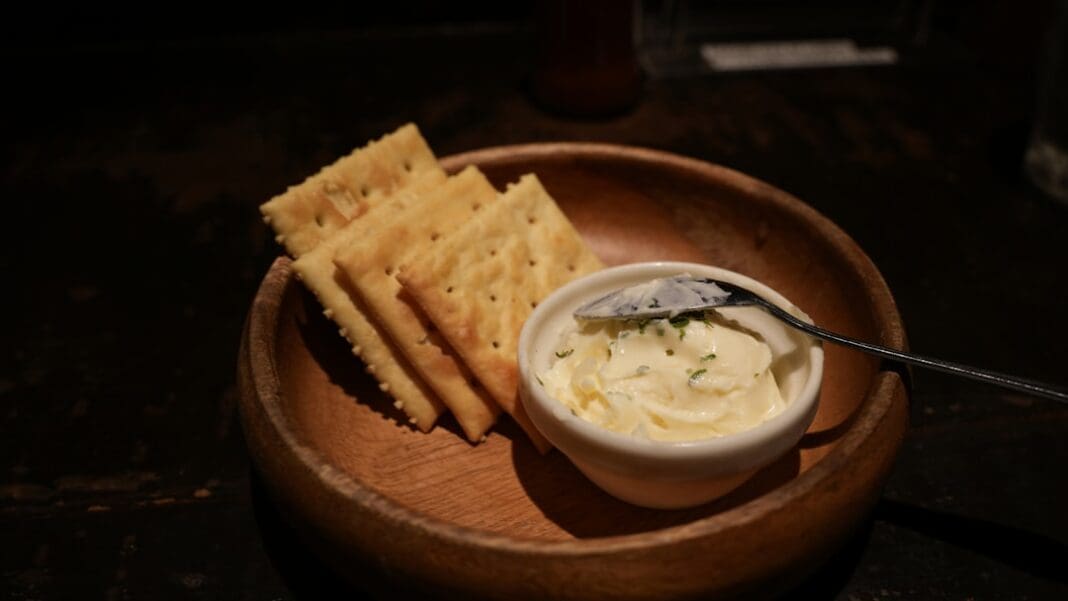
Every state has weird laws on the books. Maybe it’s illegal to carry an ice cream cone in your back pocket in Alabama, or you can’t sing off-key in North Carolina. But Wisconsin has a food law so bizarre, so specific, and so fiercely protected that it’s still being enforced (technically, at least) well into the 2020s. And lawmakers are actually trying to make it stricter.
We’re talking about margarine. Yes, the butter substitute that’s been sitting quietly in American refrigerators for over a century. In Wisconsin, it’s basically treated like contraband. And the story behind how it got there is wilder than you’d expect.
Margarine Is Literally Illegal to Serve in Wisconsin (Unless You Ask for It)
Under Wisconsin state law, it is illegal for any restaurant or public eating place to serve you margarine instead of butter unless you, the customer, specifically request it. That’s not a guideline. It’s not a suggestion. It’s an actual statute, complete with real penalties. If a restaurant gets caught slipping you margarine when you didn’t ask, the punishment can include fines between $100 and $500, up to three months in prison, or both.
Let that sink in. A diner in Kenosha could theoretically face jail time for putting a tub of Country Crock on your table without asking first.
The law also prohibits serving margarine to students, patients, or inmates of any state institution as a substitute for butter. The only exception is if a doctor orders it. So if you’re a college student eating at a state university dining hall in Madison, that spread on your toast had better be real butter, or someone’s breaking the law.
How Wisconsin Went to War With a Spread
To understand how Wisconsin ended up in a decades-long feud with margarine, you have to go back to the 1800s. Margarine was invented in France in 1869 as a cheap substitute for butter. It crossed the Atlantic quickly, and the American dairy industry immediately saw it as a threat. Congress passed an act in 1886 regulating the new product and taxing it to squash its popularity.
Wisconsin, already deeply tied to dairy farming, went further. In 1895, the state legislature banned the manufacture or sale of yellow-colored margarine entirely. See, margarine is naturally white. Companies were dyeing it yellow to make it look like butter, and sometimes outright labeling it as butter or mixing it in with real butter to cut costs. Wisconsin said absolutely not.
Thirty-one other states passed similar bans, but nobody held the line like Wisconsin. While most states started relaxing their restrictions in the 1950s after wartime butter shortages made margarine a practical necessity, Wisconsin refused to budge. The Badger State was literally the last state in America to permit the sale of yellow-colored margarine, finally caving in 1967. That’s nearly a century after margarine was first produced.
The Senator Who Got Busted by His Own Wife
The story of how the 1967 ban was finally lifted is genuinely one of the funniest things in American political history. State senator Gordon Roseleip was one of the loudest voices against margarine in the legislature. He was vocal, passionate, and absolutely certain he could tell butter from margarine.
So someone challenged him to a blindfolded taste test. He agreed. And he failed. Spectacularly.
But the real kicker came after the test, when it was revealed that his own wife had been secretly serving him margarine at home and telling him it was butter. She’d been buying it across state lines in Iowa, where it was legal. The man who spent years railing against margarine in the state capitol had been happily eating it at his own dinner table the entire time.
After that humiliation, the ban on selling yellow margarine was lifted. But the restaurant restriction stayed.
Wisconsin Women Ran a Margarine Smuggling Operation
During the 1950s and ’60s, while the full ban was still in effect, many Wisconsin women went on what became known as “oleo runs.” They’d drive across the border into Illinois to stock up on margarine because it was cheaper and was considered a modern alternative to butter at the time.
This was technically illegal. The fine for oleo bootlegging could run up to $6,000, which was a serious chunk of money in the 1950s. But there’s no evidence the law was ever actually enforced against any of these smugglers. Imagine getting pulled over on I-94 with 40 pounds of Country Crock in your trunk. The whole thing sounds like a comedy sketch, but it was a real part of daily life in Wisconsin for years.
Other states had their own versions of the oleo wars. South Dakota and Vermont both had strong dairy lobbies and criminalized margarine. Some states got creative: they’d sell margarine, but only if it was dyed cotton-candy pink so nobody could possibly mistake it for butter. Problem solved, apparently.
Kerrygold Butter Was Also Banned Until 2017
Wisconsin didn’t just go after margarine. From 1970 until 2017, the state had a separate regulation requiring all butter sold in Wisconsin to carry a federal grade mark. That sounds innocent enough until you realize it effectively banned Kerrygold, the beloved Irish butter that happens to be the second best-selling butter in the entire United States, right behind Land O’Lakes.
Because Kerrygold is made in Ireland, it didn’t carry the required U.S. grade mark. Store owners who sold it could face $1,000 in fines or up to six months in prison. For selling butter. In America’s Dairyland. The irony is thick enough to spread on toast.
The ban was finally lifted in late 2017 after Kerrygold agreed to comply with Wisconsin’s butter-grading test. So if you’re in Wisconsin now, you can grab a block of Kerrygold without worrying about doing time.
Lawmakers Are Actually Trying to Make the Margarine Laws Stricter
You’d think in 2025 this would be a forgotten relic of an old law, something people laugh about and ignore. But no. A bipartisan group of Wisconsin state lawmakers actually introduced a bill in late 2025 to tighten restrictions on margarine even further.
State Rep. Todd Novak, a Republican from Dodgeville, said the bill was a direct response to family farmers who showed up at a September meeting of the Iowa County Farm Bureau and voiced strong opposition to margarine being served in schools. “I grew up milking cows,” Novak said. “This is kind of the type of bill I love doing because it’s constituent-oriented.”
Wisconsin’s more than 5,000 dairy farms contribute nearly $53 billion every year to the state economy, according to the Department of Agriculture, Trade and Consumer Protection. That’s not a small lobby. When dairy farmers in Wisconsin say they don’t want margarine in schools, legislators listen.
Restaurants Don’t Even Bother Carrying Margarine
The practical effect of this law is that most Wisconsin restaurants simply don’t carry margarine at all. Why would they? If they can only serve it when someone specifically asks for it, it’s not worth keeping in stock.
John Wise, the Director of Operations for Bartolotta Restaurants in Wisconsin, put it plainly: “We don’t carry margarine. If guests don’t want butter we provide olive oil. It’s not a request we get often for margarine, perhaps once in a while.”
A push in 2011 to finally repeal the restaurant margarine law went nowhere. The law, it seems, isn’t going anywhere either. Wisconsin’s state law still dedicates about 500 words to regulating margarine. Five hundred words! Most restaurants don’t put that much effort into their entire menu descriptions.
Wisconsin Also Has a Proposed Warning Label Law for 51 Ingredients
While the margarine situation gets most of the attention, Wisconsin lawmakers are casting a wider net too. In October 2025, the state Assembly introduced Assembly Bill 550, which would require warning labels on any packaged food containing any of 51 specific ingredients. The list includes things like titanium dioxide, BHA, BHT, acesulfame potassium, bromated flour, carrageenan, diacetyl, and dozens more.
If passed, food products sold in Wisconsin containing any of these ingredients would need to carry a prominent label reading: “WARNING: This product contains an artificial color, chemical, or food additive that is banned in Australia, Canada, the European Union, or the United Kingdom.” Violators could face criminal penalties from $100 to $5,000, or up to one year of imprisonment.
The bill follows similar laws recently enacted in Texas and Louisiana. Whether or not it passes, the fact that Wisconsin is pursuing this alongside its century-old margarine restrictions paints a pretty clear picture. This is a state that does not mess around when it comes to what goes on your plate.
The Bottom Line: Wisconsin Takes Its Butter Very Seriously
So to answer the question in the headline: margarine. That’s what’s illegal to use in Wisconsin. Not in your home (you can eat whatever you want there), but in restaurants, schools, and state institutions, the stuff is essentially banned unless someone goes out of their way to ask for it. The law has survived for over a century, dodged multiple repeal attempts, and is actually getting strengthened in 2025.
Wisconsin’s license plates say “America’s Dairyland,” and they clearly mean it. If you’re visiting the state and you sit down at a restaurant, just know that the yellow spread on your bread is the real thing. Because if it wasn’t, somebody could technically go to jail.

