

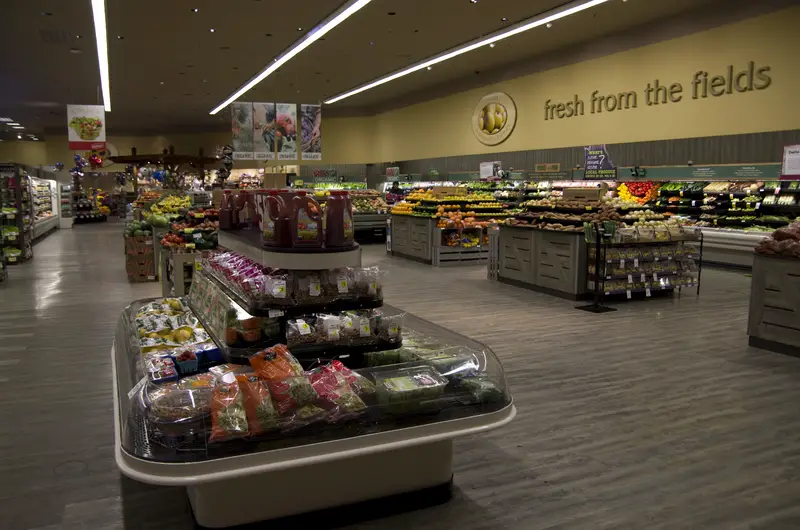
If your neighborhood Safeway has felt a little emptier lately, you’re not imagining things. The 111-year-old grocery chain is shutting down more locations heading into 2026, and it’s not a one-off. This has been building for a couple of years now, and the reasons behind it are messier than a spilled gallon of milk in aisle five.
Safeway is one of those stores that just feels permanent. It’s been on street corners for generations. Your grandparents probably shopped there. So when a brand that old starts locking its doors, people notice. Let me walk you through what’s actually happening, why it’s happening, and what it means the next time you go looking for eggs and bread.
A Store That Started With $1,089
Safeway did not start as some corporate powerhouse. Back in April 1915, a guy named Marion Barton Skaggs bought his father’s tiny 576-square-foot grocery store in American Falls, Idaho. The price? Just $1,089. That’s it. From that one little shop, he built a retail empire that grew to 428 stores before merging with the Safeway network in 1926.
Here’s a fun fact most people don’t know. Safeway helped invent stuff we all take for granted now. Per-pound pricing on produce? That was them. Those “sell by” dates on your yogurt? Also Safeway. Even the idea of giving customers a parking lot came from this chain. They shaped how grocery shopping works in this country, which makes the current shrinking act sting a little more.
For most of its final decade as an independent company, Safeway pulled in more than $35 billion a year in revenue, peaking around $44 billion in 2008. Then in January 2015, Albertsons scooped it up for roughly $9.4 billion, and Safeway stopped being its own boss after 87 years running solo.
Which Stores Are Actually Going Dark
Let’s get to the part everyone cares about. So far in 2026, at least a dozen locations have closed or been marked to close, according to a detailed breakdown of local reports and the company’s own store locator. And these aren’t just Safeway signs coming down. The closures hit sister brands too, including Acme, Balducci’s, Randalls, and Vons, plus regular Albertsons stores.
One of the most talked-about closures is the Safeway at Hechinger Mall in Washington, D.C., over on 1601 Maryland Ave NE. That store served the neighborhood for nearly 40 years. It shut down on May 16, and its pharmacy had already closed on April 1. The company’s official line was pretty corporate: they said the lease was ending and they decided to “reinvest our resources into other existing stores.”
More than half of the 2026 closures are clustered in two states, California and Texas. Others have popped up in New Jersey, Connecticut, Nevada, and D.C. And this follows a rough 2025, when the parent company closed somewhere between two and three dozen stores. So the 2026 wave isn’t some sudden shock. It’s a continuation of a trend that’s been rolling for a while now.
The Merger That Blew Up Everything
To understand why all this is happening, you have to rewind to 2022. That’s when Kroger, the biggest traditional grocery chain in America, agreed to buy Albertsons in a deal worth around $24.6 billion. It would have created a grocery giant so big it could go toe-to-toe with Walmart. Both companies were betting on it.
Then it fell apart. In 2024, the Federal Trade Commission sued to block the deal, arguing it would kill competition and jack up prices for millions of shoppers. Regulators also worried it would weaken workers’ bargaining power. Federal and state judges agreed the merger was unlawful, and by late 2024 both companies walked away.
That left Albertsons in an awkward spot. The company had basically been getting ready to fold into Kroger. When that plan died, it had to rethink its entire operation as a standalone business. Suddenly every underperforming store looked like dead weight, and the pruning began.
Why California And Texas Got Hit Hardest
There’s a logic to where the closures landed. California and Texas are the two states where the company runs its densest store networks, which means lots of locations packed close together. It’s also where the competition is brutal. In Texas especially, they’re up against H-E-B, a regional chain Texans are borderline obsessed with.
When you’ve got a bunch of your own stores competing with each other AND a beloved rival stealing customers, the math gets ugly fast. So the chain has been steadily cutting underperformers in exactly those crowded markets. The Texas closures alone accounted for 138 jobs, while two Vons closures in California hit another 135 jobs.
The Layoffs Nobody Wants To Talk About
Store closures are only half the story. The company has also been cutting jobs at the corporate level. In 2026, it announced plans to lay off 295 corporate and divisional support staff. That came after earlier rounds that eliminated hundreds of positions, including 225 jobs at a Phoenix office and 156 across two offices in Pleasanton, California.
The good news, if you can call it that, is the company says store-level workers aren’t part of that particular corporate cut. And in D.C., the company leaned toward reassigning employees rather than firing them outright. Still, when a store closes, the people who worked there have to scramble, and that’s real for a lot of families.
Follow The Money
Here’s what’s really driving all this. Back in early 2025, the company revealed a plan to cut $1.5 billion in expenses by 2027. A big chunk of that is aimed at selling, general, and administrative costs, which is the boring corporate stuff like office overhead and back-office operations.
The financial pressure is no joke either. The company reported a net loss of $481 million in the fourth quarter of its 2025 fiscal year. A lot of that came from a $774 million lawsuit settlement tied to allegations about its pharmacies. The company admitted no wrongdoing in reaching that settlement, but a hit like that still shows up on the books.
CEO Susan Morris has talked about making “smarter decisions” through technology and finding “sustainable efficiencies to reinvest” in growth. In plain English, that means closing stores that don’t make enough money and pouring the savings into online shopping, automation, and the locations that actually turn a profit.
What Closed In 2025
The 2026 closures follow a busy 2025. Back in September of that year, Safeway announced it would close 12 stores within a few weeks. Ten of those were in Colorado, with one each in Nebraska and New Mexico. At the time, Safeway still operated more than 900 stores nationwide, so the cuts were a small slice, but a telling one.
The company blamed store performance, which is the standard reason. If a location isn’t pulling its weight, it goes on the chopping block. Kroger, by the way, has been doing the same thing on its own side, announcing plans to close 60 of its stores by mid-2026. This isn’t just one chain tightening its belt. It’s happening across traditional supermarkets.
What This Means For You At The Register
So why should you care if a store two towns over closes? Because fewer stores usually means less competition, and less competition tends to mean fewer reasons for the remaining stores to keep prices low. When your closest affordable option disappears, you either drive farther or pay more where you can get to. Neither is fun.
The bigger picture is that shoppers are simply changing where they buy food. A recent industry outlook found that specialty retailers are gaining ground while traditional supermarkets are losing it. Names like Publix and Safeway are seeing shoppers pull back across every income group. Meanwhile Walmart and Costco keep vacuuming up business with their low prices and bulk deals.
To put the scale in perspective, the parent company still runs 2,243 stores under 22 different banners across 35 states. Names you’d recognize include Safeway, Vons, Jewel-Osco, Shaw’s, Acme, Tom Thumb, Randalls, Pavilions, Star Market, and Carrs. So even with all the closures, this is still a massive operation. It’s just a smaller one than it was a year ago.
The takeaway is pretty simple. If you shop at Safeway or one of its sister brands, keep an eye on your local store’s status and don’t be surprised if the map keeps shifting. A brand can be 111 years old and still have to fight for every dollar. That’s the reality of the grocery business right now, and the folks running these companies are betting that a leaner footprint beats a bigger one that bleeds cash.

