

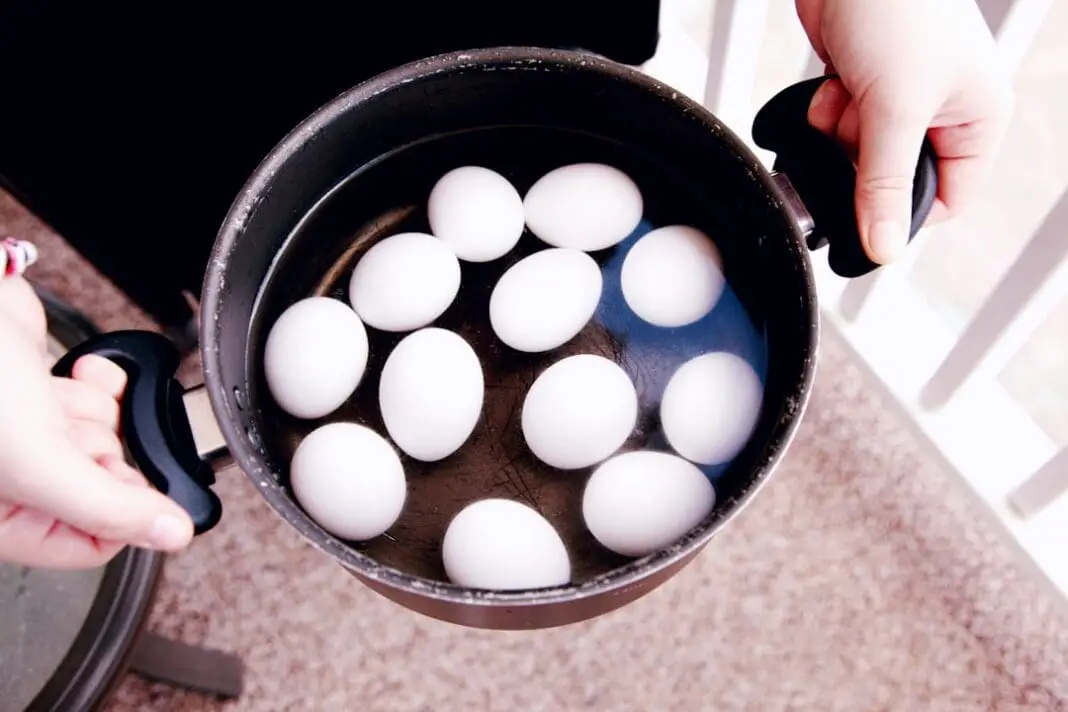
Here’s a fun experiment. Go boil an egg right now, the way you’ve always done it. Cut it in half. If you see a grayish-green ring hugging the yolk, congratulations. You’ve been overcooking your eggs, probably for your entire life, and you never even questioned it because that’s just what a boiled egg looked like to you.
You’re not alone. Most people treat boiling eggs like it’s the simplest task in the kitchen, something that requires zero attention. Toss the eggs in water, boil them for a while, pull them out whenever you remember. But that casual approach is exactly why so many people have never actually eaten a properly cooked hard-boiled egg. The mistake is overcooking, and it affects everything from the color to the smell to the texture. Once you fix it, you’ll wonder why you spent years eating chalky, sulfur-scented eggs when the fix takes about 30 seconds of effort.
The “Death Star” Problem Nobody Talks About
Brooklyn restaurateur and brunch specialist Nick Korbee has a name for what happens when you overcook a hard-boiled egg. He calls it the “Death Star Effect.” The yolk turns gray and imposing looking. The texture goes dry and chalky. And the flavor? Korbee compares it to sulfuric flatulence. His exact words to home cooks: “PLEASE DON’T DO THIS TO YOUR EGGS.”
That green or gray ring around the yolk isn’t just ugly. It’s a signal that a chemical reaction happened inside the egg. Sulfur from the egg white reacted with iron from the yolk, and the result is a compound called ferrous sulfide. It forms right at the surface where the white meets the yolk. The ring is safe to eat, sure. But the texture and flavor are already ruined by the time it appears. You’re eating a worse version of an egg for no reason other than leaving it on the heat too long.
That same chemical reaction is responsible for the rotten egg smell you sometimes get when you peel a boiled egg. Hydrogen sulfide gas forms when the egg’s proteins are exposed to too much heat for too long. So if your kitchen smells funky every time you make egg salad, it’s not the eggs. It’s you.
Why “Just Boil Them Longer” Is Terrible Advice
There’s a surprisingly persistent belief that you can’t really overcook a hard-boiled egg. One Reddit debate actually featured people arguing that “you could leave them in there for 2 hours and it wouldn’t make a difference.” This is completely wrong. The longer eggs stay in boiling water, the more their texture degrades. Whites become increasingly rubbery, like little bouncy balls. Yolks go from creamy to crumbly to something resembling wet sand.
The problem is that many people learned to boil eggs by watching someone who also overcooked them. It gets passed down. You grow up thinking a hard-boiled egg is supposed to be kind of dry and chalky with a faint sulfur taste. Then one day someone hands you a properly cooked one with a bright yellow, slightly creamy center and you realize what you’ve been missing.
The Single Step Most People Skip
If you only change one thing about how you make boiled eggs, make it this: use an ice bath. The moment your eggs come out of the hot water, they need to go directly into a bowl of ice water. Not lukewarm water. Not “I’ll let them cool on the counter.” Ice water, immediately.
Here’s why this matters so much. Eggs keep cooking even after you take them off the heat. The residual heat inside the egg continues to push the temperature higher, which means your perfectly timed 12-minute egg can easily become an overcooked 15-minute egg while it’s just sitting there on the counter looking innocent. The ice bath stops all cooking instantly. It also does something else that’s really useful: it helps separate the thin membrane from the shell, which makes peeling dramatically easier.
Don’t rush this step either. Leave the eggs in the ice bath for at least 14 to 15 minutes. Even eggs that feel cool on the outside can still have residual heat trapped inside. And according to professional kitchen testing, eggs that feel cool in your palm may still be warm enough inside to continue cooking the yolk.
The Hot Start vs. Cold Start Debate
This is where things get interesting, because the experts actually disagree with each other.
Some swear you should start with cold water. Place eggs in the pot, cover with water, bring everything up to temperature together. The logic is that gradually heating the eggs prevents cracking from thermal shock. This is the method many home cooking sites recommend, and it does work fine for even cooking.
But extensive testing from Milk Street’s kitchen found something different. Starting in cold water causes the egg white to gradually bond with the membrane inside the shell as the water heats up. That bond is what makes peeling such a nightmare. When you start with boiling water, the sudden temperature change makes the white release from the membrane almost immediately. It’s the same principle as why food doesn’t stick to a properly preheated pan.
Chef Billy Parisi, who has made thousands of hard-boiled eggs in professional kitchens, also swears by the hot start. He says cold water starts produce eggs that “fight you when you peel.” His 6+6 method has apparently worked without failure for 15 years: boiling water, lower eggs in gently, boil for 6 minutes, then lid on and heat off for 6 more minutes. Straight to the ice bath after that.
The “Turn Off the Heat” Trick That Fixes Everything
If you tend to get distracted in the kitchen (no judgment, we all do), the off-heat method is probably your best bet. The concept is simple. You bring the water to a boil, then turn off the heat entirely and let the eggs sit in the hot water with the lid on. No more active boiling. No more watching a timer like a hawk.
This off-heat method is forgiving in a way that sustained boiling isn’t. If your timer goes off and you don’t get to the eggs for another minute or two, they’ll still be fine. With a rolling boil, every extra minute matters. The timing chart for off-heat cooking with large eggs breaks down like this: 6 minutes for a liquid yolk, 8 minutes for soft but not runny, 10 minutes for just a touch of softness in the middle, and 12 minutes for a perfectly cooked hard-boiled egg that’s tender and creamy. Going past 14 minutes is where you start risking that green ring again.
Sustained boiling is the single biggest cause of overcooked, rubbery, green-tinged eggs. Removing the sustained heat source is the easiest way to avoid it.
Your Eggs Might Be Too Fresh
This one surprises people. If you’re buying the freshest eggs you can find for hard-boiling, you’re actually making things harder on yourself. Fresh egg whites bond tightly to the inner shell membrane, which is why peeling farm-fresh boiled eggs feels like trying to unwrap a present that’s been sealed with industrial glue.
As eggs age in the fridge, two things happen. They lose a small amount of moisture through tiny pores in the shell, which makes the air pocket at the tip grow larger. And the pH level of the whites rises, which means they cling less aggressively to the shell membrane. The result is an egg that practically slides out of its shell.
The move here is simple. Buy your eggs a week or two before you plan to boil them. Let them hang out in the fridge. Save the super fresh eggs for scrambles and fried eggs where freshness actually helps. For boiling, older is better.
Your Pot Is Probably Too Small
Another mistake that flies under the radar: cramming too many eggs into a tiny pot. When eggs are packed in tight, they don’t all cook at the same temperature. The ones in the middle are shielded by the ones on the outside. You end up with a batch where some eggs are perfect and others are underdone or overdone. They also bump into each other and crack more easily.
Eggs should sit in a single layer with enough space to move around a bit. If you’re cooking more eggs than can fit in one layer, use a bigger pot or do two batches. It takes an extra few minutes but the consistency is worth it.
What to Do If You’ve Already Overcooked Them
Look, it happens. Maybe you got distracted by your phone. Maybe you forgot the timer. You crack open an egg and there’s that grim greenish ring staring back at you. Don’t throw it out.
Multiple professional chefs have confirmed that overcooked eggs can still be salvaged, especially if you’re using them in something like egg salad or deviled eggs where the texture gets masked by mayo and mustard. As long as the sulfur smell isn’t overwhelming, chop them up and mix them into something. Just use them within a few days and keep them sealed in an airtight container in the fridge.
But next time? Set a timer. Use the off-heat method. And for the love of everything, don’t skip the ice bath. Your eggs will actually taste like eggs instead of chemistry experiments.

