

Let me save you some money and some frustration: that bag of “triple-washed” lettuce sitting in your fridge right now is probably already turning into a slimy mess. You paid a premium for it, it’ll be unusable in three days, and the “pre-washed” label on the front is doing a lot more marketing work than actual cleaning work.
The pre-washed bagged lettuce industry is worth billions of dollars. And honestly? Most of it is a terrible deal. You’re paying more per ounce, getting a shorter shelf life, dealing with wilted filler leaves, and the convenience factor basically evaporates once you realize you probably need to wash it again anyway.
I ranked the most common ways Americans buy their lettuce, from the absolute worst options to the genuinely best. If you’ve been tossing a bag of spring mix into your cart every week without thinking about it, this might change the way you shop.
8. Bagged “Salad Blends” From Budget Store Brands (Worst)
These are the bottom of the barrel, and I’m not even being dramatic. Budget store-brand bagged salad mixes, the kind you find for $2.49 at discount grocery chains, are often assembled from substandard lettuce heads that aren’t presentable enough to sell whole. Those heads get shipped to packing plants, sprayed with preserving agents, chopped into pieces, and sealed into bags.
Open one of these bags and you’ll almost always find a few badly wilted or brown pieces mixed in. That’s not an accident. It’s the business model. Lettuce that couldn’t be sold as a whole head gets a second life as “spring mix” or “garden blend.” You’re paying roughly 36 cents per ounce for what is essentially the reject pile, dressed up in a pretty bag.
And the shelf life? Maybe three days after you open it if you’re lucky. More often, you’ll see slime forming within 48 hours. That sealed plastic bag, especially if there’s been any lapse in refrigeration during shipping, is basically an incubator for bacteria. It’s the worst combination: low quality, short shelf life, and a high price per ounce.
7. Pre-Washed Bagged Romaine (Chopped or Shredded)
Romaine is America’s salad workhorse, so it makes sense that bagged chopped romaine is everywhere. But here’s the problem. Research has shown that chopped lettuce harbors more than twice the bacteria of uncut lettuce, and shredded lettuce carries eleven times the amount. The chopping process ruptures plant cells, releases nutrients onto the leaf surface, and creates a playground for bacterial growth.
Food safety lawyer Bill Marler put it bluntly: buying a head of romaine is like taking a bath with your significant other, while buying a bag of romaine is like swimming in a public pool in Las Vegas. The analogy is gross, but it sticks with you for a reason.
The FDA reported at least nine bagged lettuce recalls between 2021 and 2023 alone. A single Dole recall in January 2022 impacted 30 states. Romaine specifically has been at the center of repeated, large-scale contamination events. In 2018, contaminated romaine caused five deaths and 27 cases of kidney failure. In 2024, another romaine incident sent 36 people across 15 states to the hospital. If any single variety of bagged lettuce deserves extra skepticism, it’s chopped romaine.
6. Pre-Washed Bagged Spinach and Spring Mix
Spinach and spring mix bags are a half-step above chopped romaine, mostly because spinach leaves tend to be smaller and require less aggressive processing. But they share many of the same problems.
A University of California, Riverside study found that only 10 percent of bacteria is actually removed by the bleach solution used on baby spinach during commercial washing. That means 90 percent of whatever was on those leaves when they arrived at the processing facility is still there when you open the bag at home.
Yes, bleach. Companies aren’t just rinsing your greens with water. They’re washing them in diluted bleach solutions, which the FDA actually encourages because it kills off some bacteria. Traces of those chemicals remain on the leaves. And despite all that chemical washing, the results are mediocre at best.
Spring mix bags also tend to contain a hodgepodge of delicate greens that deteriorate at different rates. You’ll pull out a bag where half the arugula is still fine but the baby chard has turned into brown mush. It’s a shelf life lottery, and you almost always lose.
5. Clamshell-Packaged Greens (Spinach, Arugula, Spring Mix)
Now we’re starting to get into slightly better territory, though still not ideal. Clamshell containers, the rigid plastic boxes you see stacked in the produce section, have one notable advantage over bags: they’re typically made from #1 PET plastic, which is widely recyclable. Some brands even use 100-percent recycled containers. The soft plastic bags? Almost never recyclable, thanks to additives and polymer barriers.
Clamshells also protect the greens better during transport. Bags get crushed, stacked, and squeezed, which accelerates bruising and wilting. The rigid container keeps leaves from getting smashed.
That said, you’re still dealing with pre-cut, pre-washed greens that share the same fundamental problems: shorter shelf life than whole heads, the same industrial washing process, and a significant price premium. By weight, you’re still paying considerably more than you would for a whole head. The clamshell is a better package, but the product inside has the same issues.
4. Romaine Hearts (Multi-Packs)
Here’s where things start to tip in your favor. The three-pack of romaine hearts you see at every grocery store, often priced around $2.99 for 18 ounces, is a dramatically better deal than bagged lettuce. At roughly 17 cents per ounce versus 36 cents per ounce for bagged organic mix, you’re getting more than twice the lettuce for your money.
Romaine hearts are minimally processed. They’ve been trimmed and the outer leaves removed, but they haven’t been chopped, shredded, or dunked in bleach water. You’re getting something much closer to a whole head of lettuce with just a small convenience boost.
The shelf life is better too. Romaine hearts will stay crisp for a week to 10 days in the fridge, which is a massive improvement over the three-day window you get with bagged greens. Store them unwashed in a loosely closed plastic bag in the crisper drawer and they’ll hold up beautifully.
The only reason these don’t rank higher is that they’re still packaged in plastic wrap, and the trimming process does expose more surface area than a full, untouched head.
3. Whole Heads of Romaine
A whole head of romaine is one of the best deals in the entire produce section. You can usually find one for under $2, and it’ll last 10 to 20 days in the refrigerator. That’s not a typo. A properly stored whole romaine head can last nearly three weeks.
The inner leaves of a whole head are naturally protected. They haven’t been touched by processing equipment, haven’t been handled by multiple workers, and haven’t been exposed to the same contamination risks that come with industrial chopping and bagging. Consumer Reports notes that whole heads may be safer than bagged greens because the inner leaves are less exposed to contamination and have been handled far less.
The “inconvenience” of buying whole romaine amounts to about 90 seconds of chopping. That’s it. You wash it, chop it, and you’ve got salad for the week. Compare that to paying 73 percent more for a bag that goes bad three times faster, and it’s honestly hard to justify the bagged version at all.
2. Whole Heads of Iceberg Lettuce
I know, I know. Iceberg lettuce doesn’t get a lot of love from food snobs. But hear me out. In terms of pure value, shelf life, and practicality, iceberg is quietly one of the smartest things you can buy in the produce aisle.
A whole iceberg head, properly stored, lasts 7 to 14 days in the fridge. It’s also incredibly cheap, usually under $2 at most grocery stores. The tightly packed head structure means the interior leaves stay crisp and clean for a remarkably long time. Wrap it tightly in plastic or a damp paper towel, stick it in the crisper, and it’ll be waiting for you well into next week.
At the store, look for heads that are snugly wrapped with crispy-edged leaves. The base stem should be a fresh shade of light green, and avoid any heads with brown-tipped or wilted outer leaves. A fresh head will have a faint, earthy fragrance. If it smells pungent or off, pass on it.
If iceberg wilts on you before you use it all, try the revival trick: submerge the leaves in an ice water bath for five minutes, then pat dry. It’ll crisp right back up.
1. Farmers Market Greens and Locally Grown Lettuce (Best)
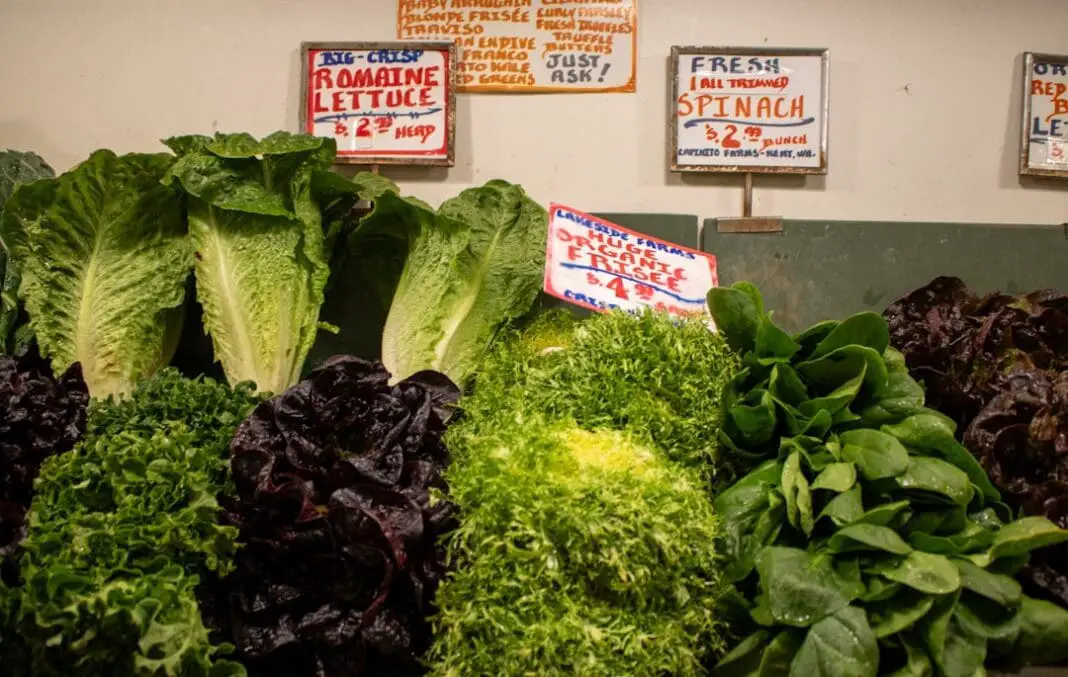
Nothing beats lettuce that was picked the same day or the day before you buy it. Farmers market greens, whether it’s butterhead, leaf lettuce, arugula, or romaine, are in an entirely different league from anything in the bagged salad aisle.
Grist ranks locally grown greens as the environmentally superior option, and the reasons go beyond just sustainability. These greens haven’t traveled across the country in a refrigerated truck. They haven’t been processed at a massive facility alongside tens of thousands of other heads. They haven’t been dunked in bleach solution and pumped full of nitrogen gas to extend shelf life.
When you buy from a local grower, you’re typically getting lettuce that was harvested within 24 to 48 hours. The flavor difference is immediately obvious. The crunch, the brightness, the way the leaves actually taste like something instead of tasting like cold water. Once you’ve had truly fresh lettuce, the bagged stuff feels like a sad imitation.
The cost is often comparable to, or even cheaper than, bagged greens from the grocery store. A big head of locally grown butter lettuce at a farmers market might run you $2 to $3, and it’ll taste better than any $4 bag of pre-washed mix you’ve ever opened.
If you don’t have access to a farmers market, your second-best move is buying whole heads from the grocery store and storing them properly. Either way, stop buying those bags. Your wallet and your salads will both be better for it.

