

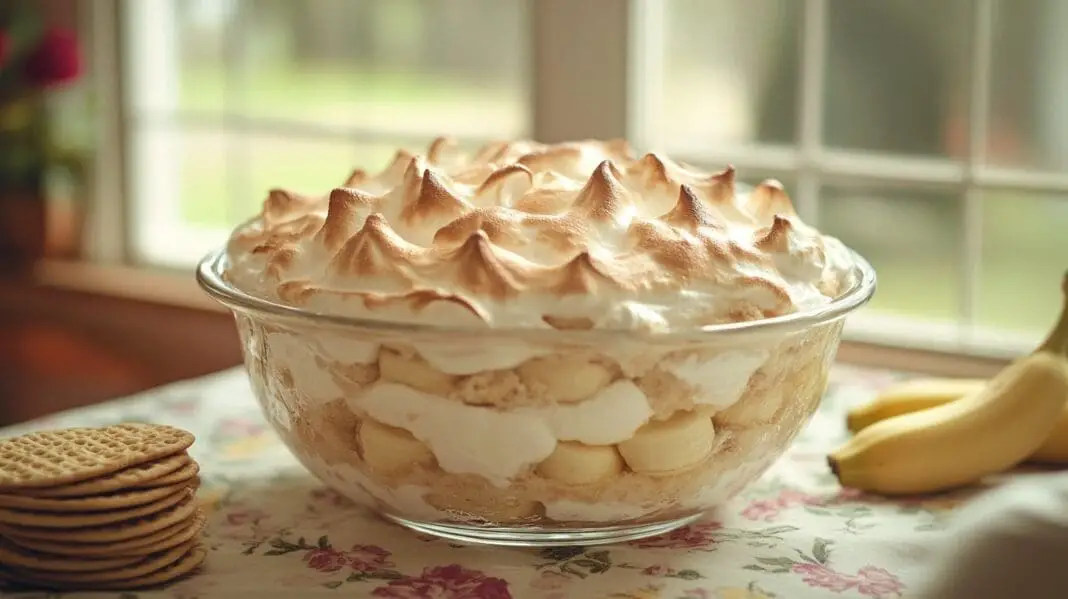
Ask anybody what their grandmother made for dessert and something strange happens. No matter the region, no matter the decade, no matter whether grandma was from rural Georgia or suburban Ohio, the answers collapse into the same tiny list. It’s not a coincidence. It’s a pattern so strong that hundreds of home cooks, when asked independently, keep circling back to the same three things.
Banana pudding. Pound cake. Some form of fruit cobbler or pie. That’s it. That’s the holy trinity of grandmother desserts in America, and if you’re sitting there right now nodding your head, you already know I’m right.
Today I’m going to break down why these three dominated every grandmother’s kitchen for the better part of a century, what made them so universal, and then give you a proper from-scratch banana pudding recipe, because that one sits at the very top of the pyramid and deserves to be made the right way.
The Big Three, and Why It Was Always These Three
When you look at community submissions from home cooks describing their grandmother’s go-to desserts, the same names surface over and over. Banana pudding, pound cake, and fruit cobbler (or pie, depending on the family). These weren’t chosen because grandmothers had some secret council meeting. They emerged because of a perfect storm of practical factors that made them almost inevitable.
First, the ingredients. All three desserts are built from pantry staples that were always on hand: flour, sugar, butter, eggs, milk, and whatever fruit was in season or came from a can. Nobody needed to make a special trip to the store. Second, the technique. None of these require pastry school training. A cobbler is fruit in a dish with batter or crumble on top. A pound cake is four ingredients beaten together. Banana pudding is custard layered with cookies and fruit. Third, and this is the one people don’t talk about enough, all three of these feed a crowd. These are potluck desserts, church supper desserts, Sunday dinner desserts. Grandma wasn’t baking for two. She was baking for twelve.
Banana Pudding: The One Everyone Remembers First
If you had to pick just one dessert that represents American grandmothers as a whole, banana pudding wins in a landslide. It has roots going back to the late 1800s, when bananas became widely available through Caribbean trade and were considered a trendy new fruit. By the 1920s, the version most of us know had solidified: homemade vanilla custard, sliced bananas, and Nilla Wafers, layered in a big dish and topped with meringue.
What makes banana pudding the single most emotionally loaded dessert in the American memory? It’s the context. This was the dessert that showed up after church, sitting in a big bowl on the counter, waiting its turn. It appeared at potlucks, holidays, family reunions, and random Tuesday suppers when grandma felt like making something sweet. One home cook described it perfectly: it’s the dish you secretly hoped would make an appearance. When it did, the whole table shifted.
A lot of people now make banana pudding with instant pudding mix from a box, and I get it. Life is busy. But if you’ve never had it made from scratch with real stovetop custard, you owe it to yourself. The texture is completely different. The flavor is richer. The custard has body and warmth to it, not that slick, artificially smooth quality that instant pudding has. People who grew up eating the from-scratch version will tell you there is no comparison, and they are correct.
Pound Cake: The Quiet Workhorse
Pound cake doesn’t get the same sentimental press that banana pudding does, but it might actually be the most universally baked grandmother dessert in America. The recipe is genuinely ancient. It showed up in the first cookbook ever published in the United States, Amelia Simmons’ “American Cookery” from 1796. The original concept is almost stupidly simple: one pound of butter, one pound of sugar, one pound of eggs, one pound of flour. That’s the whole recipe. That’s where the name comes from.
What made pound cake a grandmother staple is that it required no leavening agent in its original form. No baking powder, no baking soda. You just beat air into the butter and eggs, and the cake rose on its own. Once electric mixers became common in American households in the early 20th century, pound cake went from being a physically demanding recipe (try beating a pound of butter by hand) to something anyone could pull off. It became foolproof.
In African American families, pound cake holds an especially deep cultural significance. It’s been a centerpiece at Sunday dinners, church functions, and family reunions for generations. Many families have a “Big Mama’s pound cake” recipe written on an index card, or sometimes never written down at all, passed along through watching and doing. Variations like 7-Up pound cake, sour cream pound cake, and cream cheese pound cake all branched off the same trunk.
The beauty of pound cake is its flexibility. You can serve it plain with a dusting of powdered sugar. You can glaze it. You can eat it with strawberries and whipped cream. You can toast a slice and put butter on it the next morning. It’s a dessert that keeps giving for days, which is exactly why grandmothers loved it.
Fruit Cobbler and Pie: Whatever Was Ripe
The third pillar of grandmother desserts is more of a category than a single recipe, but that’s part of the point. Grandmothers adapted to whatever fruit was available. Peach cobbler in summer. Apple pie in fall. Blackberry crumble when the bushes out back were loaded. Pineapple upside-down cake when there was a can of Dole in the pantry. The technique changed based on what grandma had and what she felt like doing, but the principle was always the same: fruit, sugar, some kind of dough or crumble, heat.
The cobbler was probably the most common version because it’s the most forgiving. A pie requires rolling out crust, which takes practice and patience. A cobbler is just fruit in a baking dish with batter dropped or spread on top. Some grandmothers used biscuit dough. Others used a simple batter of flour, sugar, milk, and melted butter. Some went with an oat crumble topping. The result was always the same: bubbling fruit, golden crust, served warm with a scoop of vanilla ice cream if the family was feeling fancy.
Pineapple upside-down cake deserves special mention here because it shows up in almost every single grandmother dessert list ever compiled. The concept of baking a cake upside down in a skillet was common well before pineapple was added, but by the 1920s, the pineapple rings and maraschino cherries version had become firmly embedded in American baking tradition, particularly around the holidays.
The Honorable Mentions That Didn’t Quite Make the Top Three
A few other desserts kept showing up in grandmother memory collections, and they deserve a nod. Bread pudding, which started as a thrift recipe using day-old bread, was a staple in many homes. Jell-O molds were the defining potluck dessert of the post-war era, brightly colored and jiggly and made in those ribbed Bundt-like molds with fruit floating inside. Pecan pie was huge in families where someone had pecan trees on their property. And gingersnaps, kept in a cookie jar in the pantry, were the everyday sweet that grandmothers always seemed to have ready.
But none of these had the same universal reach as the big three. Banana pudding, pound cake, and fruit cobbler crossed every regional and cultural line in America. They were cheap, they were simple, they fed a crowd, and they tasted like love. That’s why every grandmother made them, and that’s why we all remember them the same way.
How to Make Old-Fashioned Banana Pudding From Scratch
Since banana pudding sits at the top of the grandmother dessert pyramid, here’s a proper from-scratch recipe that does justice to the original. No instant pudding mix. No shortcuts. Just real homemade custard, Nilla Wafers, fresh bananas, and a proper meringue on top. This is the version people are talking about when they say “my grandmother’s banana pudding was different.” It was different because she made it this way.
A few important tips before you start. Use bananas that are ripe but still firm, with just a few brown spots. Overly ripe bananas will turn mushy and dark. Sprinkle them with a little lemon juice as you slice them to keep them from browning. And use real Nilla Wafers by Nabisco. Store brand vanilla wafers are fine in a pinch, but the Nabisco ones have a specific flavor and texture that matters here. They soften in the pudding but hold their shape, turning almost cake-like overnight.
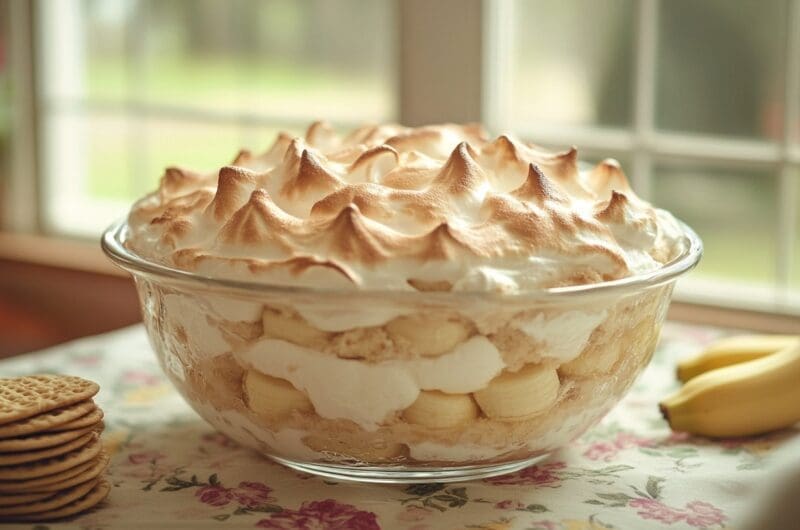
Old-Fashioned Banana Pudding From Scratch
Course: DessertCuisine: American10
servings25
minutes20
minutes320
kcalThe grandmother dessert that every single American remembers, made the right way with homemade custard, Nilla Wafers, and real meringue.
Ingredients
3/4 cup granulated sugar
1/3 cup all-purpose flour
Pinch of salt
4 large eggs, separated (yolks for custard, whites for meringue)
2 cups whole milk
1 cup evaporated milk
1 teaspoon pure vanilla extract
1 box (11 oz) Nilla Wafers by Nabisco
5 to 6 medium bananas, sliced, plus 1 tablespoon lemon juice
Directions
- In a medium saucepan, whisk together the sugar, flour, and salt until combined. Add the egg yolks and whisk until smooth. Gradually pour in the whole milk and evaporated milk, whisking constantly so no lumps form.
- Place the saucepan over medium heat and cook, stirring constantly with a whisk or wooden spoon, until the custard thickens enough to coat the back of a spoon. This takes about 10 to 12 minutes. Do not walk away from the stove or stop stirring, or you will get scrambled eggs.
- Remove the custard from heat and stir in the vanilla extract. Let it cool for about 5 minutes while you prepare the bananas and wafers.
- Preheat your oven to 350 degrees F. Slice the bananas about 1/4 inch thick and toss them gently with the lemon juice to keep them from turning brown. This is a small step but it makes a big difference in how the finished pudding looks.
- In a 2-quart baking dish or casserole, layer Nilla Wafers across the bottom, then add a layer of sliced bananas, then spoon about a third of the warm custard over the top. Repeat with two more layers, ending with custard on top.
- Make the meringue: In a clean bowl, beat the 4 egg whites with an electric mixer on high speed until soft peaks form. Gradually add 1/4 cup of sugar while continuing to beat until stiff, glossy peaks form. Spread the meringue over the top of the pudding, making sure it touches the edges of the dish to seal it.
- Bake at 350 degrees F for about 10 to 12 minutes, or until the meringue is golden brown on top. Keep an eye on it because meringue can go from golden to burnt in about 30 seconds.
- Let the banana pudding cool at room temperature for about 30 minutes, then refrigerate for at least 2 hours before serving. It’s good warm, but it’s even better cold the next day when the wafers have softened completely into the custard.
Notes
- If you prefer whipped cream instead of meringue, skip the oven step entirely. Just top the assembled pudding with homemade whipped cream or Cool Whip and refrigerate. Both versions are legitimate, but meringue is the old-fashioned way.
- This pudding actually tastes better the next day. The wafers absorb the custard overnight and turn soft and cake-like, which is exactly what you want. Make it the night before if you can.
- Use whole milk and real evaporated milk for the richest custard. Skim milk or low-fat substitutions will give you a thinner, less flavorful result that your grandmother would not approve of.
Frequently Asked Questions
Q: Can I use instant pudding mix instead of making custard from scratch?
A: You can, and a lot of people do. But the texture and flavor are noticeably different. From-scratch custard has a richness and depth that instant pudding just doesn’t match. If you’ve only ever had the instant version, making it from scratch at least once will show you what all the fuss is about.
Q: Why do all these grandmother desserts seem to be Southern?
A: They’re not exclusively Southern, but Southern culture did an exceptional job of preserving these recipes through church cookbooks, family reunions, and oral tradition. Grandmothers all over the country made pound cake and cobbler, but Southern families were more likely to write them down, talk about them, and pass them along as a point of family pride.
Q: What’s the best fruit for cobbler if I want to make one like grandma did?
A: Peaches are the classic, especially in the South. Use fresh ones in summer, or canned peaches (drained) the rest of the year. Blackberries, blueberries, and apples all work great too. The whole point of cobbler is that grandmothers used whatever fruit was available, so go with what looks good at the store.
Q: Why did grandmothers all seem to make the same things?
A: It comes down to practicality. Before the internet and cooking shows, recipes spread through church cookbooks, neighbors, and family tradition. The recipes that stuck were the ones that used cheap, available ingredients, didn’t require special equipment, and fed a lot of people reliably. Banana pudding, pound cake, and cobbler checked every single one of those boxes.

