

If you’ve ever walked through Costco’s bakery section and wondered why everything looks freshly baked but feels completely room temperature, you’re not alone. It’s one of the most common questions shoppers have, and most of them just assume the timing was off. Maybe they got there too late. Maybe the morning batch cooled down hours ago. But the truth is simpler and more deliberate than that. A self-identified Costco bakery employee explained on Reddit exactly why those croissants, bagels, muffins, and danishes will never, ever be warm when you pick them up off the shelf.
And once you understand the reason, it actually makes a lot of sense.
The 80 Degree Rule
Here’s the deal. Costco’s bakery items are packaged in enclosed plastic containers, the clamshell kind with no ventilation. According to the employee, every item that goes into one of those sealed boxes must be cooled to below 80 degrees Fahrenheit before it gets packed up. If they sealed a hot croissant or a warm muffin into one of those containers, the residual heat would create steam. That steam turns into condensation on the inside of the packaging. And condensation plus warmth is basically a welcome mat for mold.
The employee put it pretty bluntly: “You will never be given hot croissants, bagels, etc. Those are in enclosed boxes and the items must be cooled to below 80 degrees before being packed or it could introduce mold. It will never be hot if it gets to you.”
So it’s not a timing issue. It’s not that you showed up at the wrong hour. It’s a packaging decision. The items are intentionally cooled before they ever hit the shelf, every single time.
There’s One Exception, and You’ve Probably Noticed It
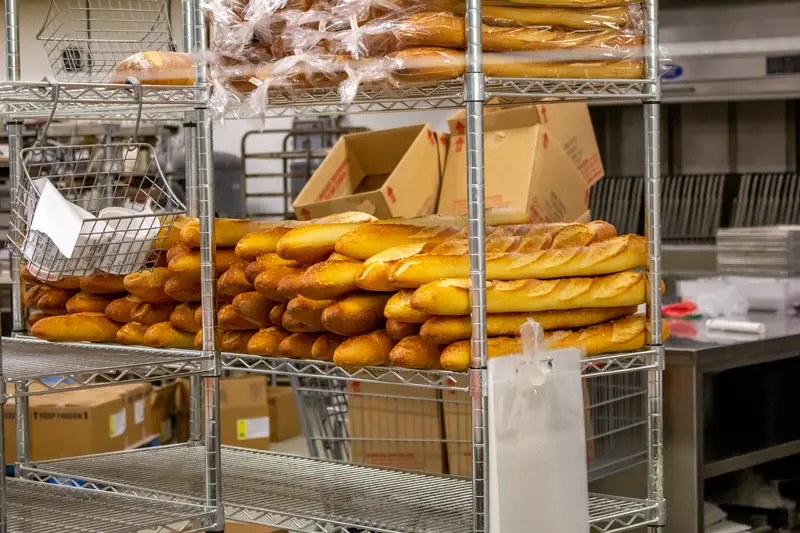
The employee also pointed out that bread is the one bakery item that can be sold warm. That’s because Costco’s bread is packaged in bags that have small vent holes in them, not sealed clamshell containers. Those tiny openings allow steam to escape instead of getting trapped inside, which means they don’t have the same condensation problem.
This is why you might pick up a loaf of bread and feel some warmth, then grab a box of croissants from the next shelf over and they’re completely cool. It’s not random. It’s about the packaging. Bread gets breathable bags. Everything else gets airtight boxes. Different packaging, different rules.
Costco Bakery Items Already Mold Fast Enough
Here’s the thing that really puts this into perspective. Even with the cooling protocol, Costco’s baked goods are already some of the most frequently returned items in the entire store, largely because they mold quickly. Bread and bagels are the worst offenders. One customer on Reddit said their Kirkland bagels and ciabatta were moldy well before the printed expiration date. Another person reported mold just days after purchase, even while storing them in a dry desert environment with almost no humidity.
The likely reason? Costco’s baked goods don’t have a ton of preservatives in them. That sounds nice until your $7 bag of bagels turns green on Tuesday when you bought it Saturday. Without the chemical preservatives that keep supermarket bread looking pristine for weeks, Costco’s stuff has a much shorter window. If they were also packing it hot and introducing moisture into those sealed containers, the mold problem would be way worse.
The Rotisserie Chicken Question
This one comes up all the time: if Costco won’t sell hot baked goods because of moisture concerns, why do they sell piping hot rotisserie chickens literally ten feet away? It’s a fair question. The difference comes down to how those products get used.
A rotisserie chicken is a meal. Most families are cracking that open within hours, maybe minutes. You’re not storing a hot chicken in your pantry for a week. But Costco sells bagels by the dozen and croissants in packs of 12. Those items are going to sit around. They need to last at least a few days. If moisture is sealed into the package from the start, you’ve basically given the mold a head start.
It’s also worth considering that the chicken containers have vents in them and are designed for immediate consumption. Bakery clamshells are designed to keep things fresh on a shelf. Two completely different purposes.
Not Everything in the Bakery Is Even Made Fresh
Another detail most shoppers don’t realize is that a lot of what’s in the Costco bakery section didn’t start from scratch in that building. The croissants are labeled “baked fresh daily,” and they are baked on site, but the dough arrives at the warehouse frozen. It gets proofed overnight and then baked in the morning. Same goes for the bread and baguettes, which are parbaked and shipped frozen before getting finished in the store’s ovens.
The apple pie? That comes in frozen and raw. The store bakes it and adds finishing touches like dusting sugar on top. The Tuxedo Chocolate Mousse Cake arrives already fully assembled and frozen. It just gets thawed and sliced. Cookie dough is sent frozen too, though the cookies themselves are formed and baked in-store.
So the idea that everything comes straight out of the oven and should be served warm is a little misleading to begin with. Some of these products were never meant for hot service in the first place.
Other Things Costco Bakery Employees Wish You’d Stop Doing
The original Reddit thread where this information surfaced wasn’t just about temperature. It was a broader thread asking Costco employees what they wished customers would start or stop doing. And the bakery workers had some things to say.
One big pet peeve: customers digging through bakery shelves looking for a product with a later expiration date. According to one employee, “For breads, in particular. There are only ever two dates out there for breads. The ones from the day before and the ones from that day.” Everything on the shelf from a given pallet has the same date, so pulling stuff from the back won’t get you anything different. You’re just making a mess.
Another employee was frustrated by customers asking for bakery items to be specially packaged when the product is already sitting out on the floor ready to grab. “Just take one off the table. Especially croissants. We bake them every day.” And then there’s the classic: customers asking for samples of everything. One worker called it “the most instantly annoying thing.”
The Smart Move: Freeze and Reheat
Since Costco’s baked goods aren’t going to be hot when you buy them and they mold quickly once you get them home, the smartest thing to do is freeze what you’re not eating right away. This is especially true for muffins, bagels, and croissants, the three items that seem to go bad the fastest.
For croissants, put each one in an individual sealable plastic bag and toss them in the freezer. When you’re ready to eat, preheat your oven or air fryer to 325 degrees and warm them for about five minutes. Add a couple extra minutes if they’re frozen solid. You’ll get a flaky, toasty croissant that honestly tastes better than it did at room temperature out of the clamshell.
For bagels, slice them before freezing. That way you can pop a half directly into the toaster without waiting for the whole thing to thaw. Muffins do well with a quick 20 to 30 seconds in the microwave followed by a minute in the oven to crisp the outside.
Use two layers of wrapping for anything going into the freezer to prevent freezer burn and staleness. Plastic wrap first, then a freezer bag.
The Value Is Still Hard to Beat
Even with the mold issue and the room temperature thing, Costco’s bakery prices are genuinely impressive. A 12-pack of croissants runs about $5.99, which comes out to roughly $0.50 per croissant. That same croissant at Starbucks costs $3.95. At Walmart’s bakery, you’re looking at about $0.83 each. Costco’s version is also about 40% bigger than a standard grocery store croissant at 2.3 ounces per piece.
Their pumpkin pie is $5.99 and weighs over three and a half pounds. Costco’s cakes can be up to 53% cheaper than similar options at other stores. The newer Carrot Bar Cake that dropped in April 2025 is $18.99 for 12 slices, about $1.58 per serving, which is pretty reasonable for a specialty cake.
So yeah, you’re never going to get a hot croissant at Costco. That’s by design. But at fifty cents a croissant, you can afford to buy a pack, throw most of them in the freezer, and reheat them yourself. Five minutes in the oven and you’ve got something that’s honestly better than what you’d get hot out of most bakeries. For the price, that’s a pretty good deal.

