

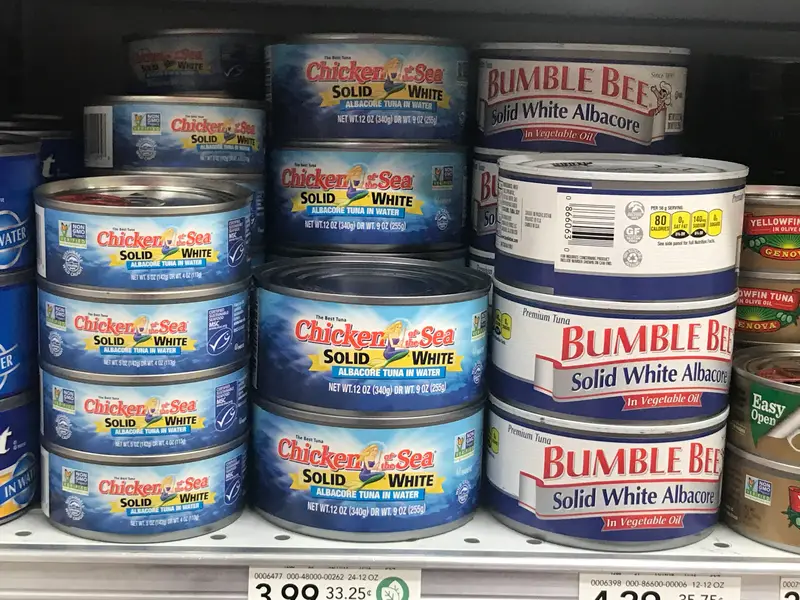
Be honest. There’s probably a can of tuna sitting in the back of your pantry right now that’s been there longer than some of your friendships. Canned tuna is the ultimate set-it-and-forget-it food. You buy a few cans, shove them behind the beans, and forget they exist until you’re standing there at 7 p.m. with zero dinner plan and a growling stomach.
Most of the time, that’s totally fine. Americans go through about one billion pounds of the stuff every year, and it’s the second most popular seafood in the country for good reason. But “lasts a long time” and “lasts forever” are two very different things. There are a handful of moments when you should put the can down and walk away, no matter how hungry you are. Here’s exactly what to watch for.
The Can Is Puffed Up Or Bulging
This is the one that should stop you cold. If the top or bottom of the can is swollen, domed, or looks like it got slightly inflated, do not open it. Don’t poke it. Don’t “just check.” A bulging can usually means gas-producing bacteria have set up shop inside, and that gas is what’s pushing the metal outward.
A normal can is flat, maybe even a little sunken in. A puffed one is waving a giant flag at you. This is the single clearest sign that something went wrong in there, and it is not worth the couple of bucks you’d save by rolling the dice. Straight into the trash it goes.
Deep Dents And Rust Along The Seams
Not every dent is a dealbreaker. A little ding on the flat part of the can from getting tossed around a grocery cart? Probably fine. What you actually care about is where the dent lives. Deep dents right on the seams, or on the top and bottom edges, are the real problem.
Those creases can create tiny cracks in the seal you can’t even see, and once air sneaks in, bacteria can follow. Same goes for rust. A little surface spot might wipe right off, but deep, flaky rust means moisture has been working on that metal for a while. If the rust is eating into the can, put it back on the shelf and grab a different one.
It’s Leaking Or Weeping
The entire point of canning is a tight, pressurized seal that keeps everything locked out. So if you spot liquid seeping from a sealed can, or the label has a suspicious wet stain on it, something failed. A leaking can means the preservation process didn’t hold, and the date stamp on the bottom no longer means a thing.
I don’t care if the “best by” date is three years out. A leaker goes straight in the garbage. Don’t rinse it, don’t try to salvage it, and don’t taste it to be sure. Once the seal is gone, all bets are off.
The Smell Punches You In The Face
Let’s be real. Canned tuna doesn’t smell like a bouquet of roses on its best day. It’s fishy and a little metallic, and that’s completely normal. What you’re smelling for is something different. Spoiled tuna gives off a sharp, sour, acrid odor that hits you the second you pop the lid.
Think rancid, like something turned. Normal tuna smells like the ocean and a tin can. Bad tuna smells like a mistake. If you get that acidic punch to the nose, wash your hands and toss the whole thing. Your gut reaction is usually right here, so trust it.
The Color Looks Wrong
Good canned tuna is a pretty consistent pale pink or light tan, depending on whether you grabbed albacore or light. When it goes off, the color tells on it. Look for dark brown or black streaks running through the meat, an overall grayish tone, or in the worst cases a darker color than you’d ever expect.
Those dark lines aren’t seasoning and they aren’t “just part of the fish.” They’re a sign the tuna has broken down inside the can. Dull, muddy coloring instead of that clean, flaky look means the can has been sitting too long or something got in where it shouldn’t have.
The Texture Turns Mushy Or Slimy
Fresh-from-the-can tuna should be firm, with flakes that hold together when you drag a fork through them. When it’s past its prime, the whole thing goes slimy or mushy, breaking into a loose paste that won’t stick to itself. A sticky, slick surface or a can swimming in way more liquid than usual is another tell.
If you take a tiny taste and it comes back sour or just plain off, that’s your answer right there. Your mouth usually knows before your brain catches up. Spit it out and pitch the can. No tuna melt is worth chewing your way through that.
It’s On The Recall List Right Now
Here’s the sneaky one. Sometimes tuna looks perfect, smells fine, and tastes normal, and you still shouldn’t eat it. That’s the deal with an active recall that’s been making the rounds. Tri-Union Seafoods pulled certain cans of Genova Yellowfin Tuna in Olive Oil after finding a defect in the easy-open pull tab that could break the seal over time and let in a botulism risk.
The specific product is the Genova Yellowfin Tuna in Olive Oil, 5.0 oz, sold in a 4-pack (UPC 4800073265). Check the bottom of the can for code S84N D2L or S84N D3L with a “Best If Used By” date of 1/21/2028. The affected cans went to Meijer stores in Illinois, Indiana, Kentucky, Michigan, Ohio, and Wisconsin, Giant Foods in Maryland and Virginia, plus Safeway, Albertsons, Vons, and Pavilions in California.
The instruction is blunt: do not eat it even if it looks and smells totally fine. If you have a match, throw it out or return it to the store. You can reach Tri-Union Seafoods at 833-374-0171 to ask for a retrieval kit and a coupon for a replacement. No illnesses have been reported, but this is one where you just don’t play the odds.
How To Store It So It Actually Lasts
Most of the bad-tuna horror stories start with bad storage. Canned tuna holds up for two to five years when you treat it right, and plenty of cans are still good past the printed date, since that date is about quality and not a hard cutoff. The trick is keeping it somewhere cool, dark, and dry.
A pantry or cabinet is perfect. Don’t stash cans next to the oven, on top of the fridge, or anywhere they’ll bake in the heat all day. And here’s a small one people miss: don’t bury cans under a pile of heavy stuff that can dent or puncture them. A crushed can in the back of a deep cabinet is how you end up with a busted seal you never even noticed until it was too late.
Once You Open It, The Clock Starts
The rules flip the second you break that seal. One quick trick: when you crack the lid, you should hear a faint hiss of air rushing in. That little sound tells you the vacuum seal was still intact, which is a good thing. No hiss at all can mean the seal was already compromised.
Once it’s open, that tuna needs to get used fast. Don’t leave the open can sitting out on the counter, and definitely don’t store leftovers in the can itself in the fridge. That exposed metal can leave your tuna with an unwanted metallic taste. Scoop it into a glass or plastic container with a tight lid instead, and get it in the fridge right away. Opened tuna is good for about three to five days cold, so that tuna salad you made Sunday shouldn’t still be hanging around the next weekend.
When In Doubt, Toss It
Canned tuna is cheap, easy, and honestly one of the most reliable things you can keep in a pantry. But reliable doesn’t mean bulletproof. A puffed can, a nasty smell, a weird color, a mushy texture, or a name on a recall list are all your cue to stop and step back. The math is simple. A single can runs you a couple of bucks, and no sandwich on earth is worth gambling on one that’s clearly turned. When something feels off, trust that feeling and throw it out. You’ll never regret pitching a two-dollar can, but you might really regret eating one.

