

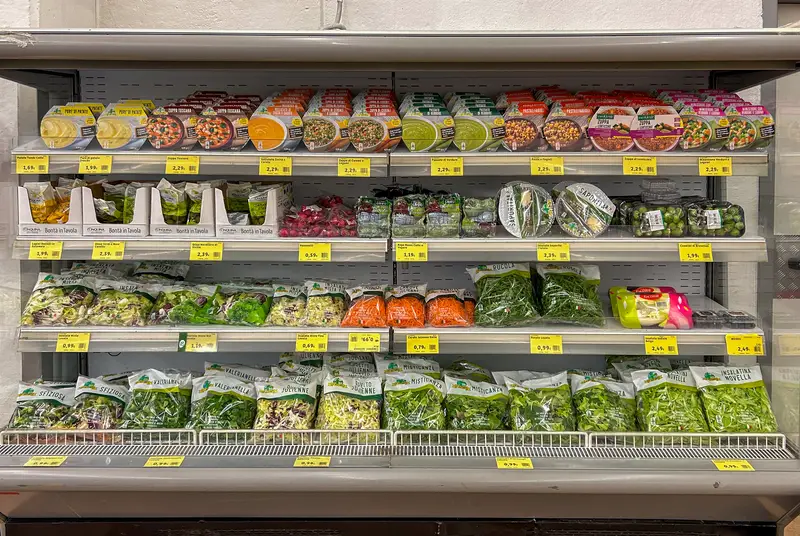
You grab a bag of salad from the fridge, tear it open, dump it on a plate. It takes about 15 seconds. That’s the whole appeal of packaged salads. They’re fast, they’re easy, and you don’t have to think about them. But maybe you should be thinking about them, at least for a few seconds, before you eat. Because there are some very clear, very visible warning signs that your bagged salad has gone bad. And if you miss them, the consequences can be a lot worse than a wilted lunch.
A Puffy Bag Is the Biggest Red Flag
This is the number one thing to watch for, and it’s also the most misunderstood. If your bag of salad looks inflated, like someone blew air into it, that could be a sign that bacteria inside the package are producing gas. According to the USDA’s Food Safety and Inspection Service, swollen or puffy packages are “potentially spoiled and therefore risky or unsafe.” Their official recommendation is to not use the product at all.
Now, here’s where it gets a little tricky. Some bagged salads use something called modified atmosphere packaging, or MAP. This is a process where manufacturers pump approved inert gases into the bag during production to help the greens stay fresh longer. That can make the bag look a little puffy right out of the gate, and that’s normal. The difference is consistency. If you’re standing in the grocery store and every bag of that brand looks slightly puffed, that’s MAP doing its job. If one bag is noticeably more bloated than the others sitting right next to it, put it back. Compare before you buy. It’s that simple.
The Smell Test Still Works
Your nose knows. If you open a bag of salad and get hit with a sour, funky, or ammonia-like odor, do not eat it. Those smells come from gases that bacteria produce as they multiply inside the bag. Even if the leaves still look green and crisp, a bad smell is a non-negotiable reason to throw the whole thing in the trash.
This is especially important with pre-packaged salads that are still within their “best by” date. People tend to trust the date on the label like it’s some kind of guarantee. It’s not. It’s the manufacturer’s estimate of peak freshness, not a promise that your salad is fine. If the bag smells off before that date, the date is irrelevant. Toss it.
Slime, Dark Spots, and Yellow Leaves
These are the visual clues most people already know about, but it’s worth being specific. Spinach leaves turning yellow? That’s decay. Red cabbage developing brown patches? Same thing. Widespread dark spots across your greens mean enzymes and microorganisms are breaking down the chlorophyll in the leaves. The greens are actively decomposing.
Then there’s the slime. If you reach into the bag and the leaves feel wet and slippery in a way that isn’t just moisture from condensation, those greens are done. That slimy texture is a byproduct of bacterial growth, and once it’s started, there’s no washing it off or “saving” the good leaves. The whole bag needs to go. Discard the product and sanitize any surface it touched, including your hands, cutting boards, and countertops.
Why Bagged Salads Are Riskier Than a Head of Lettuce
There’s a reason packaged salads show up in contamination reports over and over again. When leafy greens are harvested, cut, washed, and bagged in large batches, one contaminated leaf can spread bacteria to thousands of bags through shared wash water and equipment. A whole head of lettuce sitting in your crisper drawer doesn’t carry that same amplification risk. It’s just one head. It wasn’t processed alongside ten thousand other heads in a factory.
The CDC reports that more than half of all multistate E. coli O157:H7 outbreaks in the U.S. between 2009 and 2020 were linked to leafy greens. More than half. That’s a staggering number for something people think of as the “safe” option in their fridge.
Pre-cut leaves also degrade faster because of the increased surface area from processing. A whole head of lettuce, stored properly, can last about a week. Bagged greens start losing the freshness race the moment they’re cut.
Kits With Chicken, Cheese, or Dressing Are Even Riskier
Those all-in-one salad kits that come with grilled chicken, shredded cheese, croutons, and a packet of dressing? They’re convenient, sure. But they also carry a higher risk because of the mixed ingredients. More moisture, more protein, more surfaces for bacteria to latch onto.
In one notable incident, Fresh Express recalled its Gourmet Café Chicken Caesar Salad Bowls after the chicken component, supplied by an outside company called BrucePac, was found to be potentially contaminated with Listeria monocytogenes. The affected products were distributed in California, Louisiana, Texas, and Washington. Here’s the thing the FDA stressed in that case: even though the fresh vegetables in the bowl weren’t the source of the contamination, consumers were told not to eat any part of the salad, including the uncontaminated greens. When one component is compromised, the entire package gets treated as compromised.
Contamination Can Hide for Years
Here’s something that should make you take those warning signs a lot more seriously. A peer-reviewed CDC study published in December 2025 analyzed two concurrent Listeria outbreaks linked to packaged salads from two different companies. Combined, those outbreaks caused 30 illnesses, 27 hospitalizations, and 4 deaths over an eight-year span from 2014 to 2022.
Eight years. The same bacterial strains persisted in production environments for years while people kept getting sick. One of the outbreaks was investigated three separate times before investigators could pin down the source. The other was cracked only after routine water-sediment sampling in California’s Salinas Valley (a major hub for leafy green production) matched clinical samples from sick patients. Without that routine surveillance sampling, researchers said both investigations likely would have gone unsolved.
The alarming part for consumers is this: packaged salads that look, smell, and feel completely fine may still carry bacteria. Listeria, in particular, can actually multiply at refrigerator temperatures, which makes it uniquely dangerous in processed produce that sits in your fridge for days.
Mislabeled Ingredients Are a Separate Problem
Bacterial contamination isn’t the only reason to scrutinize your packaged salad before eating it. In May 2026, a Portland, Oregon grocery chain called Market of Choice recalled its Vegan Kale Caesar Salad because sesame had been added to the dish but was never listed on the label. The recall covered products sold between April 16 and May 4, 2026, packaged in clear clamshell containers with UPC 0 210126 01099 3.
Sesame became the 9th officially recognized major allergen in the United States on January 1, 2023, under the FASTER Act. For the estimated 32 million Americans with food allergies, an unlisted ingredient on a label can be just as dangerous as a contamination event. The lesson here is straightforward: always read the full ingredient list on a packaged salad, not just the product name or the front-of-package description. Formulations change, suppliers change, and labels don’t always keep up.
How to Actually Protect Yourself
First, check every bag before you buy it. Look at the “best by” date. Look at the bag itself. Is it puffier than the others on the shelf? Is there excessive liquid pooling at the bottom? Are any of the leaves visibly brown, yellow, or slimy through the packaging? If yes to any of those, skip it.
Second, get your salad into the fridge fast. The USDA says that a salad left on the counter for two hours enters the danger zone, where bacteria can double every 20 minutes. Keep your fridge set between 35°F and 38°F for the best results.
Third, stay on top of active recall alerts from the FDA. Fresh Express products alone are sold at Walmart, Target, Aldi, ShopRite, Price Chopper, and other major retailers nationwide. When a recall hits, it can affect stores in your area before any signage goes up.
Fourth, and this one is underrated, trust your senses over the date on the package. A bag that’s two days past its “best by” date but looks and smells fine is probably in better shape than a bag that’s within its date range but smells sour and feels slimy. The date is a guideline. Your eyes, nose, and fingers are the real tools here.
The Quick Checklist Before You Eat
Before you open that bag tonight, run through this in about ten seconds. Is the bag bloated more than the others were at the store? Does it smell sour, funky, or like ammonia when you open it? Are the leaves slimy, discolored, or covered in dark spots? Is the product on an active recall list? If any answer is yes, throw it out. Don’t pick around the bad leaves. Don’t rinse and hope for the best. Just toss the whole bag.
A $4 bag of salad is never worth the gamble. And now that you know what to look for, you’ll spot the signs every single time.

