

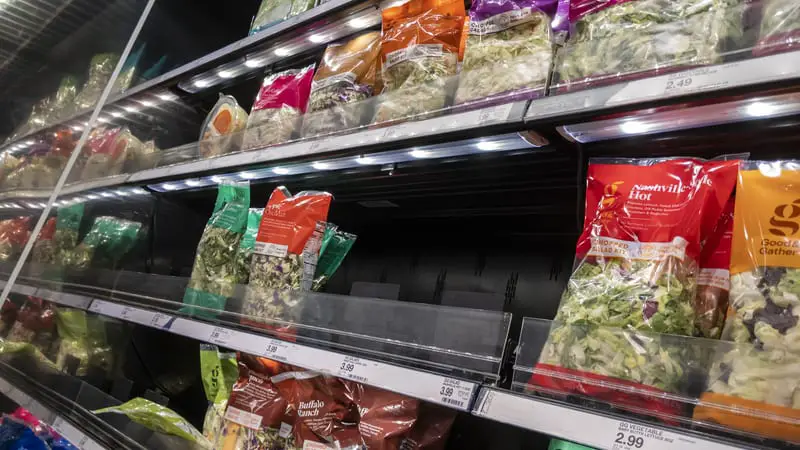
The bag of chopped romaine at the front of the cooler looks fine from three feet away. Pick it up and tilt it sideways before it goes in your cart. If a small puddle slides into the corner, or the leaves look wet and slightly see-through instead of crisp, set it down and grab a different one.
That puddle is probably not water. It is salad juice, the fluid that leaks out of cut lettuce cells, and it is the clearest signal you can get through plastic that the greens inside have already started coming apart.
The Puddle At The Bottom Of The Bag
Kantha Shelke, a certified food scientist and senior lecturer on food safety regulations at Johns Hopkins University, keeps a short list of things that send a bag back to the shelf. “Avoid bags with pooled liquid, slimy or translucent leaves, or browning at the cut edges, or dark crushed leaves,” she said.
Decaying leaves feed bacteria. Lab research at the University of Leicester found that juice leaking from cut and damaged leaves helps salmonella grow, even in the fridge, which is why a bag with liquid in it goes downhill faster than a dry one. A couple of wilted leaves in an otherwise crisp bag are not a crisis, and you can pull them out. A bag sitting in its own soup is a loss. Do not try to rescue it by rinsing.
Water Droplets Are A Different Problem
Clear condensation on the inside of the plastic is not the same thing as slime. It is not spoilage. It is a receipt showing the bag got warm at some point between the plant and the shelf.
Bagged salads are spun dry before they get sealed, so a bag that left the plant correctly and stayed cold should be close to dry inside. Fogged plastic means a temperature swing happened during stocking or transport, and that moisture speeds the leaves toward mush. Condensation alone is not a reason to panic. Condensation plus slimy leaves plus discoloration is three strikes.
Pink Edges Are Not A Reason To Put It Back
A faint pink or rust-colored tinge around the base of romaine throws people. It looks like rot. It is not. The pink is the plant’s response to stress, like a snipped stem, and the leaf is fine to eat.
Registered dietitian and food scientist Jennifer Pallian calls pink or rusty edges on leaves that are still crisp and dry “a cosmetic issue, not a safety one.” What changes the math is when color shows up alongside something else: a slippery film, dark water-soaked patches, fuzzy growth, or a sour, musty smell when you open the bag. Color by itself is just color.
A Puffy Bag Is Normal, A Torn One Is Not
Salad bags are not supposed to be shrink-wrapped tight around the greens. A lot of them use modified-atmosphere packaging, which means the air in there is doing a job and the bag will look inflated on purpose.
Tears, punctures and broken seals are the real packaging problem, and a pinhole is enough to matter. One bag that looks dramatically more swollen than every other identical bag next to it deserves suspicion, especially if the greens inside are also dark, wet or smell off. Rigid clamshell containers beat soft bags for one simple reason: nobody can crush the leaves on the way to the register.
Where The Bag Was Sitting Beats The Date On It
Those wide-open refrigerated produce cases are built for easy grabbing, not for holding a steady temperature. The FDA Food Code requires stores to keep cut leafy greens at 41 degrees Fahrenheit or below, and open cases drift above that line all day long as shoppers lean over them.
Greens behind closed refrigerator doors are a better bet. If your store only uses open cases, dig past the front row, where the warmest packages sit, without going all the way to the back, where the cold can damage the leaves. The USDA tells shoppers to grab refrigerated items last and head home, and to toss perishables that sit out more than two hours. An insulated bag in the trunk costs almost nothing and protects a $4 purchase.
The Best By Date Is A Quality Date
Reaching to the back for the latest date is the most common move at the salad case, and it is close to useless. Pallian describes the best-by date as “a quality date, not a safety date,” an estimate of when the salad will still look and taste right, assuming it was stored properly the whole way.
Those labels are not even required. The USDA notes that, with the exception of infant formula, food date labels are not federally mandated, which is why the same shelf carries use by, best by, sell by and enjoy by. For best quality, FoodKeeper suggests three to five days for bagged greens after you buy them, and two days once the bag is open. Pallian’s rule is to “trust time and temperature first, your senses second,” and a 2021 study of ready-to-eat salads in Cyprus found spoilage microbes building up as the salads neared the end of their shelf life. A fresh-looking bag that expires Thursday beats a tired bag that claims next Tuesday.
Washing It Again At Home Makes Things Worse
The instinct to dump a triple-washed bag into a colander and rinse it feels responsible. Shelke says skip it. “Resist re-washing,” she said. “Any organisms surviving commercial washing will tend to resist further removal, and rinsing only adds to cross-contamination risk (from hands and sinks can spread any organisms that escaped the commercial precautions in your kitchen).”
Her advice for people who still want the convenience is plain: “Use clean hands and a clean bowl, eat it soon after opening, and reserve washing for anything not labeled ‘washed,’ ‘triple washed,’ or ‘ready-to-eat.'” Leave the bag sealed until you are actually eating. Repacking greens into Tupperware with a paper towel keeps them dry, but opening the bag early just invites in whatever is on your counter.
A Bag Of Romaine Costs About 3.5 Times What A Head Costs
Convenience has a number attached to it. A head of romaine weighs around 22 ounces and, in an August 2026 price check, ran about $2 at Walmart. A 10-ounce bag of chopped romaine hearts is about $3.20, so buying that same 22 ounces in bags comes to more than $7, roughly 3.5 times the price.
You also lose shelf life and texture. Shelke lays out why the two products behave differently: “Bagged salad is made by pooling leaves from many heads, fields, and often multiple farms, so a single contaminated plant can seed the entire lot. While pre-cutting makes it convenient, it also ruptures cells, releasing nutrient-rich fluid that fosters pathogen multiplication during storage. A whole head, by contrast, is one intact plant with a protected interior, and contamination, if any, usually stays confined to it.” Cut lettuce also wilts faster. You are paying about 3.5 times as much for greens that quit sooner.
Check Recalls, Because The Bag Will Not Tell You
Taylor Farms de Mexico recalled all the iceberg lettuce it sourced from central Mexico on July 17, 2026, with the FDA posting the notice the next day. On the retail side it covered Marketside Iceberg Salad in 12 ounce and 24 ounce sizes and Marketside Shredded Lettuce in 8 ounce and 16 ounce sizes, sold at Walmart, with Best if Used By dates from July 18 through August 3, 2026. The lettuce went out between June 29 and July 16 across 27 states.
Taylor Farms told shoppers that anyone who bought the recalled iceberg lettuce “should discard it immediately and not consume it. Full refunds are also available at the location of purchase.” The recall came out of a traceback investigation rather than a lab hit; as of July 19, 2026, the FDA said no product sample had produced a confirmed positive for Cyclospora, and an early presumptive result was later called a false positive. By August 18, 2026, the CDC had confirmed 15,716 cyclosporiasis cases nationwide since May 1, with 11,841 more awaiting lab confirmation. The largest single outbreak, tied to Taylor Farms de Mexico iceberg lettuce served at restaurants and sold at Walmart, sickened 12,883 people in 21 states before the CDC declared it over on September 11, 2026. Shoppers noticed: household purchase data from Numerator showed more than 6.5 million households stopped buying salad mixes and kits in the month ending July 26, 2026.
Recalls are not always about germs, either. In October 2026, Taylor Farms pulled a Backyard BBQ Chop Salad kit sold at H-E-B stores in Texas because soy and almonds in the kit were not declared on the label. Sign up for FDA alerts and look at FoodSafety.gov before you clear out the fridge, and throw recalled lettuce away instead of trying to cook it, which is exactly what recall notices tell you to do.
What Is Actually Worth Buying
Buy the head. It is cheaper by a wide margin, it stays crisp for days longer, and you are getting one plant instead of a blend pooled from several farms. Five minutes with a knife is the whole tradeoff.
When the bag wins on time, be picky about which bag. Single-ingredient mixes hold up better than combo packs, where the fastest-spoiling green drags down everything around it. Pick a clamshell over a soft pouch, pick one that is dry inside and cold to the touch, pull from the middle of the case, and plan to finish it within a couple of days of opening. Darin Detwiler, who teaches food policy at Northeastern University, has said he avoids buying bagged greens altogether. That is a stricter line than most of us will hold at 6 p.m. on a Tuesday, but the shopper who tilts the bag before buying it is already ahead of almost everyone else in the produce aisle.

