

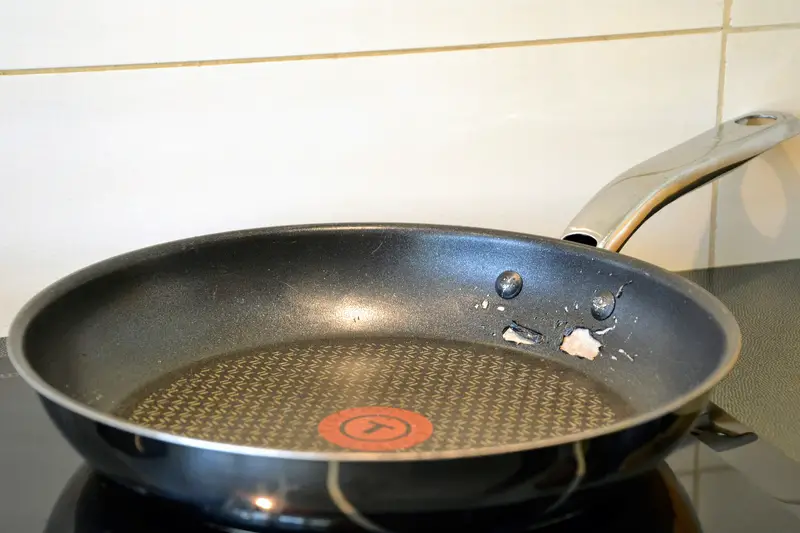
I get it. You love that nonstick pan. Maybe it was part of a set you got as a wedding gift, or you snagged it on sale at Target six years ago and it’s been your go-to for scrambled eggs ever since. But here’s the thing — nonstick pans don’t last forever. Not even close. And if yours has certain telltale signs of wear, you’re long overdue to chuck it in the trash and move on.
I’m not being dramatic. There are real, concrete reasons to ditch a beat-up nonstick pan, and most of them come down to the fact that the coating on these things was never meant to take a beating. Once it starts breaking down, your cooking gets worse, cleanup gets harder, and you’re basically using a compromised tool that’s working against you. Let’s talk about what to look for.
The Coating Is Peeling, Chipping, or Flaking
This is the big one. If you flip your pan over or look at the cooking surface and see bits of coating lifting up, peeling away, or flaking off — that pan is done. Once the nonstick coating starts coming apart, it accelerates. It doesn’t heal itself. It just keeps getting worse, and every time you cook with it, you’re adding microscopic (and sometimes not-so-microscopic) pieces of that coating to your food.
Studies have found that damaged nonstick cookware can release millions of micro- and nanoplastic particles into food. That’s not a typo — millions of particles from a single damaged pan. The coating on most nonstick pans is made from PTFE, better known by the brand name Teflon, and once it starts breaking apart, those particles end up in whatever you’re cooking. If your pan looks like it’s shedding its skin, it needed to go yesterday.
Deep Scratches That Cut Through to the Metal
Light surface scratches are one thing. But if you can see the bare metal underneath the coating — usually a silver or gray color peeking through the dark nonstick surface — that’s a pan you need to stop using. Those deep scratches mean the barrier between your food and the pan’s base material is gone in those spots.
Deep scratches also create little grooves where bacteria can camp out and where food residue builds up in ways that regular washing can’t fix. One expert quoted by AARP pointed out that the second you cut into a Teflon coating with a metal utensil, you’re exposing the underlying chemicals. This is the number one reason professional cooks are so insistent about never using metal spatulas or forks on nonstick surfaces. If yours already has deep scratches, the damage is done.
Dark Discoloration That Won’t Come Off
A little bit of discoloration over time? Normal. Your light-colored nonstick pan is going to look slightly different after a year of regular use. But deep, dark staining — the kind that doesn’t budge no matter how much you scrub — is a sign the coating is wearing out from the inside. That discoloration usually comes from a combination of burning and residue buildup that’s bonded to the deteriorating surface.
When a pan reaches this point, it’s not just ugly. The cooking performance has tanked, and you’re likely dealing with uneven heat distribution and food sticking in certain spots. If scouring doesn’t bring it back to something resembling its original color, don’t fight it. Replace it.
The Pan Is Warped
Set your pan on a flat surface. Does it sit perfectly flat, or does it rock back and forth like a seesaw? Warping is incredibly common in cheaper nonstick cookware, especially thin aluminum pans. It happens when the pan is exposed to drastic temperature swings — like running cold water over a hot pan, or cranking the burner to max on a lightweight skillet.
A warped pan means uneven cooking across the board. Oil pools on one side. Eggs cook faster in one spot. Pancakes come out with one crispy edge and one pale, undercooked edge. And if you have an induction cooktop, a warped pan might not even work at all since it needs to make full contact with the surface. Warping is especially common in lower-quality aluminum cookware, and once it happens, there’s no bending it back.
Food Sticks to Everything
The entire point of a nonstick pan is that food doesn’t stick. If your eggs are gluing themselves to the surface, if your pancakes are tearing when you try to flip them, if you need to use as much butter as you would in a stainless steel pan just to keep things from welding to the bottom — your nonstick pan has stopped being nonstick. And a nonstick pan that doesn’t work is just a bad pan.
This usually means the coating has worn through enough that it’s lost its release properties, even if you can’t see obvious peeling or scratching with the naked eye. Most nonstick pans are designed to last somewhere between one and five years, depending on quality and how you treat them. Ceramic coatings tend to give out even faster — about two years on average.
Rust on the Surface or Around the Rivets
If you see rust anywhere on your pan — on the cooking surface, on the bottom, or around the rivets and screws that attach the handle — that’s corrosion, and it means the protective coating has failed. Rust is most common in cast iron and carbon steel cookware, but it can show up on any pan where the coating has worn through and exposed bare metal to moisture.
With cast iron, minor surface rust can sometimes be scrubbed off and the pan reseasoned. But on a nonstick pan, rust means the game is over. There’s no reseasoning a Teflon pan. And extensive rust on any type of cookware means replacement is the only move.
Loose or Wobbly Handles
This one isn’t about the coating — it’s about not dumping boiling food on yourself. If the handle on your pan wiggles, feels loose, or has visible gaps where it connects to the pan body, that’s a serious safety issue. A handle that gives way while you’re carrying a pan full of hot oil or simmering sauce is a trip to the ER waiting to happen.
Sometimes tightening the rivets or screws can fix it. But if you’ve already tightened everything and the handle still wobbles, the connection points have degraded beyond repair. Don’t risk it. A compromised pan isn’t worth a kitchen accident.
Your Pan Was Made Before 2015
Here’s something a lot of people don’t know: nonstick pans manufactured before 2015 were made using a chemical called PFOA (perfluorooctanoic acid) in the production of their PTFE coatings. PFOA was detected in the blood of 99.7% of Americans, according to research, and it has since been phased out of production. Pans made after 2015 don’t contain PFOA.
So if you’ve got an ancient nonstick pan kicking around — the kind that’s been in the back of your cabinet for a decade — check if there’s a manufacture date on it. If it predates 2015, or if you picked it up at a yard sale and have no idea when it was made, it’s worth replacing. This goes double for thrift store and secondhand cookware finds.
A Greasy Film That Won’t Wash Off
You wash the pan. You dry it. You run your finger across the surface, and it still feels… slick. Not nonstick-smooth — greasy. That persistent oily film is a sign the pan’s surface has become porous and is trapping oil and food residue in ways that soap and water can’t reach anymore. This is especially common in older nonstick and hard-anodized aluminum pans.
Beyond being gross, this residue buildup can actually alter the flavor of your food. If last Tuesday’s fish fry is haunting tonight’s fried eggs, the pan has become a liability. When cleaning no longer restores the surface, the pan has outlived its usefulness.
What to Replace It With
The obvious question: if you’re ditching your nonstick pan, what do you buy instead? You have a few solid options.
Cast iron is the classic choice. It’ll last generations if you take care of it, develops a natural nonstick surface over time, and costs less than most fancy nonstick sets. A Lodge 12-inch skillet runs about $20-$30 at most stores. Stainless steel is another strong option — durable, dishwasher-safe, and it won’t degrade the way coated pans do. Carbon steel splits the difference, giving you cast iron-like seasoning in a lighter, more responsive pan.
If you still want nonstick, look for pans specifically labeled PTFE-free (not just PFOA-free — that label doesn’t mean what most people think it means). Research from the Ecology Center found that 79% of tested nonstick cooking pans were still coated with PTFE. Ceramic-coated options from brands like GreenPan run about $20 for a basic skillet at Walmart — roughly double the price of the cheapest traditional nonstick, but a meaningful upgrade. Pingping Meng, an assistant professor of chemistry at East Carolina University, said the research on PFAS prompted her to toss every nonstick pan in her kitchen. That’s pretty telling.
Whatever you choose, stop stacking your pans without something between them. A dish towel, a pan protector, even a paper plate — anything to keep the surfaces from scratching against each other. It’s the single easiest thing you can do to make any pan last longer. And for nonstick pans you do keep, stick to wooden or silicone utensils, hand wash instead of using the dishwasher, and never crank the heat past medium. Treat them right, and you’ll get the full lifespan out of them instead of needing a new one every 18 months.

