

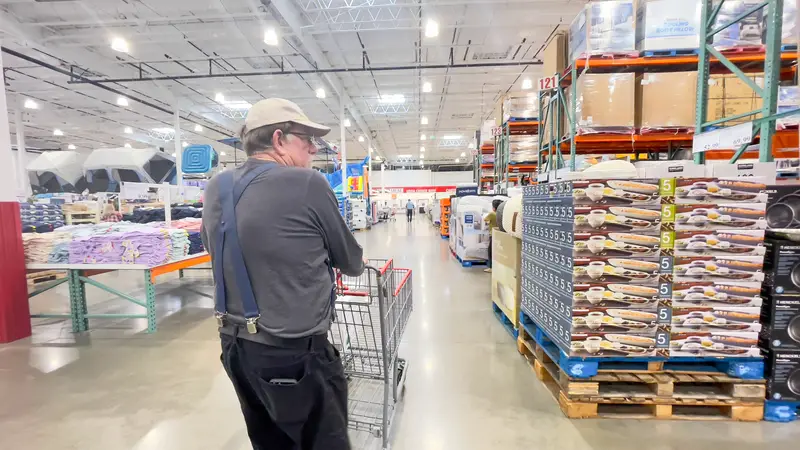
You walked into Costco for paper towels and rotisserie chicken. You walked out $247 poorer with a kayak, a 5-pound bag of dried mango, and a set of patio furniture you didn’t know existed twenty minutes ago. Sound familiar? You’re not weak-willed. You’re not bad at shopping. You’re the target of one of the most effective retail strategies in America, and it starts with the fact that nothing in that building stays in the same place for very long.
The Whole Store Reshuffles Before You Even Walk In
Every single morning, before the doors open, Costco employees are driving forklifts around reorganizing the warehouse. They call it getting “showtime ready.” Products are shifted, aisles are reconfigured, and by the time you show up on Saturday morning, the store looks different from the one you visited last week. This isn’t because a truck came in and they needed to make room. It’s a deliberate, company-wide approach to keep you guessing.
Costco rearranges its aisles roughly every few weeks. Seasonal items and sale products move the most, sometimes daily. Even year-round staples get shifted every couple of months. In a space that covers about 146,000 square feet — that’s more than two and a half football fields — a few changes can completely alter your route through the store. And that’s exactly the point.
Costco Calls It the “Treasure Hunt” and It’s Not Accidental
Costco has a name for this strategy: the treasure hunt. The idea is that shopping should feel like an adventure. You never know what you’ll find, where you’ll find it, or whether it’ll be there next time. That limited-time pressure combined with the surprise factor creates a shopping experience that hits the same psychological reward systems that make people scroll endlessly through social media or dig through clearance racks. You spot a deal you weren’t expecting — a big-name brand at a jaw-dropping price — and your brain gets a little dopamine hit. That feels good. So you toss it in the cart.
Royne Stafford, who chairs the marketing and international business department at UNLV, has studied this. She says the biggest reason Costco rearranges so frequently is to push customers into different parts of the store. When people wander into unfamiliar territory, they find products — often higher-margin ones — they never planned to buy. The layout changes disrupt your habits and force you to improvise, which almost always means spending more per trip.
There Are Almost No Signs, and That’s Also on Purpose
Here’s something you might not have consciously noticed: Costco warehouses have almost no aisle signs. There are no maps. No helpful overhead banners telling you which row has the canned goods. Compare that to your average grocery store, where everything is labeled and organized within an inch of its life. Costco doesn’t want you to find things quickly. It wants you to wander.
Think about it — if you could walk straight to the three items on your list and leave, Costco would lose a fortune. The store is designed to be slightly disorienting, not in a frustrating way (ideally), but in a way that makes you slow down and look around. One comparison that keeps coming up is a Las Vegas casino: winding paths, artificial lighting, and no clear exit. The longer you’re inside, the more you spend.
They Use “Triggers” to Drag You Across the Building
Costco internally refers to everyday essentials — toilet paper, cleaning supplies, tissues — as “triggers.” These are the things most people actually need when they walk in. But instead of grouping them all together conveniently, Costco sprinkles them in separate corners of the warehouse. Need paper towels? They’re over here. Need laundry detergent? That’s on the opposite side of the building. To get both, you have to cross acres of merchandise. And on that journey, you’re going to pass a lot of tempting stuff.
The fresh and frozen foods are almost always at the back of the store. So if you came in for that famous $4.99 rotisserie chicken, you’ve got to walk past seasonal displays, sample kiosks, electronics, clothing, and whatever random luxury items they’ve got this week. The chances of leaving with only a chicken are slim to none.
The “Racetrack” Layout Is Designed to Maximize Exposure
Costco employees call the main perimeter pathway around the store “the racetrack.” Following it will bring you past every major section of the warehouse. But here’s the thing — if you cut through the middle of the racetrack instead of sticking to the edges, you expose yourself to even more unplanned items. It’s a lose-lose situation for your wallet. Stick to the outside and you see everything. Cut through the middle and you see different everything.
When you first walk in, you’re also given something close to a bird’s-eye view of the entire floor. Unlike IKEA, which funnels you through a single winding path, Costco lets you see everything at once. This gives you the illusion of control while simultaneously overwhelming you with options. You think you’re making efficient choices. You’re actually browsing.
Some of the Chaos Isn’t Even Planned
Here’s where the story gets a little messier. According to Costco employees who’ve spoken up on social media, the treasure hunt isn’t always as carefully orchestrated as corporate might want you to believe. The sheer volume of products Costco pushes through every day is enormous. Forklift drivers move pallets from delivery trucks to the sales floor constantly, and when old items need to make room for new ones, those replaced products get stashed wherever there’s space.
Multiple employees have said the company’s inventory tracking system is outdated, making it difficult to log exactly where things end up after being moved. This leads to some genuinely bizarre product placement. Customers have reported finding granola shelved with chips and snacks instead of cereal. Baby diapers turning up in the soda section. Cat litter relocated completely out of the pet aisle. Some of this is strategy. Some of it is just the reality of running a warehouse that does this much volume.
The Membership Fee Makes You a Willing Participant
There’s another layer to this that doesn’t get talked about enough. Because Costco members pay an annual fee — $65 for a basic Gold Star membership, $130 for Executive — they walk in with a built-in motivation to get their money’s worth. That psychology changes your behavior. You don’t just pop in and grab one thing. You want to browse. You want to make the trip count. You’re more receptive to impulse buys because you’ve already committed financially to being a Costco shopper.
Costco knows this. The company keeps its product markups capped at about 15 percent, way below what traditional retailers charge. It actually makes most of its profit from those membership fees, not from the stuff on the shelves. So the entire operation is designed to make you feel like you’re getting incredible value while the membership renewals keep rolling in. When products seem hard to find or only available for a limited time, shoppers perceive them as more valuable — which makes them even more likely to buy on the spot.
Costco Only Carries About 4,000 Products and That Matters
A regular supermarket stocks over 30,000 different items. Costco carries around 4,000 SKUs. That’s it. This limited selection actually works in the store’s favor psychologically. You’re not overwhelmed by 47 different brands of ketchup. There are maybe two or three. This makes decisions faster and makes the items that are available feel curated and special. Combined with the treasure hunt layout, it creates a shopping experience that feels exciting rather than exhausting — at least, that’s what Costco is going for.
Fewer products also mean higher turnover. Stuff moves fast. Items you saw last month might genuinely be gone this month, replaced by something new. That real possibility of missing out drives urgency. When you see a good deal at Costco, the smart play might actually be to grab it now, because it really might not be there next time.
How to Spend Less at Costco (If You Actually Want To)
If you’d rather not leave the warehouse with a receipt that makes you wince, there are some practical moves. First, skip the front section of the store entirely. That’s where Costco plants seasonal items, marked-down products, and impulse buys designed to catch you while your willpower is strongest (which, ironically, is when you first walk in — it goes downhill fast). Instead, head straight to the back where the fresh food is kept.
Stick to a list. Seriously, write it down and don’t deviate. Know that the layout is actively working against your budget, and plan for it. Also, if you go on a weekend afternoon, you’ll grab the most free samples, which is great — but those sample stations are positioned to slow you down and expose you to even more products. Every extra minute you spend in Costco is a minute the store is working on your impulse control.
It’s kind of impressive, honestly. Costco has turned a concrete warehouse with no signs, exposed steel shelving, and forklifts driving around into one of the most addictive shopping experiences in America. It’s the third-largest retailer in worldwide sales. The average person goes in for one thing and leaves having spent over $100. And every single morning, before the doors open, the whole thing gets rearranged again — ready for the next round of treasure hunters who don’t realize they’re the ones being hunted.

