
There’s a moment every Aldi shopper has. You’re grabbing a gallon of milk, you glance at the price, and you think: wait, what’s the catch? Because $3.25 for a gallon of whole milk — when Whole Foods is charging $4.59 and Trader Joe’s is at $3.99 — feels like something must be off. Maybe the cows are sad. Maybe the milk is watered down. Maybe Aldi is running some kind of long con.
None of that is true. The milk is fine. Actually, it’s more than fine — it’s often the exact same product you’d pay a premium for at another store, just wearing a different label. The real story behind Aldi’s milk prices has nothing to do with quality and everything to do with how this German-born grocery chain has stripped the American supermarket model down to its studs.
The Numbers Don’t Lie
Let’s start with cold, hard dollars. In a price comparison conducted in March 2023, a gallon of Aldi’s Friendly Farms Whole Milk ran $3.25 in a New York suburb. Costco came in at $3.67. Trader Joe’s was at $3.99. That makes Aldi roughly 12 percent cheaper than Costco — and you don’t need a membership card to walk through the door.
The half-gallon numbers are even more dramatic. Aldi’s half gallon was $1.76 compared to $2.69 at Trader Joe’s — a 93-cent difference. That’s a 35 percent savings on a staple that almost every household buys every week. Multiply that by 52 weeks, and you’re looking at real money staying in your pocket.
And it’s not just one comparison. Separate price checks in April 2023 confirmed the pattern across different regions. Aldi’s gallon price ranged from $3.03 to $3.25 depending on location. Kroger was the next cheapest at $3.39 per gallon. The most expensive? Whole Foods at $4.59. Back in 2019, a Cheapism price check found Aldi selling a gallon of 2 percent milk for $1.49 — compared to $2.48 at Walmart. A whole dollar less for the same basic product.
It’s Literally the Same Milk
Here’s the part that might bother you, or maybe it’ll make your day. Aldi’s Friendly Farms milk often comes from the exact same facilities that produce name-brand milk. Every milk jug has a production stamp on the bottom that identifies the facility where it was made. When people have actually traced those production stamps, the results are telling.
An investigation by a reviewer named James from Ordinary Guy Reviews used the website Where Is My Milk From to trace his Aldi milk. It came from the same plant that sourced milk sold under the Kemps label. Kemps is a massive Minnesota-based dairy company that does over $800 million in business annually, with half of that revenue from milk production alone. They sell milk under their own brand at Target, Walmart, and convenience stores across the Midwest.
So whether you’re paying $5.12 for a gallon of Kemps milk at Walmart or $3.95 for the Aldi version, the milk came from the same place. Same cows. Same facility. Same pasteurization equipment. The only difference is the sticker on the jug and the price tag on the shelf.
A separate research effort in 2011 found the same thing — a shopper traced production stamps on Friendly Farms bottles and matched them to Kemps facilities. This isn’t a one-time fluke. It’s the business model.
The Friendly Farms Private Label Machine
Aldi sells its dairy under a private label called Friendly Farms. And private labels are where the magic happens for discount retailers. When a store sells name-brand products, there are layers of cost baked into that price — the brand’s marketing budget, distribution network, sales reps, slotting fees. All of that gets passed to you at checkout.
With a private label, Aldi goes directly to the manufacturer and says: make us milk, put our label on it, and we’ll handle the rest. No middleman markups. No advertising costs. No paying for a Super Bowl commercial featuring talking cows. Over 90 percent of products in an Aldi store are private-label items, which means the entire store operates on this principle.
There’s also evidence suggesting that Commonwealth Dairy, a Vermont-based company also known as Ehrmann Commonwealth Dairy, is behind some of Aldi’s Friendly Farms products. This connection surfaced in 2018 through an FDA announcement about an allergen labeling issue on Friendly Farms Key Lime Crunch Tilts. The announcement listed Commonwealth Dairy as the company name behind the Friendly Farms brand.
And about that quality — Friendly Farms milk comes from cows not treated with hormones. It contains no casein, caseinate, vegetable oil, or any other filler you wouldn’t expect in your milk. It carries the REAL Seal, which means it was produced on a U.S. dairy farm and is made from 100 percent cow’s milk. That seal isn’t given out to anyone who asks nicely.
The Bare-Bones Store That Saves You Money
Walk into an Aldi and compare it to a typical grocery store. There’s no background music. The aisles are narrow. Products sit in their shipping boxes on the shelves. You won’t find someone in an apron offering you a cheese sample. This isn’t an oversight — it’s the entire strategy.
Every single one of those design choices cuts costs. Smaller stores mean lower rent and utility bills. Shorter operating hours mean less payroll. The quarter-deposit cart system means nobody has to collect carts from the parking lot. The BYO bag policy means no cost for plastic or paper bags and no employees bagging your groceries. There are fewer staff members on the floor because there’s less stocking to do.
All those saved dollars accumulate. And instead of pocketing them as profit, Aldi funnels those savings into lower shelf prices. It’s a model that looks cheap because it is cheap — on purpose, and in a way that directly benefits the person pushing the cart.
The Milk Rack Trick Nobody Talks About
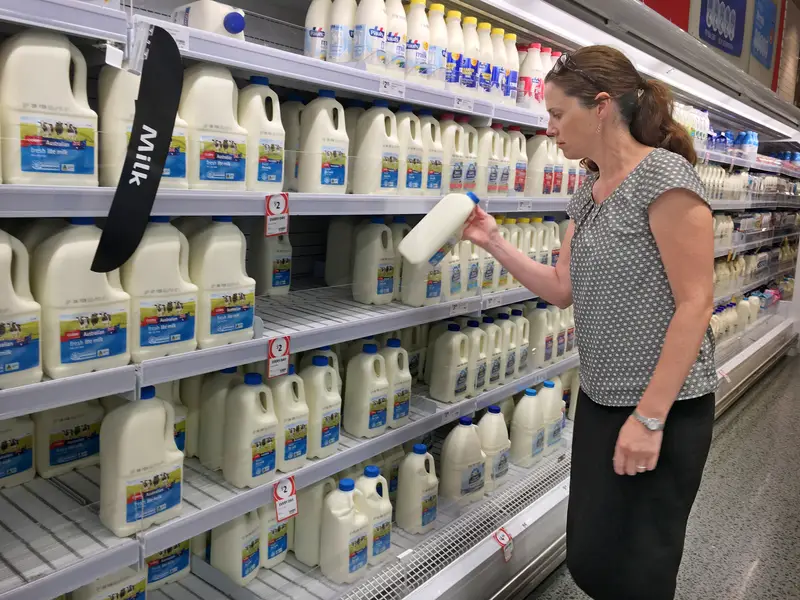
Here’s a small detail that makes a big difference. The milk Aldi purchases from its suppliers comes pre-loaded in ready-to-stock racks. An employee rolls the rack off the delivery truck, wheels it into the cooler, and that’s it. Eighty gallons of milk, shelved and ready to sell in seconds.
At a traditional grocery store, employees unload cases of milk from a delivery, break down the packaging, and individually place each gallon into the refrigerator case. That takes time, and time is labor, and labor is the single biggest operating expense for any retail store. Aldi essentially removed an entire step from the stocking process for one of the highest-volume products in the store.
This efficiency also means almost zero spoilage. Because Aldi’s milk is priced so low and moves so fast, stores restock their milk between five and seven times per week. The product rarely sits long enough to expire. And spoiled milk that gets tossed is money thrown in the trash — a cost that other stores absorb and pass along to you in the form of higher prices on everything else.
Is Aldi Losing Money on Every Gallon?
There’s a strong argument that Aldi sells milk as a loss leader. That’s a retail term for a product priced so low that the store makes little or no profit on it — sometimes even taking a loss — because it gets people through the door. Everyone needs milk. If Aldi has the cheapest milk in town, you’ll drive to Aldi. And once you’re there, you’ll pick up cereal, bread, snacks, and a bag of those randomly excellent dark chocolate almonds from the Aldi Finds aisle.
The math works because Aldi’s margins on its other private-label products are healthy enough to cover whatever it loses on milk. It’s the same reason Costco sells $1.50 hot dogs and $4.99 rotisserie chickens — not because they’re profitable on their own, but because they get you into the building with your wallet open.
The Bigger Picture for Dairy
There’s a less cheerful angle to cheap milk that’s worth mentioning. The prices dairy farmers receive for their milk are currently at their lowest point — adjusted for inflation — in half a century. Over 75 percent of smaller U.S. dairy farms have shut down since the year 2000. Demand for cow’s milk has been declining for years. In 1984, milk accounted for 15 percent of what Americans consumed at any meal. By 2019, that number had dropped to 9 percent.
When market conditions push the wholesale price of milk down, retailers like Aldi can sell it for less. But that low wholesale price also means farmers are getting squeezed. The cheap milk in your fridge is partly a reflection of an industry where the people doing the hardest work are often getting the worst deal.
What This Means for Your Grocery Bill
If you’re buying milk at Whole Foods or even Trader Joe’s without a specific reason — like wanting a particular organic brand — you’re paying more for an identical product. Not a similar product. The same product, from the same facility, produced by the same company. The only difference is packaging and the retail markup that covers a nicer shopping experience.
Aldi figured out that a lot of Americans would rather save a dollar per gallon than shop in a store with ambient lighting and artisan cheese displays. And given that Aldi is one of the fastest-growing grocery chains in the country, it seems like they figured right.
So next time you drop that Friendly Farms gallon into your cart and notice the price, you don’t need to wonder what’s wrong with it. Nothing is wrong with it. Aldi just decided to stop charging you for things that have nothing to do with milk.

