

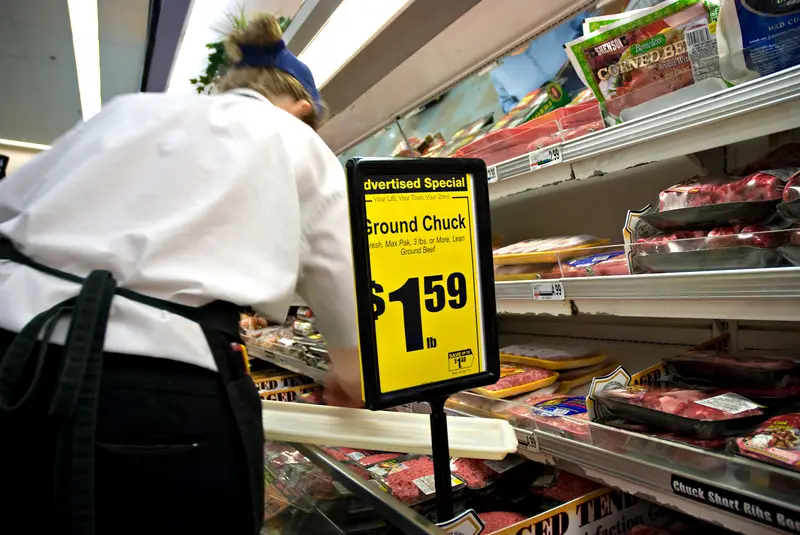
If you’ve got ground beef sitting in your freezer right now, you might want to take a closer look at the packaging. The USDA has been busy lately — issuing a string of alerts and recalls tied to ground beef products sold across the country. We’re talking metal fragments, E. coli contamination, and even meat produced without any federal inspection at all. Some of these affected products landed in grocery stores. Others went to restaurants and cafeterias. And a few may still be sitting in your kitchen right now.
Here’s everything you need to know about the recent wave of ground beef safety issues, what products are affected, and what you should actually do about it.
Metal Fragments Found in White Oak Pastures Ground Beef
On March 23, 2026, the USDA’s Food Safety and Inspection Service issued a public health alert for one-pound packages of White Oak Pastures Grassfed Ground Beef. The issue? Pieces of metal were found inside the meat. Two consumers filed complaints after biting into — or otherwise finding — metal fragments in their ground beef. That’s the kind of thing that ruins a taco night pretty fast.
The specific product is a 16-ounce, vacuum-sealed package labeled “Radically Traditional Farming, Grassfed Ground Beef.” It was produced on February 26, 2026, and stamped with a sell-by date of March 19, 2026. You’ll find the establishment number EST 34729 inside the USDA inspection mark. On the back of the package, the code 105761 is printed along with the sell-by date.
These packages were shipped to Mom’s Organic Markets in Washington D.C., Massachusetts, Maryland, New Jersey, Pennsylvania, and Virginia. Since the sell-by date has already passed, the product is no longer on store shelves — which is why FSIS didn’t issue a formal recall. But the agency made it clear: if you have this beef in your freezer, do not eat it. Throw it out or return it. No confirmed injuries have been reported yet, but swallowing metal isn’t exactly a low-risk activity.
Nearly 23,000 Pounds of Beef Recalled Over E. Coli O145
A month before the metal scare, a much larger recall hit the ground beef supply. On February 11, 2026, CS Beef Packers — a company out of Kuna, Idaho — recalled roughly 22,912 pounds of raw ground beef that may have been contaminated with E. coli O145. The USDA classified this as a Class 1 recall, which is the most serious kind. It means the product poses a high risk of causing serious health consequences or death.
The recalled products include 10-pound chubs (those big cylindrical tubes of ground beef you’ve probably seen at restaurant supply stores) under the brand names “Beef, Coarse Ground, 73L” and “Fire River Farms Classic Beef Fine Ground” in both 73L and 81L varieties. All were produced on January 14, 2026, and carry a Use/Freeze By date of February 4, 2026. Time stamps between 07:03 and 08:32 appear on stickers on the outside of the cases and on the clear packaging itself.
These products went to distributors in California, Idaho, and Oregon, and from there they were sent to foodservice locations — think restaurants, school cafeterias, and other commercial kitchens. They were not sold directly at grocery stores. The contamination was discovered during FSIS testing at a downstream customer. No illnesses had been confirmed at the time of the recall.
Forward Farms Grass-Fed Beef Hit With E. Coli O26 Recall
Before 2026 even started, another Idaho-based company was already dealing with its own E. coli problem. On December 27, 2025, Mountain West Food Group recalled about 2,855 pounds of Forward Farms Grass-Fed Ground Beef after routine FSIS testing turned up E. coli O26. The affected product is a one-pound, vacuum-sealed package with “USE OR FREEZE BY 01/13/26 EST 2083” printed on the side.
This beef was produced on December 16, 2025, and shipped to distributors across six states: California, Colorado, Idaho, Montana, Pennsylvania, and Washington. From there, it went to retail stores for sale to everyday shoppers.
E. coli O26 belongs to a group of bacteria known as Shiga toxin-producing E. coli. Symptoms include diarrhea (which can be bloody), vomiting, and stomach cramps. Most healthy adults recover within about a week. But for young kids, older adults, and people with weakened immune systems, the infection can lead to hemolytic uremic syndrome — a serious form of kidney failure. If you notice easy bruising, pale skin, or decreased urination, get to an emergency room.
Blackwing Meats Sold Beef and Pork Without Federal Inspection
This one is a different animal entirely — no pun intended. On March 25, 2026, FSIS issued a public health alert for various raw beef and pork products sold under the Blackwing Organic Meats and Blackwing Meats labels. The reason: these products were produced without any federal inspection. Some of them even carried a fake USDA mark of inspection with the unauthorized establishment number EST. 1996.
The affected products span a long window — from April 2024 all the way through March 2026. That’s almost two full years of uninspected meat potentially circulating through wholesale and retail channels across the entire country.
The products include organic beef New York strip steaks, organic ground beef, grass-fed beef stew meat, beef steak strips, ground pork, and boneless center cut pork chops — all in vacuum-packed packaging. Four of the seven products listed carried the false USDA inspection stamp. The other three didn’t bother with the stamp at all, which is somehow both more honest and equally concerning.
The USDA says food produced without inspection may contain undeclared allergens, harmful bacteria, or other contaminants. No confirmed illnesses or injuries have been reported so far, and the investigation is still ongoing. FSIS said it may add more products to the alert as it learns more.
Why Ground Beef Keeps Showing Up in Recall Alerts
Ground beef gets recalled more often than most other types of meat, and there’s a straightforward reason for that. When you grind beef, you’re mixing together meat from potentially many different animals. That means if one animal carries a pathogen like E. coli, the bacteria can spread throughout the entire batch during the grinding process. A single steak comes from one part of one animal. A batch of ground beef can come from dozens.
This is also why the USDA is so insistent about cooking temperatures. You can eat a steak medium-rare because any bacteria on the surface get killed the moment you sear it. But with ground beef, the bacteria can be mixed into the center. That’s why the safe internal temperature for ground beef is 160°F — no exceptions, no matter how pink you like your burgers. And the only reliable way to check? A meat thermometer. Not the color of the meat, not how firm it feels — a thermometer.
What To Do If You Have Any of These Products
First, check your freezer. Seriously. People buy ground beef and forget about it for months. If you have any of the products listed above — White Oak Pastures grassfed ground beef with the specific sell-by date, Forward Farms grass-fed ground beef with the January 2026 freeze-by date, or any Blackwing Meats beef or pork products — get rid of them. Don’t cook them thinking that’ll fix the problem. Metal fragments don’t care about your oven temperature.
You can throw the product away (wrap it up so no one digs it out of the trash) or return it to the store where you bought it. If you think you’ve already eaten an affected product and you’re feeling sick — especially with symptoms like bloody diarrhea, vomiting, or signs of kidney trouble — call your doctor. For children under five and adults over 65, don’t wait. Get medical attention fast.
You can also report problems directly to the USDA. Their Meat and Poultry Hotline is available at 888-674-6854, or you can email MPHotline@usda.gov. There’s also an online complaint form at foodcomplaint.fsis.usda.gov that’s available around the clock.
How To Protect Yourself Going Forward
None of this means you need to stop eating ground beef. But it does mean you should pay attention. A few habits go a long way. Always cook ground beef to 160°F and check it with a thermometer. Store raw meat on the lowest shelf of your fridge so it doesn’t drip onto other food. Wash your hands and any surfaces that touched raw meat with hot, soapy water. And once in a while, take 30 seconds to check the USDA’s recall page — it’s updated regularly and could save you from eating something you really shouldn’t.
The food supply in this country is generally safe. But “generally” doesn’t mean “always,” and the last few months have been a good reminder of that. A quick check of your freezer today could save you a trip to the ER tomorrow.

