

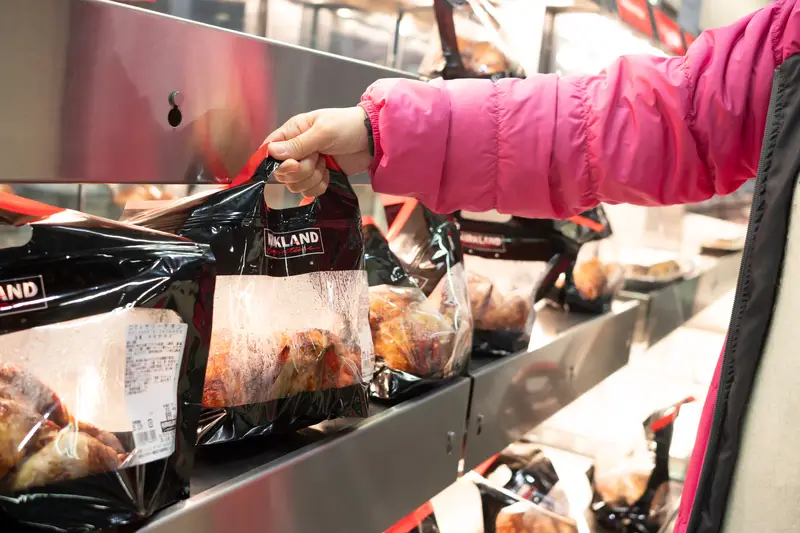
Costco sells more than 157 million rotisserie chickens every single year. That $4.99 bird is probably the most famous grocery store deal in the country. But a new class-action lawsuit says Costco has been lying about what’s actually inside those chickens. The claim? That the label says “no preservatives” while the ingredient list tells a completely different story. Here’s what’s going on and what it means for anyone who regularly grabs one of those warm chickens near the store exit.
What the lawsuit actually says
Two women in California filed a proposed class-action lawsuit against Costco on January 22, 2026. The case was filed in the U.S. District Court for the Southern District of California. Their complaint centers on one specific product: the Kirkland Signature Seasoned Rotisserie Chicken. According to the lawsuit, Costco’s in-store signs and website both claim the chicken contains “no preservatives.” But the women say that’s simply not true. The complaint alleges the chicken actually contains two added preservatives — sodium phosphate and carrageenan. Both are listed on the back of the packaging in small print.
The lawsuit doesn’t just call out the ingredients themselves. It focuses on the gap between what the big signs say and what the fine print reveals. The plaintiffs argue that Costco’s prominent “no preservatives” advertising creates a clear impression. And that impression, they say, is flat-out wrong. The two women — Anatasia Chernov and Bianca Johnston — are asking the court to certify a class that would include anyone in the United States who bought one of these chickens. They’re also requesting a separate subclass for California buyers and seeking unspecified money damages from the retailer.
The two ingredients at the center of it all
So what exactly are sodium phosphate and carrageenan? Sodium phosphate is an additive that controls the pH level in food. It also slows down fat breakdown and helps prevent spoilage. In simple terms, it helps keep meat looking and tasting good for longer. That sounds a lot like what a preservative does, right? The lawsuit says exactly that. Carrageenan, on the other hand, comes from seaweed. It’s commonly used to thicken foods and give them a more consistent feel. According to WebMD, it has no nutritional value at all but shows up in all kinds of processed foods.
Costco has said that both ingredients are approved by food safety authorities. The company told reporters that it uses carrageenan and sodium phosphate “to support moisture retention, texture, and product consistency during cooking.” That’s not exactly the same as saying they’re preservatives. But the lawsuit argues that these ingredients do function as preservatives in the chicken. Whether a court agrees with that argument is still up in the air. But the debate over what counts as a “preservative” is really the heart of this whole thing.
The big sign versus the small print
Walk into any Costco, and there’s a good chance a sign near the rotisserie chicken display will catch attention immediately. The signs are big, bold, and easy to read. They advertise no preservatives, no artificial colors, no MSG, and no gluten. It’s the kind of thing that makes people feel good about what they’re putting in their cart. Most shoppers don’t flip over the container and squint at the ingredient list printed in tiny font on the back. And honestly, why would they? The sign already told them everything they wanted to know.
That’s exactly the problem, according to the lawsuit. The plaintiffs say Costco knew most people would rely on the prominent in-store advertising. Meanwhile, the actual ingredient list — the one with sodium phosphate and carrageenan printed on it — sat in much smaller and “less prominent” text on the packaging. The complaint argues that this small-print disclosure wasn’t enough to cancel out the big, bold “no preservatives” claim. It’s a classic case of one hand saying one thing while the other hand quietly says something else entirely.
Costco already changed its signs
Here’s something interesting. Costco didn’t wait around for a court to tell them what to do. Within days of the lawsuit being filed, the company removed the “no preservatives” signage from its stores and its website. In a statement, Costco said it wanted to “maintain consistency among the labeling on our rotisserie chickens and the signs in our warehouses/on-line presentations.” Basically, they pulled the signs so that the marketing would match what’s actually on the label. That’s a pretty fast move for a massive company dealing with a legal case.
Does removing the signs mean Costco is admitting fault? Not exactly. Companies make changes like this all the time without admitting wrongdoing. But it does suggest the retailer recognized the disconnect between its advertising and its ingredient list. According to Costco’s statement, the company still stands by its use of both ingredients and points out that food safety authorities approve them. The lawsuit, however, is still moving forward. Removing a sign doesn’t make a legal complaint disappear, and the plaintiffs are clearly not satisfied with that response alone.
The plaintiffs still plan to buy the chicken
Here’s the part that surprised a lot of people. Both women who filed the lawsuit said they plan to keep buying Costco’s rotisserie chicken in the future. That might sound weird for people suing a company over its product. But it actually makes sense when looking at the details. Their complaint isn’t about the chicken being unsafe or tasting bad. It’s about the advertising. One of the plaintiffs said she would buy it again, but only if Costco’s claims about preservatives are “accurate and consistent with the product’s ingredients.” In other words, just be honest about what’s in it.
This detail is important because it shows the lawsuit isn’t trying to destroy the product. The legal action is really about truth in advertising. The plaintiffs say they make decisions about what to feed their families based on labels. When those labels are misleading, it takes away their ability to make informed choices. That’s the argument, at least. Whether a judge sees it the same way will depend on how the case plays out. But the fact that both women still want the chicken says something about just how popular this product really is.
How many chickens are we really talking about
The numbers here are kind of mind-blowing. Costco sells over 157 million rotisserie chickens a year. At $4.99 each, that’s nearly $800 million in chicken sales annually. And that’s just the chickens themselves — the real money comes from what people buy while they’re in the store grabbing one. The lawsuit claims Costco “has systemically cheated customers out of tens — if not hundreds — of millions of dollars” through its false advertising. Even if each customer only overpaid by a small amount, the total adds up fast when the volume is that enormous.
The proposed class would include every single person in the United States who bought one of these chickens during the relevant time period. That’s a lot of people. Costco has over 600 warehouses in the U.S., and the rotisserie chicken is one of its most popular items. If the court certifies the class, this could become one of the biggest food labeling lawsuits in recent memory. The California subclass adds another layer, since California has some of the strictest consumer protection laws in the country.
What laws Costco allegedly broke
The lawsuit doesn’t just accuse Costco of being misleading. It names specific laws the company allegedly violated. These include consumer protection laws in both California and Washington state, where Costco has its headquarters. The complaint also brings up unfair competition laws, claiming Costco tricked shoppers into “purchasing or alternatively paying a premium” for the chicken because of the “no preservatives” advertising. The argument is that people chose this chicken over other options specifically because they believed it was preservative-free.
Wesley Griffith, the attorney representing the plaintiffs, put it pretty simply. He told reporters that “Costco’s own ingredient list contradicts its marketing” and that the lawsuit aims to hold the company accountable. The legal team also argued that Costco had “superior knowledge” about how these ingredients worked and chose not to share that information clearly with shoppers. It’s worth noting that Costco’s stock barely moved after the news broke, dipping only about half a percent. Clearly, Wall Street isn’t panicking over this one — at least not yet.
This isn’t the first time the chicken caused problems
Costco’s rotisserie chicken has been making headlines for years, and not always for good reasons. The product has faced criticism and scrutiny multiple times. From questions about animal welfare at the company’s chicken farm in Nebraska to concerns about sodium content, this $4.99 bird seems to attract attention from all directions. The chicken even has a documented shelf life of just two hours once it comes off the rotisserie, which surprises a lot of people who assume they can let it sit on the counter for a while before eating it.
Despite all the controversy, the rotisserie chicken remains a fan favorite. It’s the kind of product that gets people through the door, and Costco knows it. The company has reportedly taken losses on the chicken just to keep it at that magic $4.99 price point. When a product is that central to a store’s identity, any lawsuit involving it is going to get major attention. And this preservative case is no exception. It’s already being covered everywhere, and the case hasn’t even gone to trial yet.
What shoppers should keep in mind right now
So what does all this mean for someone who just wants a quick, affordable dinner? For now, the chicken is still on shelves and still costs $4.99. Nothing about the product itself has changed. The only visible difference is that those “no preservatives” signs are gone from Costco stores and the website. The ingredients remain the same. If sodium phosphate and carrageenan weren’t a concern before this lawsuit, there’s no new reason for them to be a concern now. Both are approved for use in food and show up in tons of other products.
That said, this case is a good reminder to check labels. The front of any package — whether it’s a rotisserie chicken or a bag of chips — is basically a billboard. It’s designed to sell. The real information lives on the back, in the ingredient list and nutrition facts. Reading those labels takes about 10 extra seconds and can reveal a lot. This Costco lawsuit might not change what most people toss in their carts, but it could change how carefully they look at what they’re actually buying. And that’s not a bad thing at all.
The Costco rotisserie chicken lawsuit is still in its early stages, with no court ruling yet. Whether or not it succeeds, it has already pushed Costco to drop its “no preservatives” signs — which is a win for clearer labeling. For the millions of people who rely on that $4.99 chicken every week, life goes on. But next time, maybe give that ingredient list a quick glance. It only takes a second, and it might just tell a different story than the big, bold sign overhead.

