

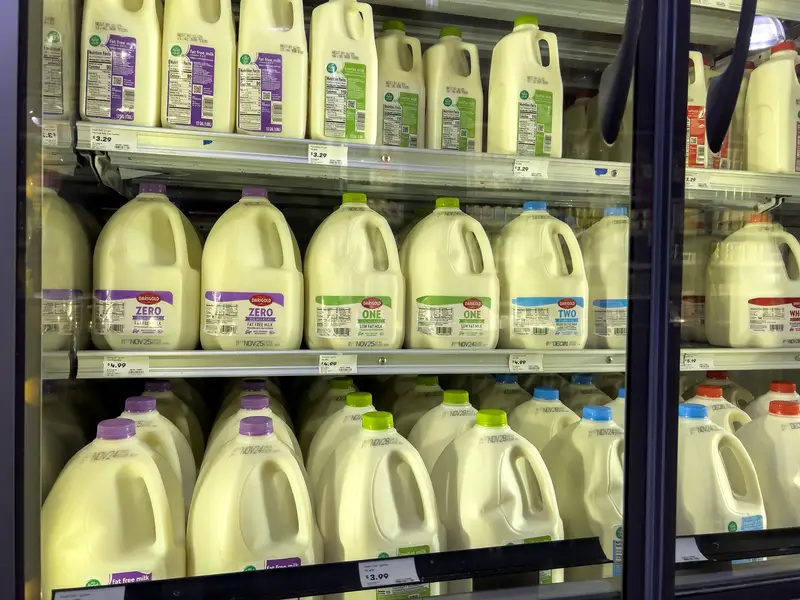
Standing in the dairy aisle last week, staring at four different colored caps on four nearly identical jugs, it hit me — most of us have been buying milk our entire lives without really understanding what those numbers on the label mean. Like, 2% of what exactly? And if whole milk is “whole,” does that mean it’s 100% fat? Spoiler: absolutely not. The confusion is more common than you’d think, and once you see how it actually works, you’ll probably feel a little silly. I know I did.
Whole Milk Isn’t What You Think It Is
Here’s where most people get tripped up. The word “whole” makes it sound like the milk is entirely fat. Like some thick, heavy cream pouring out of the jug. But whole milk contains roughly 3.25 to 3.5 percent milk fat by weight. That’s it. Not 50%. Not even 10%. Just about 3.5%.
An 8-ounce glass has about 8 grams of fat and 150 calories. That’s closer to skim than to heavy cream, when you think about it. The name “whole” just means none of the original fat has been removed — it’s milk in its most natural commercial form. It’s the closest thing to what comes straight from the cow (minus the pasteurization and homogenization, of course). So if you’ve been avoiding whole milk because you assumed it was packed with fat, the actual number might surprise you.
The Percentage Is About Weight, Not What You’d Expect
So what does that “2%” on your milk jug actually refer to? It’s the amount of fat in the milk by weight. Two percent of the total weight of that liquid is milk fat. Not 2% of some original fat content. Not 2% of your daily value. It’s purely a weight measurement.
This trips people up because we instinctively think of percentages differently when it comes to food. If someone told you a cookie was “2% sugar,” you’d think that was barely sweet. But with milk, that 2% translates to about 5 grams of fat per 8-ounce serving. Compare that to whole milk’s 8 grams, and the gap between them is smaller than most people assume. The same logic applies to 1% milk — that’s 1% of the milk’s total weight being fat, which works out to about 2.5 grams per glass.
Nobody’s Adding Water to Your Skim Milk
This is one of those persistent myths that just won’t die. People swear skim milk is watered down. It looks thinner. It tastes lighter. So it must have water in it, right? Nope. Not the case.
The way it actually works is pretty straightforward. According to dairy industry sources, before milk gets bottled, all of the fat is removed first. Then the desired amount of fat is added back in to hit the target percentage. For skim milk, no fat goes back. For 1%, a small amount. For 2%, a bit more. Whole milk gets all of its original fat returned. No water is added at any point in this process. The reason skim milk tastes thinner is simply because fat adds body and richness to liquid. Take it out, and yeah — the texture changes. But the milk itself hasn’t been diluted.
Skim milk clocks in at about 80 calories per 8-ounce glass with zero grams of fat. If you’re counting calories closely, that’s a meaningful difference from whole milk’s 150.
What About the Stuff That Doesn’t Change?
Here’s where it gets kind of interesting. Despite the differences in fat content and calories, every type of milk — whole, 2%, 1%, skim — contains the same 13 essential nutrients. That includes 8 grams of high-quality protein per serving, calcium, vitamin D, potassium, and a bunch of B vitamins. The protein doesn’t change. The calcium doesn’t change. The vitamin content doesn’t change.
So when people ask “which milk is healthiest?” the honest answer is that it depends on what you’re optimizing for. Want fewer calories? Skim. Want more richness and don’t mind the extra fat? Whole. Trying to split the difference? 2% sits right in the middle and it’s the most popular choice in a lot of American households for that exact reason. The core nutrition stays the same across all of them. Fat and calories are the only real variables.
Those Cap Colors Aren’t Universal (Which Is Annoying)
If you’ve ever grabbed the wrong milk because you relied on the cap color, you’re not alone. Most people associate red with whole, blue with 2%, light blue or green with 1%, and pink or purple with skim. But here’s the thing — those colors vary from brand to brand. There’s no federal standard dictating cap colors.
So your store-brand whole milk might have a red cap while a national brand uses a different color entirely. It’s one of those little grocery store annoyances that seems like it should have been standardized decades ago but never was. Always check the label. The percentage will be printed clearly on the front — that’s the number you can trust. The cap color is just a shortcut, and not always a reliable one.
Where Organic and Lactose-Free Fit Into All This
Do organic and lactose-free milks follow the same fat percentage system? Yes. Completely. Organic milk is produced under stricter USDA farming standards — it governs what the cows eat, how they’re cared for, and how the farm operates. But the milk itself still comes in the same fat percentage options: whole, 2%, 1%, and skim. The nutrient profile is the same, and the fat percentages mean exactly the same thing.
Lactose-free milk is real cow’s milk where the lactose — the natural sugar — has been broken down so that people with lactose intolerance can digest it without issues. It still contains the same calcium, protein, vitamin D, and other nutrients. And yes, it also comes in different fat percentages. The lactose-free label doesn’t change the fat content at all. It’s a separate thing entirely.
Flavored milks — chocolate being the obvious one — also follow the same rules. They count as a full dairy serving and offer the same 13 nutrients. They just have added sugar and flavoring on top of whatever fat percentage is listed on the carton.
Raw Milk Is a Different Conversation Entirely
You might be wondering about raw milk. It’s been getting a lot of attention lately. Raw milk is milk straight from the cow — not pasteurized, not homogenized. It’s not widely available for purchase, and federal law prohibits its distribution across state lines. The USDA, FDA, and CDC have all flagged safety concerns with it.
Before homogenization became standard, milk would naturally separate — cream rising to the top, thinner liquid settling below. That cream layer is where the fat lives. Homogenization is essentially a mechanical process that shakes the milk to create an even, consistent texture throughout. Without it, you’d need to shake your milk every time you poured a glass. Raw milk skips that process and pasteurization, which is the heating step that kills potentially harmful bacteria. Whatever your feelings on raw milk, it operates outside the standard percentage labeling system since no fat has been removed or standardized.
A Quick Side-by-Side So You Can Actually Compare
Sometimes it helps to just see the numbers lined up. All figures are for an 8-ounce serving of milk:
Whole milk (3.25% fat): 8 grams of fat, 150 calories, 8 grams of protein.
2% milk (reduced fat): 5 grams of fat, roughly 120 calories, 8 grams of protein.
1% milk (low fat): 2.5 grams of fat, 100 calories, 8 grams of protein.
Skim milk (fat-free): 0 grams of fat, 80 calories, 8 grams of protein.
Notice how the protein stays locked at 8 grams across the board. The 13 essential nutrients don’t budge either. The calorie difference between whole and skim is 70 calories per glass. Over a week, if you drink a glass a day, that’s 490 calories. Whether that matters to you depends entirely on your own dietary goals. For some people, those extra calories from whole milk fat are worth it for the taste and satiety. For others, skim does the job just fine.
There’s also a growing body of research suggesting that not all saturated fats behave the same way in the body. Dairy fats may have different effects than, say, the saturated fat in processed meats. More studies are needed before any firm conclusions, but it’s worth keeping an eye on. The old blanket advice to always choose skim isn’t quite as unanimous as it used to be.
Honestly, most of this comes down to personal preference and what works for your body. The nutritional differences between milk types are real but relatively small. You’re getting solid protein, calcium, and vitamins no matter which colored cap you grab. Pick the one that tastes good to you, fits your calorie goals, and doesn’t make your cereal taste weird. That’s really all there is to it.

