
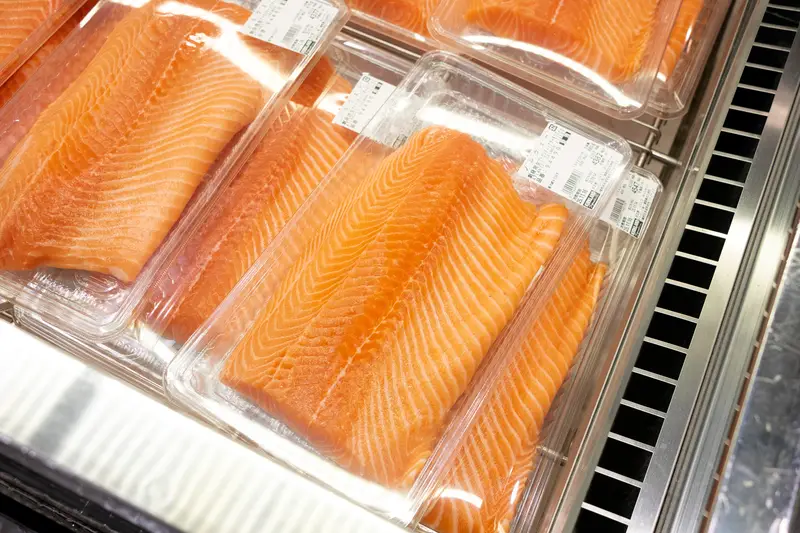
That pretty pink salmon sitting in your supermarket cart might not be quite what you think it is. According to a recent report, the way salmon is marketed versus how it’s actually produced can be two very different stories. Between the pictures of pristine Scottish lochs on packaging and the reality of modern fish farming, there’s a gap wide enough to swim through. If you’ve ever wondered why that salmon is so affordable compared to other protein, or why some brands cost way more than others, the answer has everything to do with what’s happening behind those marketing labels.
The packaging tells a prettier story than reality
When you pick up a package of salmon at Tesco, Sainsbury’s, or Waitrose, the label often shows beautiful Scottish scenery and uses words like “premium” and “responsibly sourced.” The marketing makes it sound like these fish are swimming around in crystal clear waters, living their best lives. According to recent research, none of the seven major Scottish salmon companies are actually operating in ways that fully protect fish welfare and the environment, despite what their packaging suggests. That’s a problem when you’re paying premium prices for what you think is a premium product.
The disconnect between marketing and reality shows up in some surprising ways. Some companies use certification stamps like RSPCA Assured or Soil Association organic labels, which makes everything seem fine. Others have romantic-sounding brand names or use third-party suppliers and smokehouses to distance their product from the actual farming operation. It’s like putting a fancy bow on something and hoping nobody looks inside the box. The Royal Household even gets their salmon from some of these farms, which adds another layer of perceived quality that might not match up with what’s actually happening at the source.
Mortality rates are higher than you’d expect
Here’s something that doesn’t make it onto the packaging: about 25% of farmed salmon die before they’re supposed to. That’s one in four fish, which is a pretty shocking number when you think about it. Mowi, which happens to be the world’s largest salmon farming company and supplies fish to major retailers plus the Royal Household, reported almost 5 million salmon deaths on their farms in 2023 alone. Some farms run by Bakkafrost had mortality rates over 80% at certain sites in 2022 and 2023, meaning barely any fish survived at all.
These aren’t numbers you’ll find advertised on the front of the package, but they tell you a lot about what’s happening in those salmon farms. When a quarter of the fish are dying prematurely, something’s not working right in the system. It could be disease, sea lice, or just the stress of being raised in crowded conditions. Either way, it’s a far cry from the picture-perfect farm life that the marketing departments want you to imagine when you’re standing in the fish aisle trying to decide what to make for dinner.
Chemical usage is part of the process
Salmon farms use a lot of chemicals to keep fish alive and control parasites like sea lice. Mowi used 1.3 million litres of hydrogen peroxide in 2023, and they’ve doubled their use of an organophosphate pesticide called azamethiphos between 2018 and 2023. Loch Duart, which markets itself as premium salmon and was even served at the Downing Street Coronation lunch, used over 41,000 litres of hydrogen peroxide in 2023. Even Wester Ross, which supplies the restaurant chain Leon, used more than 6,000 litres despite claiming they don’t use medicines on their farms.
The use of hydrogen peroxide isn’t necessarily bad on its own – it breaks down into water and oxygen – but the sheer volume tells you these farms are dealing with ongoing problems that require regular chemical treatments. When you’re buying salmon marketed as natural or premium, you probably aren’t thinking about thousands of litres of chemicals being used in the production process. Some farms are better than others, but the reality is that modern salmon farming relies heavily on chemical treatments to keep fish alive and control parasites that thrive in crowded conditions.
Sea lice problems keep coming back
Sea lice are tiny parasites that attach to salmon and feed on their skin and blood. They’re a huge problem in salmon farming because when you pack lots of fish together in nets, the lice spread like wildfire. Loch Duart, despite being marketed as higher welfare premium salmon, breached acceptable sea lice levels on more than one third of its farms in 2022. That means over a third of their farms had lice problems bad enough to exceed the limits that are supposed to protect fish welfare. When lice get out of control, the fish suffer, and farms have to use more chemicals to try to fix the problem.
The sea lice issue is one reason why farms need all those chemical treatments mentioned earlier. It’s a cycle that’s hard to break: crowded conditions create perfect breeding grounds for lice, lice infestations require chemical treatments, and those treatments don’t always work perfectly, so the problem continues. If you’re buying salmon thinking it lived in clean, healthy conditions, the reality of persistent sea lice outbreaks might change your perspective. It’s not the peaceful Scottish loch experience that the packaging implies.
Some marketing could be genuinely misleading
Bakkafrost sells something called Native Hebridean Salmon, endorsed by celebrity chefs Jack Stein and Gary Maclean. The marketing for this brand could make you think the fish are wild, not farmed, which would be seriously misleading if that’s the impression customers are getting. The Scottish government even approved a change allowing “Scottish Farmed Salmon” to be marketed as just “Scottish Salmon,” dropping the word “farmed” entirely. That makes it even harder to know what you’re actually buying when you see “Scottish Salmon” on a menu or at the fish counter.
Wester Ross still markets its fish as “hand-fed” through third-party supplier websites, even though they’ve been moving toward automation since Mowi bought them in 2022. If you’re paying extra because you think someone’s carefully hand-feeding these fish every day, you might be disappointed to learn that’s not really the case anymore. These kinds of marketing tactics aren’t technically lies, but they create impressions that don’t match current reality. When celebrity chefs endorse products or when the word “native” gets thrown around, it’s easy to assume you’re getting something special that justifies the higher price tag.
The antibiotics myth versus the reality
One common concern is that farmed salmon is pumped full of antibiotics, but this turns out to be less true than you might think, at least in some places. Norwegian salmon farms have gotten really good at preventing disease through vaccines and other methods rather than treating sick fish with antibiotics. By 2011, only 0.03% of Norwegian salmon production was treated with antibiotics, and that number has continued dropping. The industry reported their lowest ever antibiotic use in 2020, focusing instead on keeping fish healthy before they get sick.
That’s actually good news, though it doesn’t mean salmon farming is problem-free. The focus on prevention is better than constantly treating sick fish, but it’s worth noting that this varies by country and company. When farms do use antibiotics, certified farms aren’t supposed to use them preventatively or to promote growth – only to treat actual illness. The antibiotic issue is less of a concern than some people think, but it’s been replaced by heavier reliance on other chemical treatments for parasites and diseases. So while you might not be eating antibiotic-filled salmon, the fish you’re buying probably came from a farm that uses significant amounts of other chemicals.
What about that pink color everyone talks about
Wild salmon gets its pink color from eating small creatures that contain natural pigments. Farmed salmon would actually be grey if farmers didn’t add similar pigments to their feed. There’s a myth floating around that salmon farmers inject dye into the fish, but that’s not true – the color comes from additives in the feed, just like wild salmon get their color from food. It’s the same basic idea, except farmed salmon are being fed pellets with added pigments instead of catching their own naturally pigmented prey.
This is actually pretty common in food production and isn’t necessarily a problem, though it does highlight how different farmed salmon is from wild. The color additives used in certified farms aren’t supposed to harm the fish or the people eating them. Some farms even have color charts so buyers can choose what shade of pink they want their salmon to be, which is kind of weird when you think about it. The bottom line is that farmed salmon is naturally grey, and everything you see in the store has been colored through feed additives to look like wild salmon.
How much wild fish goes into making farmed salmon
There’s an old claim that it takes five kilos of wild fish to produce one kilo of farmed salmon, but that number is seriously outdated. According to current data, it’s actually less than one kilo of wild fish needed per kilo of salmon produced. About a third of the fishmeal and fish oil in salmon feed comes from by-products – parts of fish that would be thrown away anyway. The rest of the feed is mostly land-based ingredients like soy, which has its own set of issues but isn’t depleting ocean fish stocks.
The fishmeal myth is one of those things that keeps circulating even though it’s not accurate anymore, and it actually distracts from real concerns about where salmon feed comes from. Soy production has serious impacts too, but nobody’s talking about that when they’re busy worrying about outdated fishmeal numbers. Modern salmon feed is more plant-based than it used to be, which solves one problem but creates others. Either way, farmed salmon aren’t eating five times their weight in wild fish, so you can stop worrying about that particular issue.
Why some chefs are taking salmon off their menus
More than 350 chefs, restaurants, community groups, and charities have joined a campaign asking restaurants to stop serving farmed salmon. They’re concerned about the gap between how salmon is marketed and what’s actually happening on farms. When you’re running a restaurant that prides itself on quality ingredients and honest sourcing, serving salmon with a 25% mortality rate and heavy chemical usage doesn’t really fit the image. Some high-end places are starting to realize that the premium they’re charging doesn’t match the reality of the product they’re serving.
This shift is starting to affect what shows up on menus at nicer restaurants, though your average supermarket or chain restaurant probably isn’t changing course anytime soon. Salmon is one of the “Big Five” fish in the UK – along with cod, tuna, prawns, and haddock – making up somewhere between 62% and 80% of total fish consumption. That means it’s deeply embedded in eating habits and restaurant menus. But as more people learn about the realities of salmon farming, some are deciding to skip it entirely or at least ask more questions about where their fish comes from before buying.
The truth about supermarket salmon is that it’s a product of industrial farming with all the complications that come with that. Marketing creates an image of Scottish lochs and responsible farming, but the reality involves high mortality rates, chemical treatments, and production methods that don’t quite match the premium image on the packaging. That doesn’t mean you should never buy salmon again, but it does mean you should know what you’re actually getting for your money and not assume that pretty packaging tells the whole story.

